

Key Takeaways
Why the body stiffens overnight
During sleep, most joints remain static for hours. Synovial fluid, which lubricates cartilage surfaces, distributes less efficiently without movement. Muscle tissue cools slightly and resting tone increases. Fascia, the connective tissue surrounding muscles and organs, becomes less pliable without regular mechanical loading. The result, for many people, is the familiar stiffness that peaks in the first 30 to 60 minutes after waking.
This is not an inevitable feature of ageing. It is a predictable physiological response to inactivity that a structured movement routine can substantially reduce. If you wake with sharp foot pain specifically, morning foot stiffness may point to a more specific cause worth investigating.
The routine below uses a joint-by-joint approach, moving from the ankles upward. This order is not arbitrary. Distal joints (ankles, knees) warm up earlier because they are easier to load safely before core temperature rises. If you are new to structured mobility work, the joint-by-joint overview provides helpful anatomical context before you begin.
What you will need
The six-step morning sequence
Complete each step in order. The full sequence takes 10 to 20 minutes depending on your pace. Move within a comfortable range and stop any step that produces sharp, shooting, or worsening pain. This routine is general health information, not a substitute for guidance from a qualified healthcare professional, particularly if you have a diagnosed musculoskeletal condition.
Ankle circles and calf pumps
Sit on the edge of your bed or a firm chair. Lift one foot slightly off the floor and rotate the ankle slowly in a full circle, 10 rotations clockwise, then 10 counterclockwise. Repeat on the other side. Follow with 15 calf raises in a standing position, holding a chair for balance if needed.
This rehydrates the synovial fluid in the ankle joint and begins returning blood from the lower extremities, which tends to pool overnight.
Seated spinal rotation
Remain seated with feet flat on the floor, hip-width apart. Place your right hand on your left knee and your left hand behind you on the seat. Inhale, lengthen your spine, and exhale as you rotate gently to the left. Hold for two breaths, return to center, and repeat on the other side. Perform 5 rotations per side.
The intervertebral discs rehydrate during sleep but are still compressed in the early morning. Slow rotational movement encourages fluid distribution without loading the spine under compressive force.
Cat-cow spinal flexion and extension
Move to your hands and knees on a mat with wrists under shoulders and knees under hips. Inhale as you drop the belly toward the floor and lift your gaze (cow position). Exhale as you round the spine upward and tuck your chin toward your chest (cat position). Alternate slowly for 10 full breath cycles.
Cat-cow is one of the most direct ways to restore movement in the lumbar and thoracic spine after several hours of static posture during sleep.
Hip 90/90 transitions
Sit on the floor with both knees bent. Place your right leg in front of you at a 90-degree angle and your left leg behind you at a 90-degree angle (both shins parallel to your body midline). Sit tall for 5 breaths, then slowly rotate both knees to the opposite side. Alternate sides 6 to 8 times.
This movement works the internal and external rotation range of the hip joint, which tends to stiffen after extended periods of lying in one position.
Standing thoracic opener with arm sweep
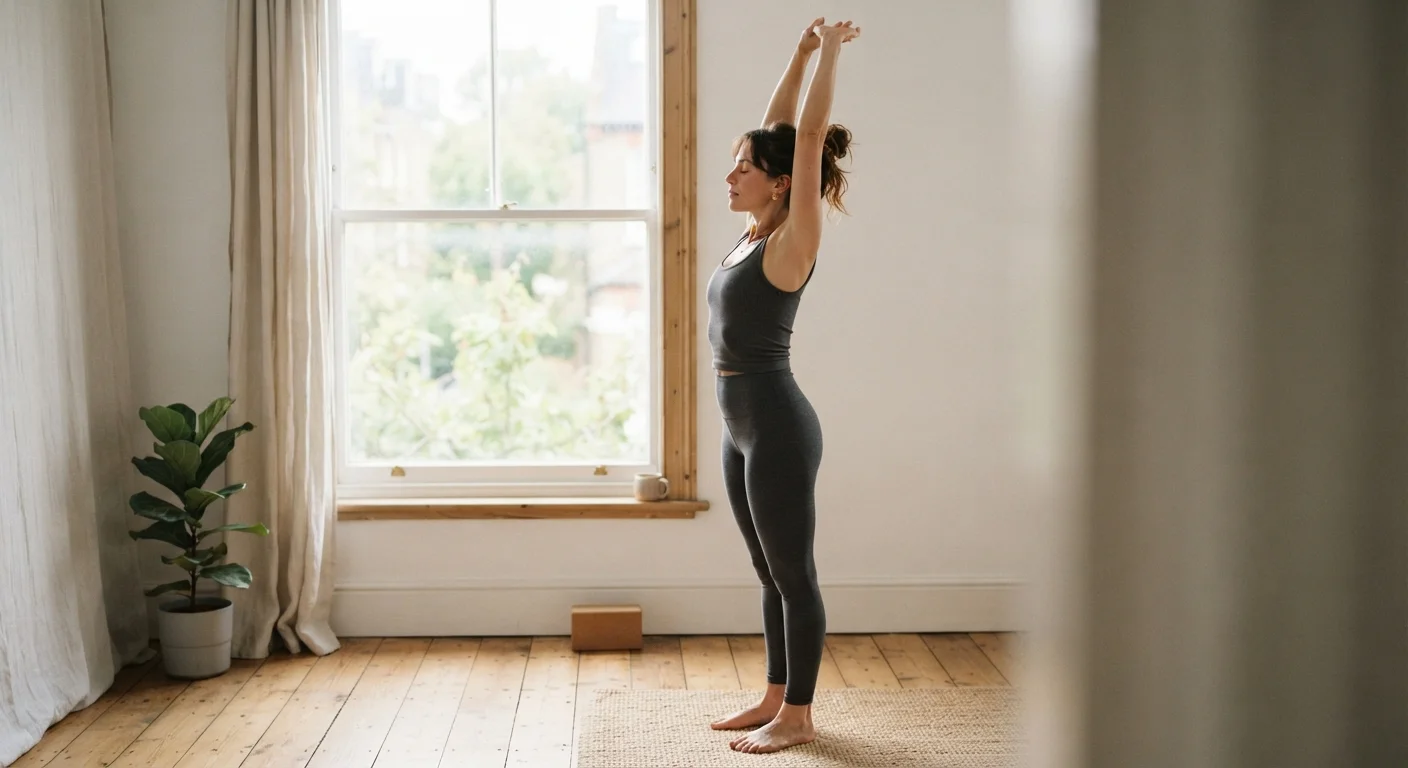
Stand with feet shoulder-width apart. Bring both arms in front of you at chest height, palms together. As you inhale, sweep your arms wide and back, squeezing the shoulder blades together and lifting your gaze slightly. Exhale and return to the starting position. Repeat 10 times with controlled breathing.
Thoracic mobility affects posture, shoulder function, and even breathing mechanics. Most adults spend hours in forward-flexed positions, and this opener begins to counter that pattern at the start of the day.
Neck half-circles
Stand or sit upright. Drop your chin slowly toward your chest, then roll it to the right shoulder, back to center, and to the left shoulder. Do not extend the neck backward into a full circle. Perform 5 slow repetitions in each direction.
The cervical spine carries significant compressive load and is vulnerable to irritation from abrupt movement first thing in the morning. Half-circles keep the movement within a safe range while addressing the suboccipital muscles that frequently tighten overnight.
This article is for informational purposes only and is not medical advice. If you have a diagnosed joint condition, chronic pain disorder, or are recovering from injury or surgery, consult a licensed healthcare professional before beginning any new movement routine.
Building the routine into your day
Consistency matters more than duration. A 10-minute sequence performed daily produces more durable change in joint range and comfort than a 45-minute session twice a week. Cortisol naturally peaks in the morning, which means your body has a hormonal readiness for mild physical effort shortly after waking. Structuring your routine to use that window is a practical application of normal circadian physiology, a principle explored more fully in aligning your daily routine with hormonal rhythms.
If a full sequence is not practical every morning, movement snacks spread across the day can fill the gap. Two or three of the steps above, done in sequence at your desk or in the kitchen, retain much of the benefit.
The morning sequence uses dynamic movement throughout rather than prolonged static holds. This choice is deliberate: research on stretching timing suggests that dynamic work is better suited to pre-activity preparation, while static stretching is more appropriate after the body is already warm. The distinction between dynamic and static stretching is worth understanding if you plan to add stretching to other parts of your day.