
Chronotypes and Sleep Timing: Why Going to Bed at the Same Hour Does Not Work for Everyone

Key Takeaways
Chronotype
A chronotype is your body's genetically influenced preference for sleep and wake timing. It reflects when your internal biological clock naturally wants you to feel alert, drowsy, and ready for deep sleep. People are generally classified as morning types (often called 'early birds'), evening types ('night owls'), or somewhere in between. These preferences are not simply habits that can be overridden with enough discipline.
Chronotype is partly determined by variations in clock genes such as PER3 and CLOCK, which regulate circadian rhythms operating on roughly 24-hour cycles. The timing of melatonin secretion, core body temperature rhythm, and cortisol peaks all shift according to chronotype.
What your chronotype actually controls
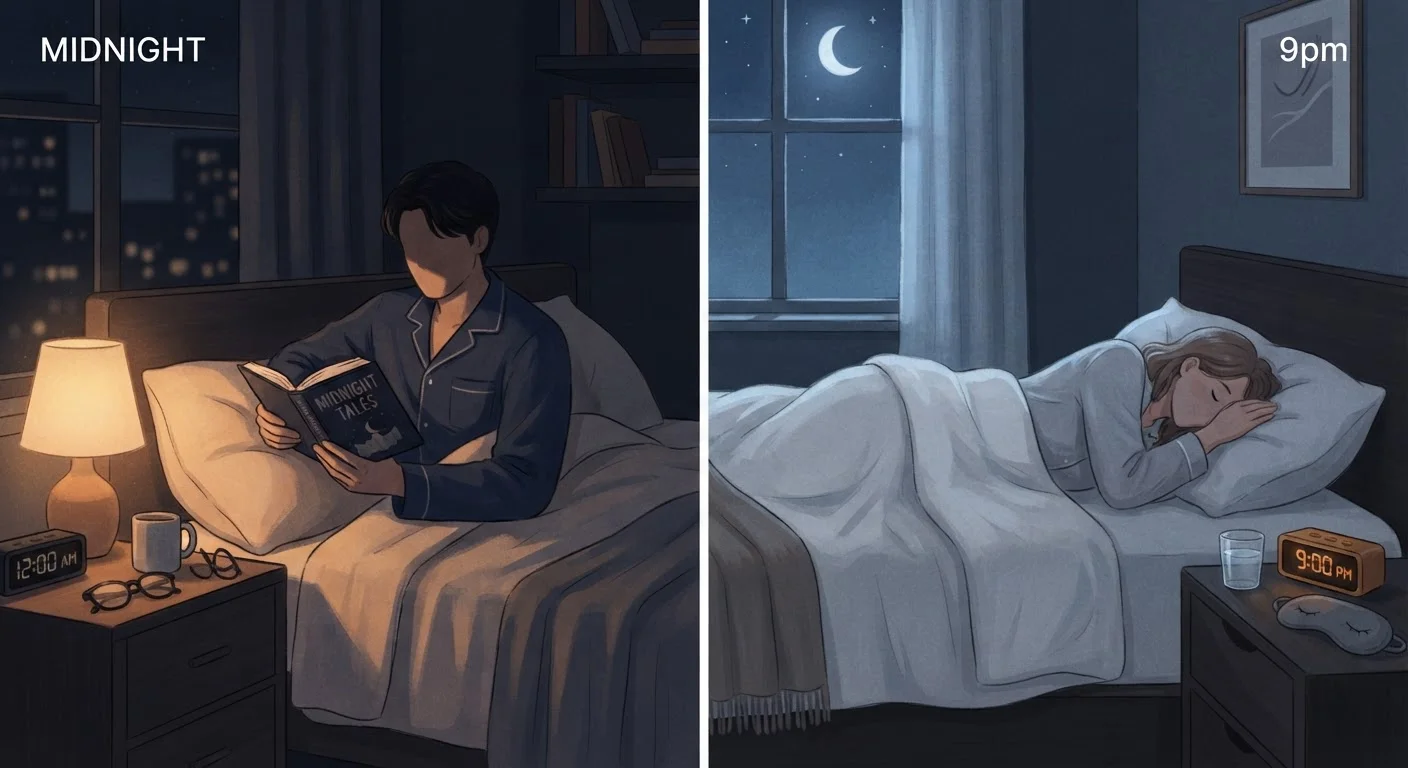
Your chronotype does not just set a preferred bedtime. It governs the full 24-hour architecture of your physiology. Core body temperature, cortisol secretion, melatonin onset, alertness peaks, and even digestion all follow a schedule that is offset by chronotype. An evening type's melatonin may not rise until midnight; a morning type's may rise at 9 p.m. Telling both people to be in bed by 10 p.m. produces very different results.
The practical consequence is that sleep quality depends heavily on whether a sleep attempt coincides with the biological window of readiness. Attempting sleep too early, before melatonin rises and body temperature drops, leaves the nervous system in an alert state. The result is prolonged sleep onset, fragmented sleep, and less time in the deeper stages that support physical recovery and memory consolidation.
For readers managing chronic health conditions, this matters beyond feeling tired. Disrupted sleep architecture affects immune regulation, appetite hormones, blood glucose control, and cardiovascular recovery. See how these patterns connect to broader hormone cycles in the guide to building a daily routine around hormonal rhythms.
Chronotype is not the same as delayed sleep phase disorder
An evening chronotype is a normal variation in biological timing. Delayed sleep phase disorder (DSPD) is a circadian rhythm sleep-wake disorder in which the sleep phase is shifted so far that it causes significant functional impairment and distress. If your sleep timing causes serious problems with daily functioning and cannot be shifted with standard sleep hygiene measures, a sleep medicine specialist can evaluate whether a clinical condition is present.
Social jetlag and the cost of chronotype mismatch
Most adults cannot choose their work start times, school runs, or social commitments. Evening chronotypes who must be at work by 8 a.m. commonly wake two or three hours before their biological morning. Over a working week, this accumulates as significant sleep debt, then partially reverses on weekends when they sleep later. This back-and-forth is social jetlag.
Research published in journals focused on chronobiology and metabolism has found associations between high social jetlag and elevated markers of metabolic dysfunction, including disrupted insulin sensitivity and altered lipid profiles. The effect is independent of total sleep duration, meaning that even people who get enough hours suffer when those hours are poorly timed for their biology.
Chronotype mismatch also affects cognitive performance. Evening types working on early schedules show reduced attention, working memory, and reaction time during morning hours, even after caffeine. Morning types working late shifts experience similar costs in the evening. The strategies for maintaining sleep during irregular schedules address how to reduce this mismatch when scheduling flexibility is limited.
How light exposure shapes timing
The circadian clock in the suprachiasmatic nucleus of the hypothalamus relies on light as its primary timing signal. Morning bright light suppresses residual melatonin, advances the circadian phase, and signals the body to shift sleep and wake timing earlier. Evening artificial light, particularly blue-wavelength light from screens and LED sources, delays melatonin onset and pushes the biological clock later.
For evening chronotypes who want to shift their timing modestly earlier, consistent morning light exposure (ideally outdoors within an hour of waking) is the most evidence-supported strategy. Evening types who eliminate bright light after sunset can sometimes move their sleep window earlier by 30 to 45 minutes without any other intervention. This will not convert a night owl into a morning person, but it can narrow the social jetlag gap enough to meaningfully improve function.
Morning types with an early chronotype generally have less conflict with standard schedules but may find their energy drops sharply in the evening. Pushing their sleep window later by using artificial light in the evening is possible but comes with trade-offs in sleep quality if overdone. The daytime habits that affect sleep quality explains how light, meals, and movement interact across the full day.
Anchor your wake time, not just bedtime
Keeping your wake time consistent, including on weekends, is more effective for circadian stability than focusing only on when you go to bed. A stable wake time anchors your clock and makes it easier to feel sleepy at a consistent hour. Even if your bedtime varies by 30 to 45 minutes, a fixed wake time reduces circadian drift.
Applying chronotype awareness practically
Chronotype knowledge is most useful when translated into concrete scheduling decisions. Evening types who have scheduling flexibility should resist compressing sleep to fit an early social norm and instead protect their full sleep window at biologically appropriate hours. Morning types should be aware that very early bedtimes can cause early-morning awakening, which is sometimes misidentified as insomnia rather than a chronotype expression.
When complete schedule alignment is not possible, partial adaptations still help. Anchoring the largest sleep block to the same start time on both workdays and rest days reduces circadian drift. Keeping morning light exposure consistent, regardless of what time that morning begins, maintains clock stability. A structured wind-down sequence also matters: see the guide to building an evening wind-down routine for practical steps.
For those weighing rigid versus flexible sleep timing, this comparison of fixed bedtimes and flexible sleep windows examines the evidence on both sides. There is no universally superior approach; the right answer depends on your chronotype, your schedule constraints, and how much variability your circadian system can tolerate.
This article provides general health information for educational purposes and is not a substitute for professional medical advice. If you have concerns about sleep disorders or chronic health conditions, consult a qualified healthcare provider.