
Phytoestrogens, Adaptogens, and Hormone-Supportive Plants: Separating Evidence from Hype

Key Takeaways
What plant compounds actually do in the endocrine system
The endocrine system operates through receptor-ligand binding: hormones travel to target tissues and activate specific receptors that trigger downstream gene expression. Plant compounds can interact with this system in several ways, including binding hormone receptors directly, modifying enzyme activity in hormone synthesis, or altering the signaling cascades that hormone receptors initiate.
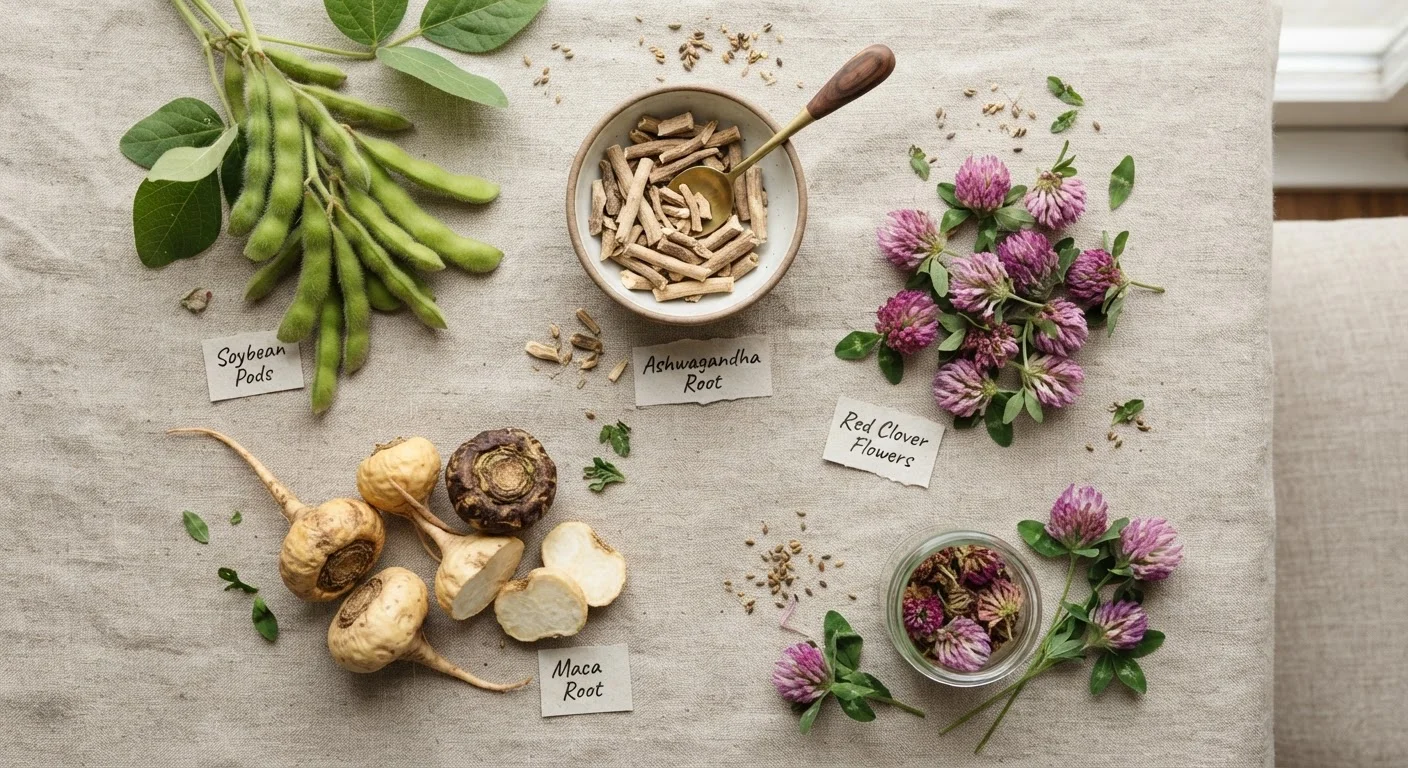
Phytoestrogens are the most studied category. Isoflavones from soy, coumestans from alfalfa, and lignans from flaxseed all bind estrogen receptors with measurable affinity, though the resulting signal is weaker and more tissue-selective than endogenous estradiol. Plant sterols, which appear in many of the same whole foods, have a structurally different effect on cholesterol metabolism rather than hormonal signaling. For a detailed look at how plant sterols affect lipid pathways, see soluble fibre, plant sterols, and dietary cholesterol factors.
Adaptogens work through a distinct mechanism: rather than binding hormone receptors, they appear to modulate the HPA axis and autonomic stress response, which secondarily influences cortisol, DHEA, and reproductive hormone ratios. This is an important conceptual separation that much of the popular literature collapses.
Myth
Phytoestrogens work just like the body's own estrogen, so they can fully replace hormone therapy.
Fact
Phytoestrogens bind estrogen receptors with far lower affinity than endogenous estradiol and produce tissue-selective, context-dependent effects that do not replicate pharmaceutical hormone therapy.
Isoflavones (found in soy and red clover) and lignans (found in flaxseed) belong to a class of plant-derived compounds that bind estrogen receptor alpha and beta. Their binding affinity is roughly 100 to 1,000 times weaker than 17-beta-estradiol, the body's primary estrogen. Because estrogen receptor beta is expressed more densely in bone, brain, and cardiovascular tissue than receptor alpha, phytoestrogens may exert selective effects in those tissues rather than a uniform estrogenic signal.
Clinical trials on isoflavones for menopausal vasomotor symptoms show modest, inconsistent results. A 2010 Cochrane review found some reduction in hot flash frequency with soy isoflavone supplementation, but effect sizes were small and varied considerably across studies. This is not the equivalent of prescribed estrogen therapy, and the two should not be conflated.
Myth
Adaptogens like ashwagandha and Rhodiola directly balance hormones the way a medication would.
Fact
Adaptogens appear to modulate stress-response pathways, particularly cortisol regulation, rather than directly altering reproductive hormones in the way pharmaceutical agents do.
The term 'adaptogen' describes plants that may help the body maintain physiological stability under stress. Ashwagandha (Withania somnifera) has the strongest human trial record in this category. Several randomized controlled trials, including a 2019 study published in Medicine, found that standardized ashwagandha root extract reduced serum cortisol and self-reported stress scores compared to placebo over 8 weeks.
The mechanism appears to involve withanolide compounds interacting with glucocorticoid receptors and moderating HPA axis reactivity. Because chronic cortisol elevation suppresses gonadotropin-releasing hormone, reducing cortisol may secondarily improve reproductive hormone signaling. However, this is an indirect effect, not a direct hormonal intervention. See also the broader discussion in adaptogens and cognitive resilience for context on what trial evidence specifically supports.
Myth
Maca root raises estrogen levels, which is why it helps with menopausal symptoms.
Fact
Maca does not raise estrogen levels measurably. Its effects on menopausal symptoms appear to occur through a different, not yet fully characterized mechanism.
Several small trials have found that maca (Lepidium meyenii) supplementation reduces the frequency and intensity of menopausal symptoms, including hot flashes and disrupted sleep, without producing corresponding changes in serum estradiol, FSH, or LH. A 2008 pilot trial published in Menopause noted symptomatic improvements alongside unchanged hormonal levels, which rules out a straightforward estrogenic mechanism.
Researchers have proposed that maca's glucosinolates and sterols may act on the hypothalamus or pituitary rather than on peripheral estrogen receptors. This distinction matters clinically: maca may be appropriate in contexts where estrogenic activity is undesirable, though the evidence base is still limited to small, short-duration trials.
Myth
Because these plants are natural, they are safe to take in any amount without side effects.
Fact
Plant compounds are metabolized as chemicals and carry real risks at high doses or in combination with medications, particularly those processed by the liver.
The liver metabolizes phytoestrogens and many adaptogenic compounds through cytochrome P450 enzymes, particularly CYP1A2 and CYP3A4. Plants that inhibit or induce these enzymes can alter the plasma concentrations of co-administered drugs, including anticoagulants, thyroid medications, and immunosuppressants. For background on how the liver handles such compounds, liver health covers these metabolic processes in more depth.
Soy isoflavones at supplemental doses (above those in ordinary food) have raised concern in animal models regarding hormone-sensitive tissue proliferation, though human data remain inconclusive. Black cohosh (Actaea racemosa), sometimes grouped with phytoestrogens despite not being one, has been associated with rare but documented cases of hepatotoxicity. Dosage, duration, and individual metabolism all shape outcomes.
Myth
All women benefit from increasing phytoestrogen intake, especially after menopause.
Fact
Phytoestrogen effects vary significantly by individual gut microbiome, genetic polymorphisms, and existing hormonal status, making universal recommendations unsupported by current evidence.
Equol, a metabolite of the soy isoflavone daidzein, is considered the more biologically active form in humans. Only roughly 30 to 50 percent of adults produce equol, depending on the composition of their gut microbiota. People who are equol producers tend to show stronger responses to soy isoflavone interventions than non-producers, which partially explains the inconsistency seen across clinical trials.
Genetic variation in estrogen receptor genes (ESR1, ESR2) further modifies response. A postmenopausal woman with low circulating estrogen and the right microbial profile may experience modest symptom relief from dietary isoflavones; one with different receptor polymorphisms and gut flora may notice no effect. This biological variability makes population-wide recommendations premature. Dietary patterns that support hormonal health covers complementary nutritional approaches with a stronger evidence base.
Where the evidence is genuinely strong, and where it is not
Ashwagandha has among the most rigorous human trial records of any adaptogen. Multiple randomized controlled trials support its effect on cortisol reduction under stress conditions, and some evidence suggests a secondary improvement in testosterone levels in men experiencing stress-related suppression. The mechanisms involve withanolide interactions with glucocorticoid receptor pathways.
For phytoestrogens, dietary soy consumption at ordinary food quantities (not supplemental doses) is associated with reduced hot flash frequency in some populations, particularly among East Asian women with lifelong dietary exposure. Whether this reflects adaptation in gut microbiota composition over years, or simply higher equol-producer rates in those populations, is not yet settled.
Compounds like phosphatidylserine and bacopa have their own distinct clinical trial histories worth consulting when evaluating plant-derived cognitive support alongside hormonal concerns. The overlap between brain health and hormonal regulation is real: estrogen and cortisol both affect neurotransmitter synthesis and receptor density, which is why hormonal imbalances often present with cognitive symptoms first.
Where evidence is genuinely weak: vitex (chaste tree), wild yam, and dong quai are widely marketed for hormonal support but their human trial records are sparse, small, and methodologically limited. Treating them as proven therapies rather than traditional remedies under investigation is not warranted by the data.
This article is for informational purposes only and does not constitute medical advice. Consult a qualified healthcare professional before making changes to your diet, supplement routine, or any health-related practice, particularly if you have a pre-existing condition or take medications.