

| Largest lymphatic vessel | Thoracic duct |
| Total lymph nodes in the body | Approximately 500 to 700 (Gray's Anatomy, 41st edition) |
| Largest lymphoid organ | Spleen |
| Primary pump mechanism | Skeletal muscle contractions and breathing |
| Main drainage point to bloodstream | Left and right subclavian veins |
| Lymph composition | Roughly 96 percent water |
How lymph moves through the body
Unlike blood, which has the heart as a dedicated pump, lymphatic fluid moves through a one-way network driven by muscle contractions, breathing, and the pressure of surrounding tissues. Fluid that leaks out of capillaries into interstitial space gets collected by tiny lymphatic capillaries, carried through progressively larger vessels, filtered through lymph nodes, and eventually returned to the bloodstream near the collarbones.
Understanding where those vessels and nodes sit helps explain why certain lifestyle choices, from regular movement to diaphragmatic breathing, affect how efficiently the system works. For a broader overview of what the lymphatic system does, see our introduction to lymphatic function.
Lymph
The clear to pale-yellow fluid that circulates through the lymphatic system. It originates as interstitial fluid that has leaked from blood capillaries into surrounding tissue.
Lymph node
A small, bean-shaped structure that filters lymph and contains immune cells. Nodes are distributed throughout the body in clusters and along lymphatic vessels.
Thoracic duct
The largest lymphatic vessel, responsible for collecting lymph from most of the body and returning it to the bloodstream at the left subclavian vein.
Cisterna chyli
A dilated sac at the base of the thoracic duct, located in the abdomen, where lymph from the lower body and digestive tract collects before traveling upward.
Lymphedema
Swelling caused by a buildup of lymphatic fluid in tissues, often resulting from damage or removal of lymph nodes. It most commonly affects the arms or legs.
Mesenteric nodes
Lymph nodes distributed around the small intestine that process lymph containing fats and immune material absorbed during digestion.
Head and neck: the body's most concentrated node clusters
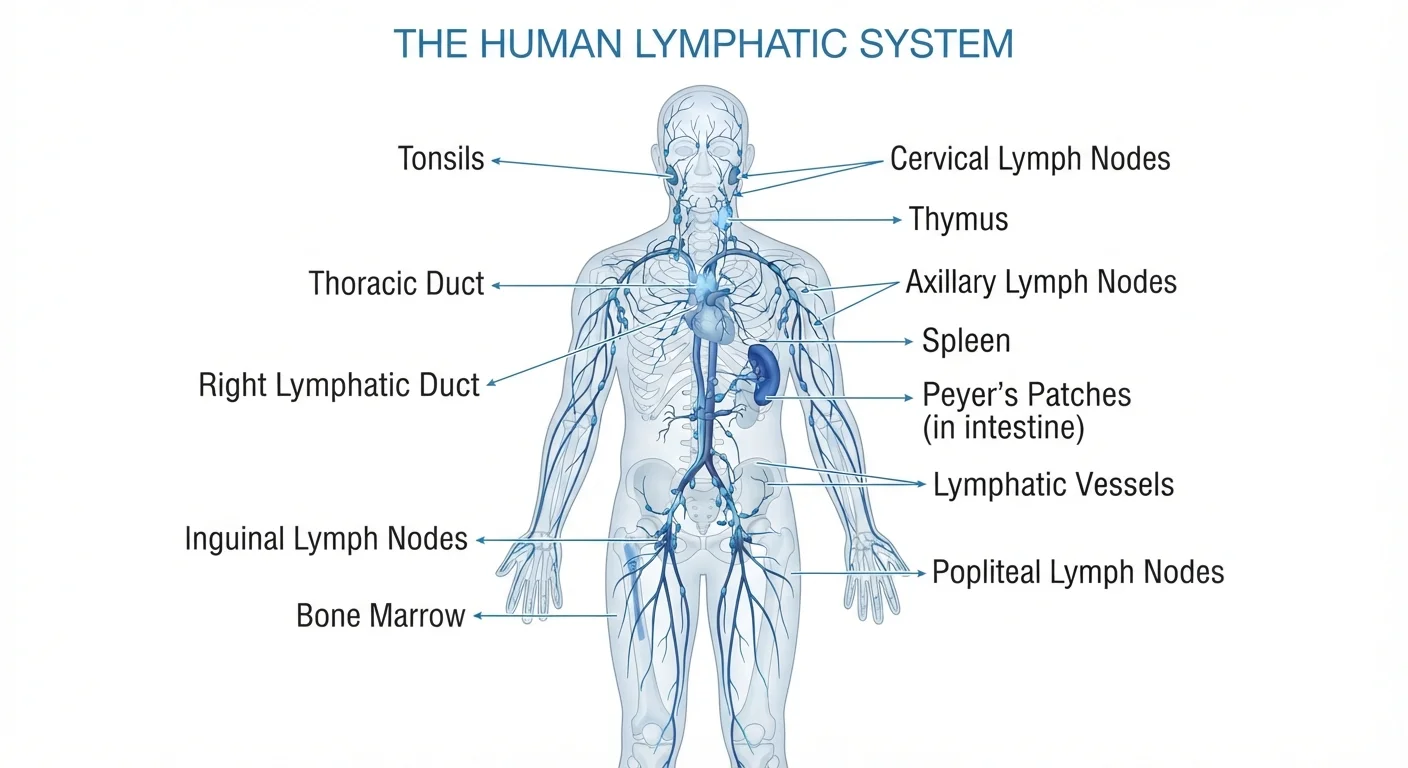
The head and neck contain some of the densest groupings of lymph nodes in the body. Cervical nodes run along both sides of the neck in superficial and deep chains. Submandibular nodes sit beneath the jaw, and submental nodes cluster under the chin. Occipital nodes are positioned at the base of the skull, while preauricular and postauricular nodes flank the ears.
Lymph from the scalp, face, nasal passages, and oral cavity drains downward through these chains toward the supraclavicular nodes near the collarbone. From there, fluid enters the thoracic duct or the right lymphatic duct depending on which side of the body it originated from.
The tonsils and adenoids, located in the throat, are also part of this regional lymphatic tissue. They act as early surveillance points for pathogens entering through the mouth and nose.
Chest and abdomen: the thoracic duct and central drainage
The thoracic duct is the largest lymphatic vessel in the body. It originates in the abdomen at a dilated sac called the cisterna chyli, travels up through the chest alongside the spine, and empties into the left subclavian vein at the base of the neck. This single vessel ultimately collects lymph from the lower limbs, abdomen, left arm, and left side of the head and chest.
The right lymphatic duct, considerably shorter, drains the right side of the chest, the right arm, and the right side of the head and neck into the right subclavian vein.
Within the chest, mediastinal nodes sit between the lungs and monitor fluid from the heart, lungs, and esophagus. In the abdomen, mesenteric nodes are densely distributed around the small intestine and handle lymph that carries dietary fats absorbed from digestion. The spleen, the largest lymphoid organ, sits in the upper left abdomen and filters blood rather than lymph directly, but it works closely with the lymphatic network to remove damaged cells and mount immune responses.
| Largest lymphatic vessel | Thoracic duct |
| Total lymph nodes in the body | Approximately 500 to 700 (Gray's Anatomy, 41st edition) |
| Largest lymphoid organ | Spleen |
| Primary pump mechanism | Skeletal muscle contractions and breathing |
| Main drainage point to bloodstream | Left and right subclavian veins |
| Lymph composition | Roughly 96 percent water |
Limbs and periphery: where flow is most vulnerable to slowdown
The arms drain through axillary nodes clustered in the armpits. These nodes handle lymph from the arm, hand, shoulder, and parts of the chest wall, including breast tissue. Because axillary nodes are a common site of surgical removal or radiation in cancer treatment, disruption there can cause lymphedema, a buildup of fluid in the affected arm.
The legs drain upward through popliteal nodes behind the knees and then into the inguinal nodes in the groin, which also receive lymph from the lower abdomen, pelvis, and genitalia. From the inguinal nodes, fluid travels through iliac vessels toward the cisterna chyli and then up the thoracic duct.
Peripheral drainage is most susceptible to slowing when a person remains sedentary for long periods, because the calf muscle pump that compresses leg veins and lymphatics is inactive. Daily movement habits that engage the legs, even short walks, directly support upward lymph flow from the feet.
Lifestyle strategies that support lymph flow
Because lymphatic vessels have no central pump, they depend on external forces. Skeletal muscle contractions during exercise compress lymphatic vessels and push fluid toward the heart. Deep, diaphragmatic breathing creates pressure changes in the chest that draw lymph up through the thoracic duct. Posture matters too, since collapsed or rounded positions can restrict flow through the neck and chest nodes.
Adequate hydration keeps lymphatic fluid at the right consistency for movement. Dietary choices that reduce chronic low-grade inflammation can reduce the load on lymph nodes over time. For specifics on how food and fluid intake affect lymph quality, see how dietary choices influence lymph health. A structured self-audit of these habits is available in the lymphatic wellness checklist.
Manual lymphatic drainage, a gentle massage technique performed by trained therapists, uses light pressure and directional strokes that follow the anatomical pathways described above. It is not a substitute for medical treatment of lymphatic disorders, but it is an established supportive therapy used in conditions such as lymphedema under clinical supervision.
This article is for informational purposes only and is not medical advice. Consult a qualified healthcare professional for guidance on any personal health concerns or symptoms.