

| Tissue involved: neuropathy | Peripheral nerve fibers |
| Tissue involved: tendinitis | Tendon (connective tissue attaching muscle to bone) |
| Tissue involved: bursitis | Bursa (fluid-filled cushioning sac) |
| Pain character: neuropathy | Burning, tingling, electric, or numb; often diffuse |
| Pain character: tendinitis | Aching along tendon path; worse with specific movement |
| Pain character: bursitis | Localized, point-specific ache; often with visible swelling |
| Common foot sites: tendinitis | Achilles, peroneal, posterior tibial tendons |
| Common foot sites: bursitis | Retrocalcaneal bursa, subcalcaneal bursa, bunion site |
Why these three conditions are easy to confuse
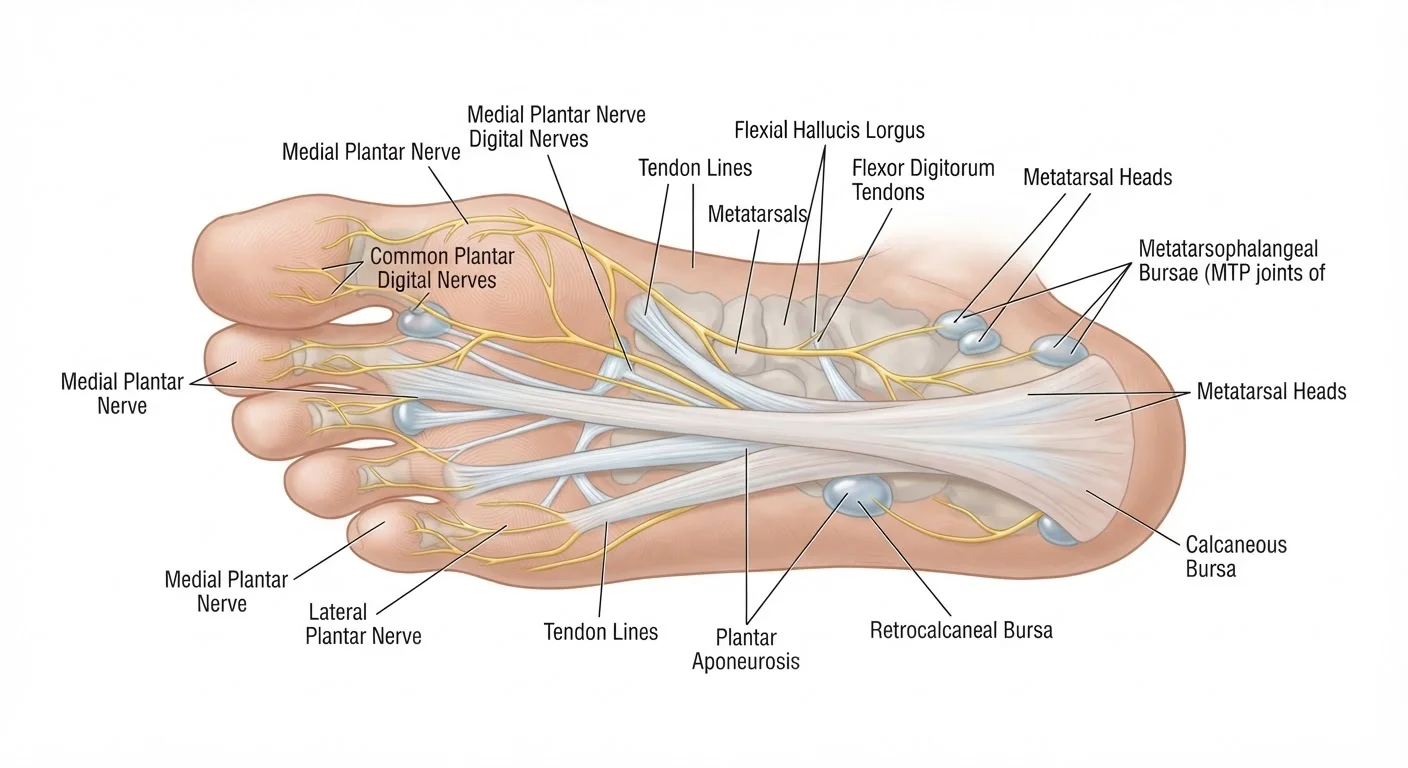
Foot pain rarely announces its cause. All three conditions covered here can produce aching, tenderness, and a reluctance to bear weight, yet they involve entirely different tissues and call for different responses. Neuropathy stems from nerve damage or compression. Tendinitis is inflammation of a tendon. Bursitis is inflammation of a bursa, the fluid-filled sac that cushions bones and soft tissue at high-friction points. Getting the distinction right matters because a strategy that helps one can aggravate another.
This article is general health information, not a diagnosis. If your symptoms are severe, worsening, or accompanied by numbness that spreads, see a qualified healthcare professional.
For a broader map of what goes wrong in feet, see our plain-language overview of common foot pain causes.
| Tissue involved: neuropathy | Peripheral nerve fibers |
| Tissue involved: tendinitis | Tendon (connective tissue attaching muscle to bone) |
| Tissue involved: bursitis | Bursa (fluid-filled cushioning sac) |
| Pain character: neuropathy | Burning, tingling, electric, or numb; often diffuse |
| Pain character: tendinitis | Aching along tendon path; worse with specific movement |
| Pain character: bursitis | Localized, point-specific ache; often with visible swelling |
| Common foot sites: tendinitis | Achilles, peroneal, posterior tibial tendons |
| Common foot sites: bursitis | Retrocalcaneal bursa, subcalcaneal bursa, bunion site |
Peripheral neuropathy: when nerves misfire
Peripheral neuropathy in the foot occurs when nerve fibers are damaged or irritated, producing signals that do not match the actual state of the tissue. Diabetes is the most common systemic cause; the condition is also associated with certain nutritional deficiencies, alcohol use, and some medications. Mechanical compression, such as from a tight shoe pressing on the branch of a nerve near the ball of the foot (a pattern sometimes called a Morton's neuroma), can produce a localized version of the same experience.
Distinguishing features include burning, electric, or stabbing sensations rather than a dull ache. Many people report tingling or numbness that persists even at rest and may be worse at night. The pain is typically diffuse rather than point-specific: pressing on one spot usually does not reproduce it cleanly. In systemic neuropathy, both feet are often affected symmetrically.
General management focuses on addressing the underlying cause where possible. Blood sugar management is the primary intervention for diabetic neuropathy. Footwear that avoids tight toebox pressure and reduces ground-reaction force can reduce mechanical aggravation. Because nerve symptoms can also indicate circulation problems, a healthcare provider should evaluate persistent numbness rather than attributing it to one cause without assessment.
Tendinitis: inflammation along a tendon's path
Tendinitis means the tendon itself is inflamed, usually from repetitive overload rather than a single traumatic event. In the foot, the Achilles tendon (running from the calf to the heel), the peroneal tendons (running along the outer ankle), and the posterior tibial tendon (running along the inner ankle toward the arch) are the most frequently affected.
The pain pattern tends to track the tendon's length. Achilles tendinitis produces pain two to six centimeters above the heel insertion, often with morning stiffness that eases slightly after a few minutes of walking, then worsens with prolonged activity. Peroneal tendinitis produces lateral ankle and outer-foot pain. Posterior tibial tendinitis causes medial arch pain and can contribute to progressive flatfoot if the tendon is chronically overloaded.
Point tenderness along the tendon's path, pain that worsens with the specific movement the tendon performs (plantarflexion for Achilles, inversion resistance for peroneal), and mild swelling along the tendon sheath are typical findings. Rest, load management, and gradual eccentric strengthening exercises are the most consistently supported approaches in clinical practice. Footwear choices affect tendon load significantly; research on footwear and foot mechanics can help clarify what to look for.
Bursitis: when the cushioning sac inflames
Bursae are small, closed sacs lined with synovial membrane. They allow tendons, skin, and bone to glide past each other with minimal friction. When a bursa is subjected to repeated pressure or friction, it becomes inflamed and fills with excess fluid.
In the foot, the retrocalcaneal bursa (between the Achilles tendon and the heel bone) and the subcalcaneal bursa (beneath the heel pad) are the most commonly inflamed. A bursa can also develop over a bunion or at the base of the fifth metatarsal in response to chronic shoe pressure.
Bursitis pain is usually localized and point-specific: you can press on one spot and reliably reproduce it. Swelling is often visible, and the area may feel warmer than surrounding tissue. Unlike tendinitis, the pain does not track along a length of tissue. Unlike neuropathy, it is not burning or electric in quality. Retrocalcaneal bursitis and Achilles tendinitis can coexist, which sometimes complicates identification. Reducing direct pressure on the affected bursa, through padding or footwear modification, is typically the first step. Habits that seem protective but apply intermittent friction can prolong the problem; common foot care habits that backfire covers several of these patterns.
This article is for informational purposes only and is not medical advice. Consult a qualified healthcare professional for evaluation and guidance on any foot symptoms you experience.