
Sitting, Standing, and Sleeping With Sciatica: Posture Habits That Make a Difference

Key Takeaways
Why posture affects the sciatic nerve
The sciatic nerve is the longest nerve in the body, running from the lower lumbar spine through the buttock and down each leg. When lumbar discs, facet joints, or the piriformis muscle compress or irritate this nerve, pain, tingling, or numbness can radiate along its path. Body position directly influences how much mechanical load the lumbar spine carries and how much space the nerve roots have to exit the spinal canal.
Certain positions increase disc pressure in the lower back. Research on spinal biomechanics, including foundational work by Alf Nachemson on intradiscal pressure, consistently shows that unsupported forward-flexed sitting places substantially more load on lumbar discs than standing or lying down. For someone already experiencing nerve irritation, that added pressure can intensify symptoms. Adjusting how you sit, stand, and sleep does not cure the structural problem, but it can reduce the daily load that keeps the nerve aggravated. See the habits that worsen sciatica for a broader look at mechanical triggers.
Sitting with sciatica
Sitting is often the most painful position for people with lumbar disc-related sciatica because the hip flexion angle flattens the lumbar curve and increases posterior disc pressure. Several adjustments can minimize this effect.
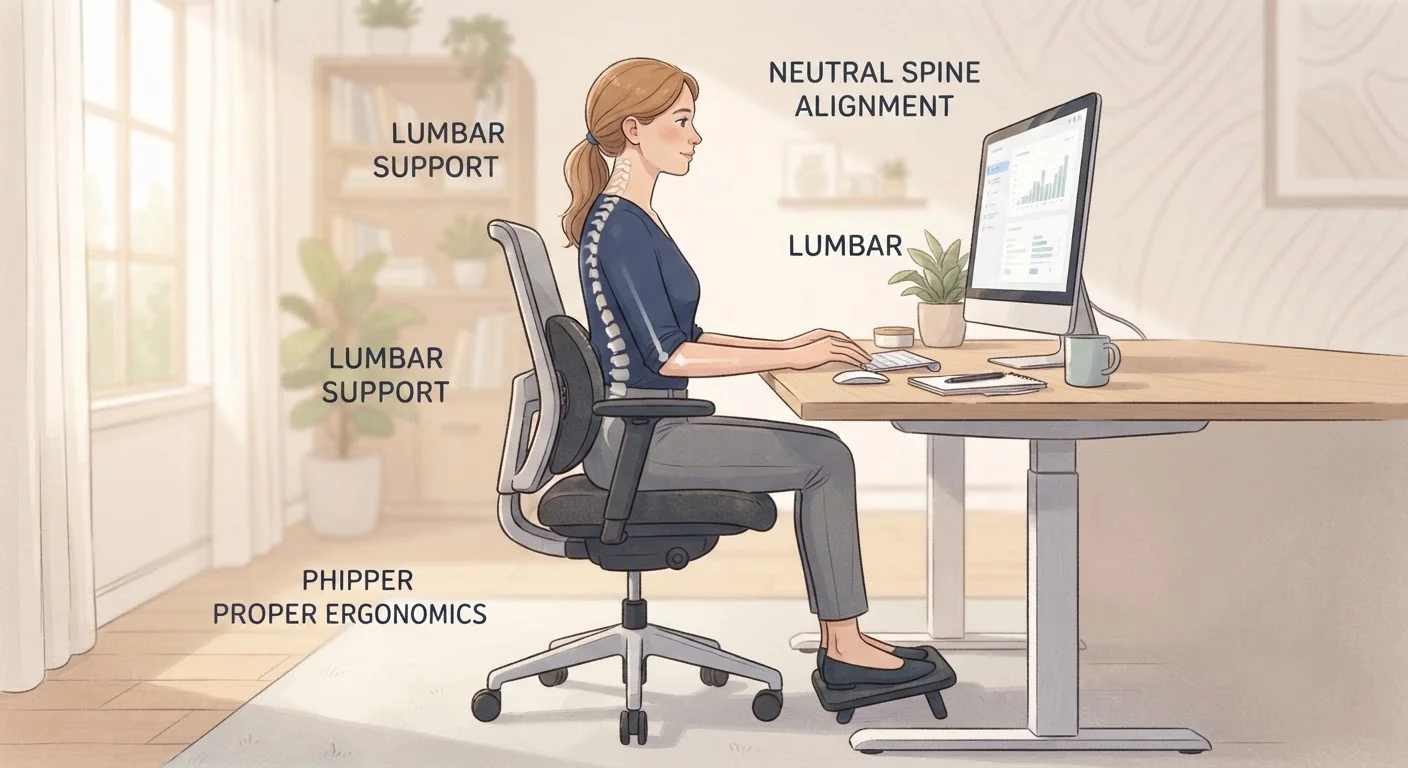
Maintain lumbar support when sitting for extended periods.
Without support, the lumbar spine tends to flex forward, flattening its natural curve and shifting disc pressure posteriorly toward nerve roots. A lumbar roll or rolled towel placed at the curve of the lower back helps preserve the natural lordosis and distributes load more evenly across the disc.
Set seat height so hips sit at or slightly above knee level.
When the knees are higher than the hips, the pelvis tips backward into posterior tilt, flattening the lumbar curve and increasing strain on lumbar discs. Adjusting seat height so the hips are level with or marginally higher than the knees allows the pelvis to tilt slightly forward, which supports a more neutral lumbar curve.
Avoid crossing your legs while seated.
Crossing the legs rotates the pelvis and introduces asymmetrical loading across the sacroiliac joint and lumbar spine. For someone with piriformis-related sciatica in particular, this position can also compress the piriformis muscle against the sciatic nerve.
Take a standing or walking break every 30 to 45 minutes.
Static posture of any kind, even well-supported sitting, allows muscle fatigue to accumulate and restricts circulation to spinal tissues. Brief position changes allow lumbar discs to redistribute fluid and give the supporting muscles a reset.
If your work requires long periods at a desk, pairing these seat adjustments with regular movement is equally important. Even correct posture becomes harmful when held for hours without a break. For a deeper look at what extended sitting does to spinal and hip mechanics, see why sitting all day tightens more than just your hips.
Standing and walking habits
Standing relieves disc pressure compared to slouched sitting, but prolonged static standing with poor weight distribution creates its own problems. Shifting weight repeatedly to one hip tilts the pelvis laterally, which can stress the piriformis and gluteal muscles on the loaded side and aggravate nerve irritation in some sciatica presentations.
Stand with feet roughly hip-width apart and weight distributed evenly across both feet. Avoid locking the knees, which increases lumbar lordosis (the inward curve of the lower back). When standing for extended periods, placing one foot on a low step or rail and alternating sides every few minutes reduces static loading on the lumbar spine. Walking, unlike standing, involves rhythmic movement that promotes circulation and can be tolerable or beneficial for many people with sciatica, provided stride length and pace are comfortable.
Lifestyle factors such as activity level and body weight also interact with how much strain the lumbar spine absorbs during daily upright activity.
Sleeping positions that reduce nerve pressure
The goal during sleep is to keep the spine in a neutral position and reduce any twisting or asymmetrical load on the lumbar region. Sleeping flat on your back with a pillow under the knees allows the lumbar spine to decompress and can reduce morning stiffness. Sleeping on your side with a pillow between the knees prevents the top leg from pulling the pelvis forward, which would rotate the lumbar spine and potentially increase nerve tension.
Stomach sleeping is generally discouraged for people with sciatica. It forces the lumbar spine into extension and turns the head to one side for hours, creating both lumbar and cervical strain. If stomach sleeping is the only comfortable option, placing a thin pillow under the lower abdomen can partially reduce the lumbar extension.
Mattress firmness is a common question. Research on mattress type and back pain outcomes is mixed, but medium-firm mattresses tend to support spinal alignment better than very soft surfaces that allow the pelvis to sink and the spine to sag. A mattress that has significantly degraded or developed visible sagging is worth replacing if sciatica is a recurring problem.
Building better posture habits over time
Individual posture corrections are easier to maintain when the muscles supporting the spine are strong enough to hold alignment without constant conscious effort. Core and gluteal muscle conditioning reduces the passive demand on joints and discs. The role of core strength in sciatica management describes how to approach that progressively.
Movement variety is the most practical strategy most people overlook. Setting a timer to change position or take a brief walk every 30 to 45 minutes is more effective than any single ergonomic product. Pairing position changes with gentle nerve-calming movements throughout the day gives the spine regular relief from static load.
Use the daily sciatica self-care audit to assess whether your current sitting, sleeping, and movement habits are working for or against your recovery. For a broader view of non-invasive management options, see non-invasive approaches to sciatica.
This article is for informational purposes only and is not medical advice. If you are experiencing sciatica symptoms, consult a qualified healthcare professional for personal evaluation and treatment guidance.