

Key Takeaways
Why blue light became the main villain
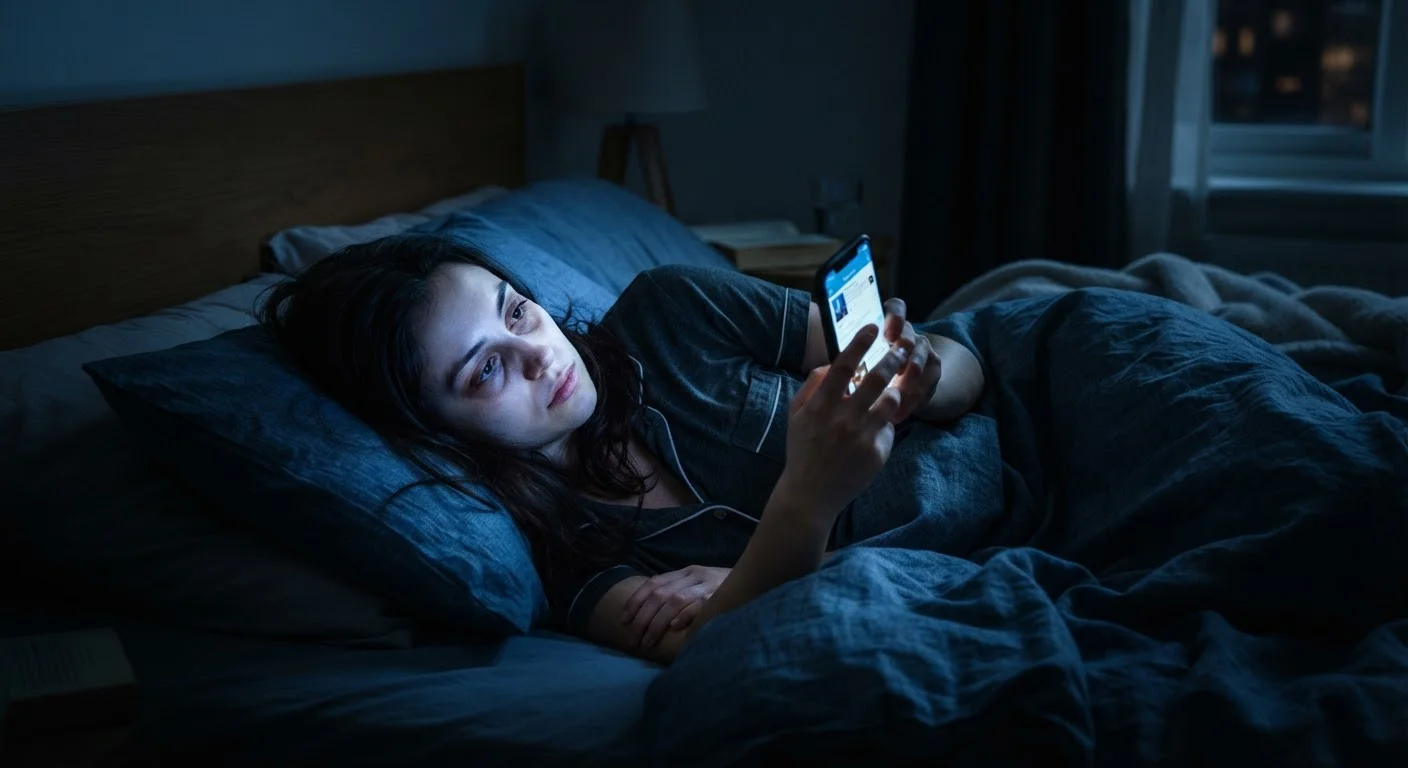
Blue light occupies a specific wavelength range (roughly 450 to 490 nanometers) that the retina's intrinsically photosensitive ganglion cells detect most efficiently. These cells signal the suprachiasmatic nucleus, the brain's circadian pacemaker, to suppress melatonin production. Because screens emit relatively high proportions of short-wavelength light, researchers correctly identified them as a potential circadian disruptor.
The problem is that popular coverage collapsed a nuanced finding into a single cause. Blue light from screens does delay melatonin onset in controlled laboratory conditions, but the magnitude depends on screen brightness, viewing distance, duration of exposure, and the ambient light already present in the room. A dim phone held at arm's length in an otherwise dark room emits far less circadian-relevant light than overhead lighting at the same hour.
For a fuller picture of how light fits into the broader sleep environment, see our sleep environment audit.
Common myths and what the evidence actually shows
Several persistent beliefs about screens and sleep misrepresent the research. The myth-fact pairs below address the most widespread ones.
Myth
Blue light glasses eliminate the sleep-disrupting effects of screens used at night.
Fact
Blue light glasses reduce short-wavelength light transmission, but they do not address the psychological arousal caused by engaging content.
Several randomized trials have tested blue light-blocking lenses against placebo lenses and found mixed or modest effects on objective sleep measures such as sleep latency and total sleep time. The lenses do filter some melatonin-suppressing wavelengths, but because screen brightness, room lighting, and content engagement all contribute to sleep disruption, filtering one wavelength band is unlikely to resolve the problem on its own. Relying on glasses as a standalone fix can give a false sense of protection while leaving the larger arousal issue unaddressed.
Myth
Night mode on your phone makes evening screen use effectively harmless for sleep.
Fact
Night mode shifts screen color toward warmer tones, reducing some blue light, but does not prevent alertness caused by stimulating content or bright displays.
A controlled study published in Sleep Medicine found that reading on a screen set to night mode still delayed melatonin onset compared to reading a printed book under equivalent ambient conditions. The color shift helps at the margins, but overall screen brightness and the attentional demands of the content remain important variables. Night mode is a partial measure, not a solution that permits unlimited evening screen use without sleep consequences.
Myth
Any screen use within two hours of bed will ruin your sleep.
Fact
The effect of screen use on sleep varies substantially by content type, brightness, individual circadian sensitivity, and timing relative to biological night.
A blanket two-hour rule overstates what population-level findings can reliably prescribe for individuals. Someone watching a dim, low-stimulation documentary 90 minutes before their habitual sleep time is in a very different situation than someone engaging with high-intensity social media 20 minutes before attempting sleep. Context matters. The goal is to reduce arousal and light input progressively as bedtime approaches, not to enforce a rigid cutoff that may not fit a person's actual schedule or sleep pressure.
Myth
Children and adults are affected by evening screen use in the same way.
Fact
Children and adolescents show greater melatonin suppression from evening light exposure and may need earlier and stricter limits than adults.
The developing circadian system is more sensitive to light at night. Research has documented that adolescents, who already experience a biologically driven phase delay (a natural tendency to fall asleep and wake later), are more susceptible to further circadian disruption from evening screen use. Parents and caregivers should treat pediatric screen guidance as categorically different from adult recommendations, and consult a pediatric health professional for specific guidance rather than applying adult frameworks directly.
Myth
Watching TV before bed is fine because the screen is farther away than a phone.
Fact
Distance reduces blue light reaching the eye, but television content can still cause cognitive and emotional arousal that delays sleep onset.
Light intensity falls with distance, so a television across the room does deliver less circadian-relevant light per unit of viewing time than a phone held close. However, content with high emotional valence, suspenseful narratives, or variable reward structures (such as news programming) maintains sympathetic nervous system activity and delays the mental deactivation needed for sleep. Viewing distance is one variable among several, and it does not neutralize the arousal pathway.
What actually disrupts sleep: arousal, not just photons
The physiological effect of blue light is real, but psychological arousal from screen content is a separate and often larger factor. Checking work email, reading distressing news, or playing a competitive game activates the sympathetic nervous system. Cortisol rises, heart rate increases, and the mental state required for sleep onset becomes harder to reach. This arousal effect operates independently of any light wavelength.
Content type matters. Passive viewing of low-stimulation video is measurably less disruptive to sleep latency (the time it takes to fall asleep) than social media scrolling or messaging, both of which involve variable reward patterns that sustain attention and emotional reactivity.
Daytime habits that keep stress hormones elevated also make evening arousal harder to overcome, regardless of what the phone displays.
This article is for informational purposes only and is not medical advice. Consult a qualified healthcare professional for guidance specific to your health situation.
Practical adjustments that have evidence behind them
A screen-free buffer of 30 to 60 minutes before bed consistently appears in sleep hygiene frameworks as a reasonable boundary. It addresses both the light and the arousal pathway simultaneously. Sleep hygiene as a practice is built on this kind of layered, cumulative approach rather than single-variable fixes.
When a full screen break is not realistic, lowering screen brightness to the minimum comfortable level, enabling a warmer color temperature (often labeled night mode or night shift), and choosing genuinely passive content all reduce the burden on the sleep system. These adjustments do not eliminate the arousal problem, but they lower the input on both channels at once.
Building a consistent pre-bed sequence that replaces screen time gives the nervous system reliable cues for the transition toward rest. Designing that wind-down routine is its own skill, one with a clear physiological rationale.
Circadian timing also interacts with screen use. People who keep irregular sleep schedules are more vulnerable to the melatonin-suppressing effect of evening light because their biological night is less predictable. The comparison between fixed and flexible sleep windows is worth understanding before drawing conclusions about your own sensitivity.