
Cortisol and Insulin: When Two Regulatory Hormones Work Against Each Other

Key Takeaways
Option A
Cortisol
The primary stress-response hormone of the adrenal glands.
Best for: Short-term mobilization of energy and immune modulation during acute stress or danger.
Option B
Insulin
The pancreatic hormone that governs blood glucose uptake and storage.
Best for: Post-meal glucose regulation and long-term metabolic balance in low-stress conditions.
If you want to understand why chronic stress affects blood sugar levels
Cortisol
Elevated cortisol from prolonged stress directly drives glucose release and suppresses insulin signaling, making it the primary hormonal mechanism to understand first.
If your focus is post-meal glucose management and metabolic health
Insulin
Insulin is the central regulator of glucose disposal after eating, and understanding its sensitivity is foundational to managing metabolic conditions.
If you are managing both chronic stress and blood sugar concerns simultaneously
Cortisol
Addressing cortisol dysregulation is often the upstream intervention; normalizing the stress hormone environment can improve the conditions under which insulin works.
How each hormone is made and what it does
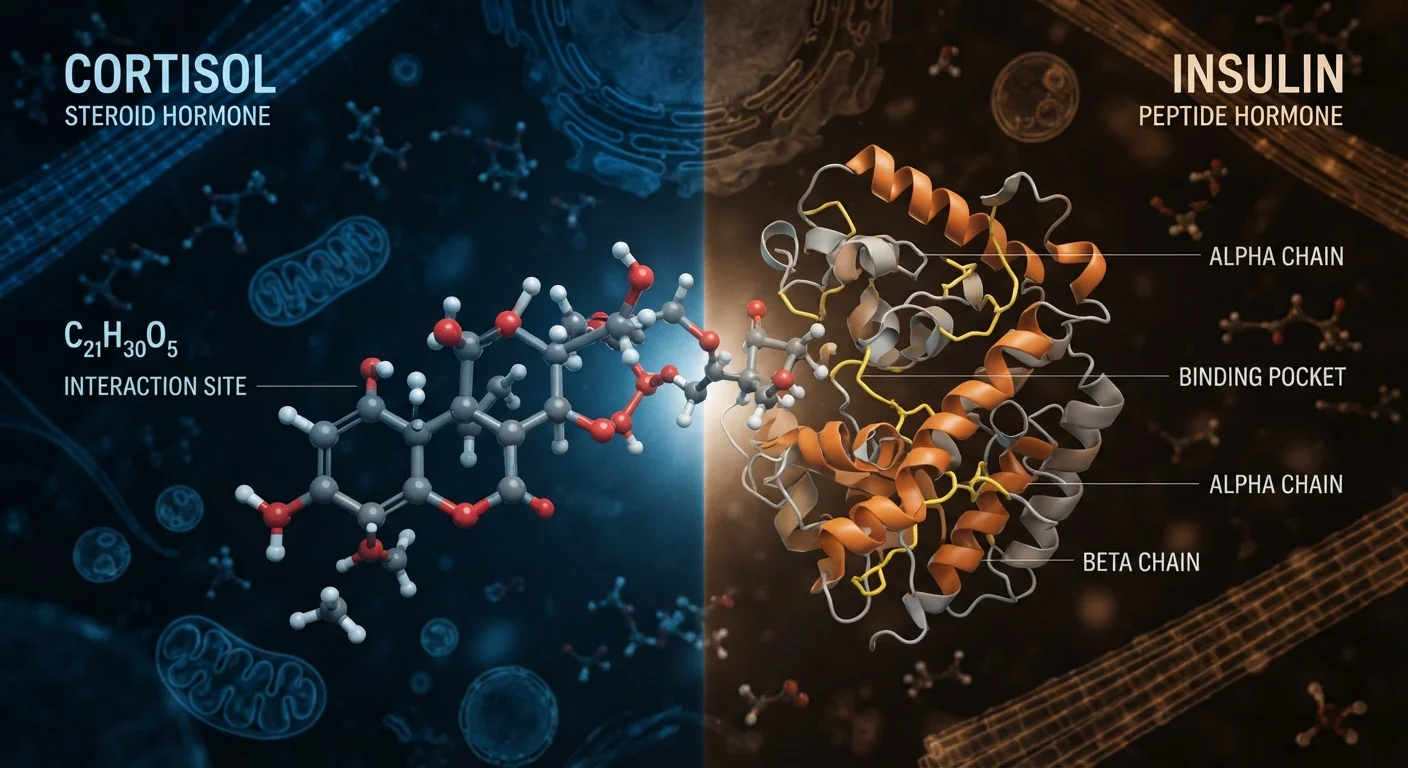
Cortisol is a glucocorticoid produced by the adrenal cortex in response to signals from the hypothalamic-pituitary-adrenal (HPA) axis. When the brain perceives a stressor, the hypothalamus releases corticotropin-releasing hormone (CRH), which prompts the pituitary to secrete adrenocorticotropic hormone (ACTH), which in turn stimulates cortisol output. In healthy physiology, cortisol follows a diurnal rhythm: highest in the early morning to support wakefulness and energy mobilization, declining through the day.
Insulin is a peptide hormone secreted by the beta cells of the pancreatic islets of Langerhans, primarily in response to rising blood glucose after a meal. It binds to insulin receptors on muscle, fat, and liver cells, signaling them to take up glucose from the bloodstream. Insulin also suppresses hepatic glucose output, meaning the liver stops releasing stored glucose when insulin is present.
The two hormones govern opposite sides of a metabolic balance. Cortisol is catabolic: it breaks down stored energy to raise blood glucose. Insulin is anabolic: it directs circulating glucose into cells for use or storage. This opposition is not a design flaw; it is normal regulatory physiology. Problems arise when cortisol remains chronically elevated.
The physiological conflict: what happens when cortisol stays high
Under acute stress, a temporary spike in cortisol raises blood glucose rapidly, providing fuel for a fight-or-flight response. The pancreas responds by releasing more insulin to contain that glucose rise. Once the stressor passes, cortisol falls, and the system resets. This acute cycle is self-limiting.
Chronic psychological or physiological stress disrupts that reset. Persistently elevated cortisol drives continuous hepatic gluconeogenesis (the liver manufacturing new glucose from amino acids and other substrates) and stimulates glycogen breakdown, keeping blood glucose elevated for extended periods. The pancreas compensates by producing more insulin, but cortisol simultaneously impairs insulin receptor signaling at the cellular level. Specifically, cortisol activates serine kinase pathways that interfere with the insulin receptor substrate-1 (IRS-1) protein, a step critical for normal glucose uptake. Cells become less responsive to insulin even as more of it circulates.
This pattern, called cortisol-induced insulin resistance, is well-documented in research on glucocorticoid excess, including the metabolic effects seen in conditions such as Cushing's syndrome, where cortisol levels are pathologically high. Epidemiological data also associate elevated psychological stress with increased risk of type 2 diabetes, though the causal pathway involves multiple factors beyond cortisol alone.
| Criterion | Cortisol | Insulin |
|---|---|---|
| Produced by | Adrenal cortex | Pancreatic beta cells |
| Primary trigger | Stress, low blood glucose, circadian signals | Rising blood glucose after a meal |
| Effect on blood glucose | Raises it (catabolic) | Lowers it (anabolic) |
| Effect on liver | Stimulates gluconeogenesis and glycogenolysis | Suppresses hepatic glucose output |
| Effect on fat tissue | Promotes visceral fat accumulation | Promotes fat storage when elevated chronically |
| Chronic elevation risk | Insulin resistance, visceral adiposity | Beta cell exhaustion, hypoglycemia |
| Regulatory axis | HPA axis | Glucose-sensing feedback in pancreas |
For a broader view of how stress hormones interact with sleep and glucose regulation, see Sleep, Stress, and Blood Sugar.
Feedback loops and compounding effects
The relationship is further complicated by feedback loops. Hypoglycemia (low blood sugar) is itself a stressor that activates the HPA axis and triggers cortisol release, which then raises glucose again. This creates a cycle in which poor blood sugar regulation and cortisol dysregulation can reinforce each other.
Sleep disruption is another compounding factor. Poor sleep raises cortisol the following day and independently worsens insulin sensitivity. The three systems, stress hormones, sleep quality, and glucose metabolism, interact closely. The three-way connection between sleep, stress, and hormones is detailed in a related article covering how each element amplifies the others.
Cortisol also affects adipose tissue distribution. Glucocorticoid receptors are particularly dense in visceral (abdominal) fat cells, and chronic cortisol exposure promotes lipid accumulation in that depot. Visceral adiposity itself worsens insulin resistance, adding a structural, not just signaling, dimension to the problem.
Understanding how chronic stress affects the endocrine system over months and years provides useful context for the timescales involved in cortisol-driven metabolic changes.
20-25%
Reduction in insulin sensitivity from glucocorticoid excess
Research on exogenous glucocorticoid administration has documented insulin sensitivity reductions in this range, as reviewed in the journal Diabetes Care.
~1.5x
Increased type 2 diabetes risk associated with high perceived stress
A meta-analysis published in Diabetologia found elevated psychological stress linked to roughly 1.5 times greater risk of developing type 2 diabetes across several prospective cohort studies.
30-40%
Higher fasting cortisol in chronic insomnia patients vs. controls
Studies comparing adults with chronic insomnia to healthy sleepers have recorded morning cortisol levels elevated by this margin, per research in the Journal of Sleep Research.
Evidence-based strategies that may support hormonal balance
No lifestyle intervention resets a hormone system overnight, and this is general health information, not medical advice. Anyone managing blood sugar concerns, elevated stress biomarkers, or suspected hormonal imbalance should work with a qualified healthcare provider.
That said, several well-studied behavioral strategies are associated with healthier cortisol patterns and preserved insulin sensitivity:
- Regular moderate-intensity aerobic exercise reduces basal cortisol over time and increases GLUT4 transporter expression in muscle cells, improving glucose uptake independent of insulin dose.
- Consistent sleep of adequate duration, generally seven to nine hours for most adults per the American Academy of Sleep Medicine, correlates with lower next-day cortisol and better insulin sensitivity markers.
- Mindfulness-based stress reduction (MBSR) has shown measurable reductions in salivary cortisol in multiple controlled trials, including research published in journals such as Psychoneuroendocrinology.
- Dietary patterns that avoid large glycemic spikes reduce the demand placed on beta cells and limit the glucose fluctuations that can themselves activate stress pathways.
How chronic stress impairs physical recovery covers the downstream tissue-level effects that make managing this hormonal conflict relevant beyond just metabolic health.
This article is for informational purposes only and is not medical advice. Consult a qualified healthcare professional before making changes to your diet, exercise routine, or any treatment plan.