
Sleep, Stress, and Hormones: The Three-Way Connection Most People Underestimate

Key Takeaways
The sleep-stress-hormone loop
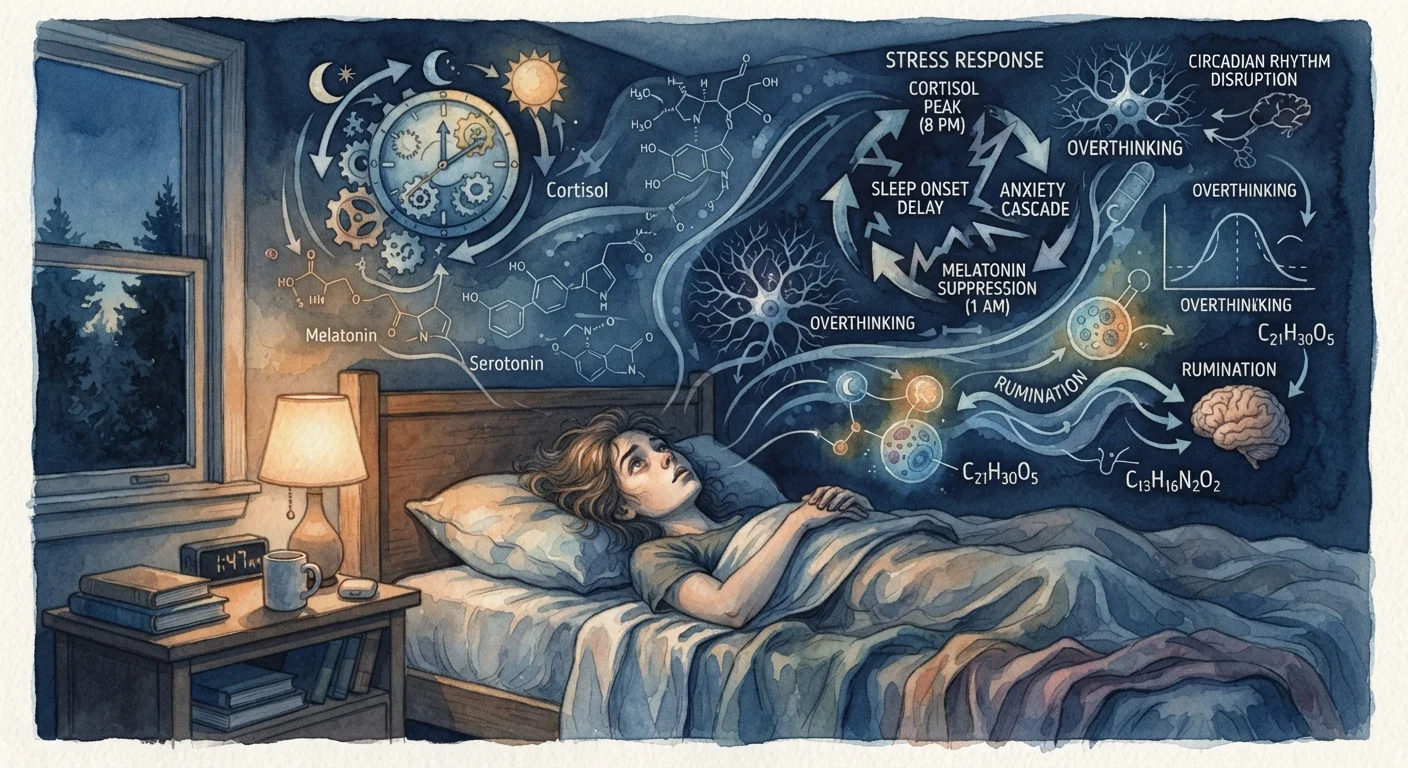
The sleep-stress-hormone loop describes how sleep quality, psychological stress, and hormone levels continuously influence one another. Poor sleep raises cortisol, the body's primary stress hormone. Elevated cortisol then disrupts production of sex hormones and growth hormone. The resulting hormonal imbalance makes restful sleep harder to achieve, restarting the cycle.
The loop runs through the hypothalamic-pituitary-adrenal (HPA) axis, which governs cortisol release, and the hypothalamic-pituitary-gonadal (HPG) axis, which regulates sex hormone production. Chronic HPA activation suppresses HPG signaling.
Why these three systems cannot be treated separately
Most people think of sleep, stress, and hormones as separate health concerns, addressed with separate solutions. In practice, the body does not organize itself that way. These three systems share overlapping regulatory machinery, so disruption in one produces measurable changes in the other two within hours.
The central hub is the hypothalamic-pituitary-adrenal (HPA) axis, which governs cortisol release. Cortisol follows a diurnal rhythm: highest in the early morning to promote wakefulness, lowest at night to allow sleep. Psychological stress and poor sleep both push that rhythm out of alignment in the same direction, amplifying each other's effects on hormone output.
For more on how the endocrine system responds to sustained stress over months and years, see the long-term view of chronic stress and the endocrine system.
How cortisol disrupts sex hormone production
Cortisol and sex hormones share a biochemical precursor: pregnenolone. When the adrenal glands are under sustained demand, they prioritize cortisol synthesis. This can reduce the pregnenolone available for downstream sex hormone production, a pattern sometimes called the pregnenolone steal, though the degree to which this occurs in humans remains an area of active research.
A more established mechanism runs through the hypothalamic-pituitary-gonadal (HPG) axis. Elevated cortisol suppresses gonadotropin-releasing hormone (GnRH) from the hypothalamus, which reduces luteinizing hormone (LH) and follicle-stimulating hormone (FSH) output from the pituitary. Lower LH means the testes produce less testosterone; lower FSH disrupts follicular development in the ovaries. This is why prolonged stress is associated with reduced libido, irregular menstrual cycles, and fertility difficulties.
~30%
Drop in testosterone after one week of short sleep
A study published in JAMA found that healthy young men sleeping five hours per night for one week showed testosterone reductions of 10-15%, with some measures approaching 30% in certain participants.
2x
Elevated cortisol risk with six or fewer hours of sleep
Research in the journal Sleep has associated habitual short sleep duration with roughly doubled rates of HPA axis dysregulation compared to those sleeping seven to eight hours nightly.
70%
Of daily growth hormone released during deep sleep
Endocrinology literature consistently finds that the majority of the daily growth hormone pulse occurs during slow-wave sleep, with the single largest secretory burst in the early sleep period.
The relationship also runs in the other direction. Low estrogen and testosterone impair the brain's ability to regulate the stress response, so declining sex hormone levels can make individuals more reactive to psychological stressors. This bidirectionality is what makes the loop self-sustaining.
Cortisol's relationship with other regulatory hormones extends further. Cortisol and insulin can work against each other when cortisol remains chronically elevated, adding metabolic consequences on top of reproductive ones.
What sleep deprivation does to hormonal output
Growth hormone (GH) provides a clear example of sleep's direct role in hormonal regulation. The largest GH pulse of the day occurs during slow-wave (deep) sleep, typically within the first few hours after sleep onset. Fragmented or shortened sleep reduces slow-wave duration, which limits GH release. Since GH drives tissue repair, muscle protein synthesis, and fat metabolism, its suppression has physical consequences that accumulate over time.
Cortisol is affected within a single night. Research in sleep medicine has documented elevated next-morning cortisol after even modest sleep restriction. Across several consecutive nights, the HPA axis shifts toward a higher baseline, making it harder for cortisol to drop fully at bedtime, which itself impairs sleep onset. This is one of the clearest examples of the loop closing on itself.
How chronic stress disrupts recovery explains the physiological chain in more detail, including how inflammation fits into this picture alongside cortisol and sleep quality.
Practical implications for daily habits
Because the three systems are interconnected, interventions that target one can produce benefits across all three. Consistent sleep timing stabilizes the cortisol rhythm. Practices that reduce psychological stress lower the chronic load on the HPA axis, which can allow sex hormone production to recover. Neither approach requires pharmaceutical intervention to have a measurable effect, though some clinical situations will require medical management.
Anchor your sleep schedule first
Before adding supplements or complex stress management protocols, establishing a consistent wake time is the most reliable way to stabilize the circadian cortisol rhythm. The body adjusts cortisol release around anticipated wake time, so irregular schedules prevent that calibration. Even a two-week trial of consistent timing can produce measurable improvements in sleep quality and morning cortisol levels, according to circadian biology research.
Sleep timing consistency matters more than most people expect. Going to bed and waking at consistent times, including on weekends, anchors the circadian rhythm that cortisol production follows. Irregular schedules introduce a form of social jet lag that keeps the HPA axis mildly dysregulated even without any identifiable stressor.
The downstream effects of this hormonal dysregulation extend beyond mood and libido. Sleep, stress, and blood pressure share overlapping hormonal pathways, and the same cortisol elevation that disrupts sex hormones also activates pressure-raising mechanisms in the cardiovascular system.
Stress-related hormonal changes also leave visible traces. Chronic stress rewires skin behaviour through cortisol's effects on sebum production and collagen synthesis, offering another indication of how broadly these systems reach.
This article is for informational purposes only and is not medical advice. If you have concerns about sleep, stress, or hormonal health, consult a qualified healthcare professional for evaluation and personalized guidance.