

Key Takeaways
How the stress response is designed to work
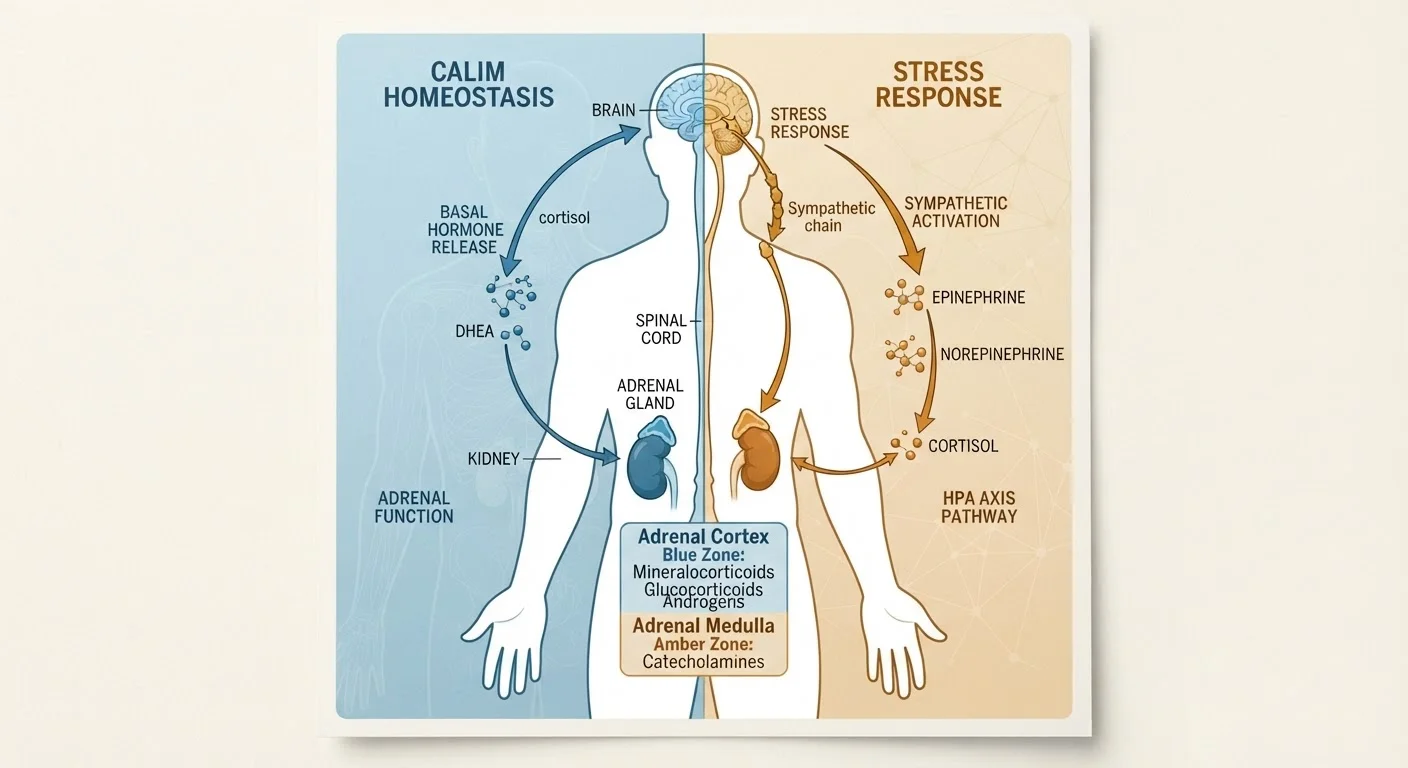
The body's stress response is a finely tuned survival mechanism. When a perceived threat appears, the hypothalamus signals the pituitary gland, which in turn signals the adrenal glands to release cortisol and adrenaline. This cascade, called the hypothalamic-pituitary-adrenal (HPA) axis, raises blood glucose, sharpens attention, and redistributes blood flow toward muscles. The entire sequence is built for short bursts: threat resolved, hormones fall, body returns to baseline.
Under that model, cortisol is not a harmful molecule. It regulates metabolism, modulates immune responses, and follows a predictable daily rhythm, peaking in the morning and tapering through the evening. The problem is not cortisol itself; the problem is sustained elevation.
What happens when stress becomes chronic
Psychological stressors such as financial pressure, interpersonal conflict, or relentless work demands do not resolve in minutes the way an acute physical threat does. The HPA axis receives a continuing activation signal, and cortisol remains above its baseline for hours, days, or years. Over that timeframe, tissues that were designed to tolerate brief cortisol spikes begin adapting in ways that compromise normal function.
Cortisol receptors in the brain, particularly in the hippocampus and prefrontal cortex, become less sensitive when chronically saturated. This receptor downregulation weakens the negative feedback loop that should turn the cortisol signal off, meaning the HPA axis loses some of its self-regulating precision. Prolonged stress also impairs the body's repair processes, including tissue regeneration and sleep architecture, both of which are necessary for hormonal recalibration.
Track your cortisol with salivary testing at four points across one day, not just a morning blood draw. The slope between those points tells a clinician far more than any single value.
Cortisol dysregulation in chronic stress often shows as a flattened diurnal rhythm rather than a uniformly elevated level, making single-point testing inadequate for a complete picture.
If you suspect thyroid symptoms, ask your clinician to test free T3 alongside TSH and T4. Conversion from T4 to T3 is where chronic stress interference most commonly appears.
Standard thyroid panels often omit free T3, which is the hormonally active form most likely to be suppressed by cortisol-driven conversion inhibition.
The HPA axis and cortisol dysregulation
Cortisol dysregulation does not always mean persistently high cortisol. Research in psychoneuroendocrinology shows that long-term stress can produce a flattened diurnal cortisol curve, where morning peaks are blunted and evening levels fail to drop adequately. This altered rhythm affects energy regulation, immune activity, and cognitive performance across the full day.
A flattened cortisol slope has been associated with burnout, chronic fatigue, and certain inflammatory conditions, though causality in human populations is difficult to isolate given the complexity of confounding variables. Clinicians can assess cortisol patterns through salivary cortisol testing at multiple time points, which provides a more complete picture than a single blood draw.
The gut also responds to cortisol dysregulation. The enteric nervous system shares receptor pathways with the HPA axis, which is one mechanism through which chronic stress alters gut motility and barrier integrity. See how stress disrupts gut function for a detailed look at that physiological pathway.
Effects on sex hormones and thyroid function
Cortisol and the sex hormones, namely testosterone, estrogen, and progesterone, share a biosynthetic starting point: pregnenolone, a steroid derived from cholesterol. Under sustained stress, the body prioritizes cortisol production. This effectively reduces the pregnenolone available for sex hormone synthesis, a dynamic sometimes described in research literature as the pregnenolone steal hypothesis. The hypothesis remains an area of active investigation rather than settled consensus, but clinically, suppressed sex hormone levels are a documented finding in populations with chronic stress exposure.
Thyroid function can also be affected. Cortisol at high concentrations inhibits the conversion of the relatively inactive thyroid hormone T4 into the active form T3. It can also suppress thyroid-stimulating hormone (TSH) output from the pituitary. The result is a subtle reduction in metabolic rate, body temperature regulation, and mood stability, symptoms that can be mistaken for primary thyroid disease. The relationship between sleep, stress, and sex hormones compounds these effects further, since poor sleep independently raises cortisol and lowers testosterone and growth hormone output.
Downstream consequences across body systems
Because the endocrine system does not operate in isolation, hormonal disruption spreads. Chronically elevated cortisol promotes insulin resistance by increasing hepatic glucose output and reducing peripheral glucose uptake. Over time, this raises the risk of metabolic dysfunction. Blood pressure responds to cortisol through multiple pathways: cortisol sensitizes blood vessels to the vasoconstrictive effects of adrenaline and promotes sodium retention in the kidneys. The interaction between stress hormones and cardiovascular pressure is particularly relevant for adults already managing hypertension.
Immune regulation is another casualty. Cortisol is immunosuppressive at sustained levels, reducing the activity of natural killer cells and altering cytokine balance. This creates a paradox: chronic stress can simultaneously suppress some immune defenses while promoting low-grade systemic inflammation through other signalling routes. The lymphatic system, which clears cellular waste and coordinates immune surveillance, also experiences altered function under prolonged hormonal stress. Stress and lymphatic function are connected through these shared immune signalling pathways.
Evidence-informed approaches to hormonal support
No single intervention reverses the hormonal effects of chronic stress, and this article does not recommend specific treatments. What the research does support is that certain lifestyle factors have measurable, documented effects on HPA axis function and cortisol output.
Consistent aerobic exercise at moderate intensity has been shown in multiple controlled trials to attenuate cortisol reactivity to psychological stressors and to improve diurnal cortisol rhythm over weeks. Sleep is not optional in this context: the bulk of growth hormone secretion and cortisol suppression happens during deep sleep stages, so inadequate or fragmented sleep perpetuates the dysregulation rather than resolving it.
Mindfulness-based stress reduction (MBSR), a structured program developed at the University of Massachusetts Medical School, has demonstrated statistically significant reductions in salivary cortisol in clinical populations in peer-reviewed trials. Dietary patterns that stabilize blood glucose also reduce cortisol fluctuations, since hypoglycaemia is itself a physiological stressor that activates the HPA axis.
Anyone experiencing symptoms that suggest hormonal disruption, including persistent fatigue, changes in libido, unexplained weight changes, or mood disturbance, should consult a qualified healthcare provider. Targeted laboratory testing can distinguish between stress-related hormonal shifts and primary endocrine conditions that require different management.
This article is for informational purposes only and is not medical advice. Consult a qualified healthcare professional before making any changes to your health regimen.