

Key Takeaways
Hormonal balance
Hormonal balance refers to a state in which the body's hormone-producing glands secrete the right amounts of each hormone at the right times to sustain normal physiological function. Hormones are chemical messengers that regulate metabolism, mood, reproduction, sleep, and stress response. Balance is dynamic rather than fixed, meaning it shifts predictably with age, stress, nutrition, and circadian cycles.
The endocrine system maintains hormone levels through negative feedback loops: when a hormone concentration rises above a set point, upstream signaling glands reduce their output, and vice versa. Disruption of these loops, rather than any single hormone being 'high' or 'low,' is often the root of imbalance.
Why 'hormonal balance' is harder to define than it sounds
The phrase 'hormonal balance' is used widely, but it does not correspond to a fixed number on a lab report. The endocrine system produces over 50 distinct hormones, each operating within its own concentration range and circadian rhythm. Cortisol, for instance, peaks within 30 to 45 minutes of waking and declines through the day. Insulin spikes after meals and falls between them. Estrogen follows a monthly pattern in people who menstruate. Calling any of these 'balanced' means they are moving through their expected rhythms without sustained deviation.
What disrupts balance is rarely a single gland failing in isolation. More often, it is a cascade: chronic sleep deprivation suppresses growth hormone release; elevated cortisol from unmanaged stress blunts thyroid hormone conversion; excess adipose tissue converts androgens to estrogens via an enzyme called aromatase. Understanding these interdependencies is more clinically useful than chasing a generic 'balanced' state.
Hormonal 'balance' shifts with life stage
What counts as normal hormone levels at age 25 differs substantially from what is expected at 50 or 70. Reference ranges on lab reports are usually based on broad population samples and may not reflect what is optimal for an individual at a specific life stage. Always review results with a clinician who can apply appropriate context.
The feedback loop: how the body self-regulates
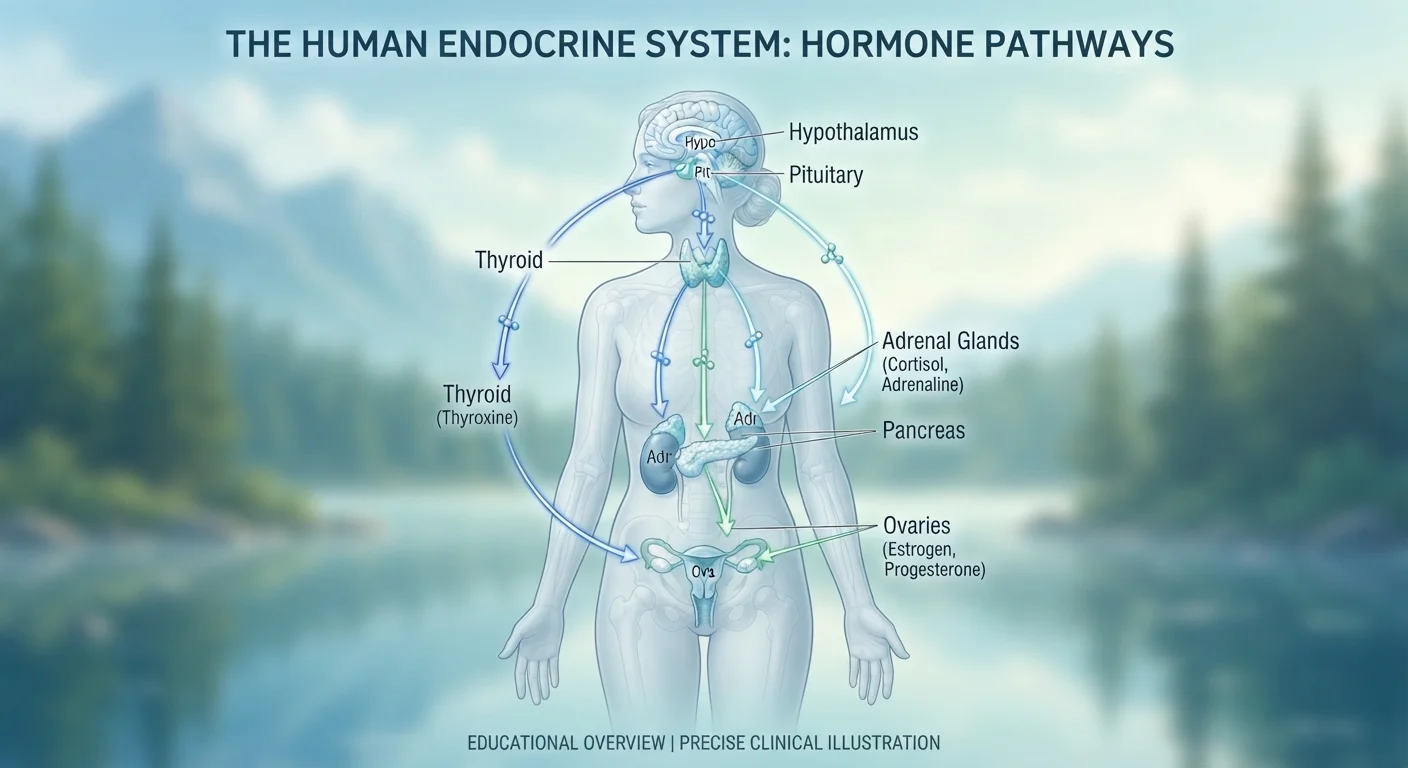
The hypothalamus and pituitary gland sit at the top of most hormonal hierarchies. The hypothalamus releases small signaling peptides that instruct the pituitary, which in turn releases hormones that stimulate peripheral glands such as the thyroid, adrenal cortex, and gonads. When those peripheral glands produce enough of their respective hormones, the elevated levels feed back to the hypothalamus and pituitary, suppressing further signaling. This negative feedback architecture keeps output within a functional range.
Disruption can occur at any point in the hierarchy. Autoimmune conditions like Hashimoto's thyroiditis damage the thyroid gland directly. Pituitary adenomas can produce excess signaling hormones. Chronic stress can dysregulate hypothalamic pulse patterns. Because the system is hierarchical, a problem at one level reverberates throughout the chain, which is why hormonal symptoms are often diffuse and overlap with other chronic conditions.
The liver's role in hormonal health
Hormone clearance is as important as hormone production. Once a hormone has delivered its signal, the body must deactivate and excrete it. The liver handles a large share of this work, conjugating steroid hormones so they can be excreted via bile or urine. When liver function is impaired, used hormones can recirculate, skewing the ratio of active to inactive forms.
This connection means that liver health is not separable from endocrine function. A liver managing chronic inflammation, excess dietary fat, or significant alcohol exposure has reduced capacity for hormone metabolism. Supporting liver function through a nutrient-dense diet, adequate hydration, and limiting hepatotoxic exposures is therefore relevant to hormonal health, even when the liver itself is not the primary focus of concern.
Lifestyle factors with measurable hormonal effects
Several modifiable factors have documented effects on hormone levels and signaling:
- Sleep: Growth hormone is secreted in pulses during slow-wave sleep. Consistently poor sleep quality reduces overall growth hormone output and elevates evening cortisol. A body of research links short sleep duration to insulin resistance and disrupted leptin and ghrelin signaling.
- Physical activity: Resistance training acutely raises testosterone and growth hormone. Regular aerobic exercise improves insulin sensitivity and reduces resting cortisol. Mobility and recovery practices also reduce the chronic low-grade inflammatory signaling that can interfere with receptor sensitivity.
- Nutritional status: Iodine and selenium are required for thyroid hormone synthesis and conversion. Zinc is necessary for testosterone production and is a cofactor in hundreds of enzymatic reactions. Magnesium influences cortisol regulation and sleep architecture.
- Chronic stress: Sustained activation of the HPA axis keeps cortisol elevated beyond its normal diurnal peak, with downstream suppressive effects on thyroid, reproductive, and immune hormones.
Prioritize sleep before adding supplements
Sleep is when the body conducts much of its hormonal housekeeping, including growth hormone secretion and cortisol regulation. Before pursuing any supplement or intervention for hormonal symptoms, addressing sleep duration and quality is a well-supported first step. Aim for consistent sleep and wake times, as irregular schedules disrupt the circadian signaling that governs hormone release.
Testing and interpretation: what the numbers do and do not show
Hormonal testing gives a partial picture, not a complete diagnosis. A serum testosterone level drawn at 2 p.m. will be meaningfully lower than one drawn at 8 a.m. in the same person, because testosterone follows a diurnal pattern. A single TSH measurement may not capture subclinical thyroid dysfunction if the patient's pattern fluctuates. Comprehensive evaluation typically requires multiple tests, collected at appropriate times, read in the context of symptoms and history.
For a detailed breakdown of what specific hormonal tests measure and their limitations, see Key Facts About Hormonal Testing. Pursuing testing independently without clinical guidance often leads to misinterpretation of results that fall near the edges of a reference range. Reference ranges are population statistics, not individual targets.
For broader context on how hormones shift across decades, the article Hormonal Fluctuations Across a Lifetime maps the predictable hormonal phases of human development.
This article is for informational purposes only and is not medical advice. Consult a qualified healthcare professional before making any changes related to your hormonal health.