

Key Takeaways
Start here
What hormones actually do
Next
Puberty: the first major hormonal transition
Then
Reproductive years and hormonal cycling
Going deeper
Midlife: perimenopause, andropause, and beyond
When you're ready
Supporting hormonal balance across life stages
What hormones actually do
Hormones are chemical messengers produced by glands in the endocrine system. They travel through the bloodstream and bind to receptors in target tissues, triggering responses that regulate metabolism, growth, reproduction, mood, sleep, and immune function. Even small changes in hormone concentration can produce noticeable physiological effects because the system operates on tight feedback loops.
The major players include estrogen, progesterone, testosterone, cortisol, insulin, thyroid hormones, and growth hormone. These do not work in isolation; they interact constantly. For a plain-language overview of how individual hormones shape daily energy and mood, see the major hormones that shape your daily energy and mood.
Endocrine system
The network of glands and organs that produce, store, and release hormones into the bloodstream to regulate bodily functions.
HPG axis
The hypothalamic-pituitary-gonadal axis; the three-part signaling chain that controls reproductive hormone production by linking the brain to the ovaries or testes.
Estrogen
A group of steroid hormones produced mainly in the ovaries that regulate the menstrual cycle, bone density, and cardiovascular function, among other roles.
Progesterone
A steroid hormone produced after ovulation that prepares the uterus for pregnancy and has calming effects on the nervous system via GABA receptors.
Testosterone
A steroid hormone produced in the testes and, in smaller amounts, the ovaries and adrenal glands; it supports muscle mass, bone density, libido, and mood.
Cortisol
A hormone released by the adrenal glands in response to stress and low blood sugar; it regulates metabolism, immune response, and the sleep-wake cycle.
Perimenopause
The transition period before menopause, often lasting several years, during which ovarian hormone production becomes irregular before declining overall.
SHBG
Sex hormone-binding globulin; a protein that binds to sex hormones in the blood, reducing the amount that is biologically active in tissues.
The liver processes and clears many hormones from circulation, which is one reason liver health matters to endocrine balance. When clearance is impaired, hormones can accumulate or convert into less favorable metabolites.
Puberty: the first major hormonal transition
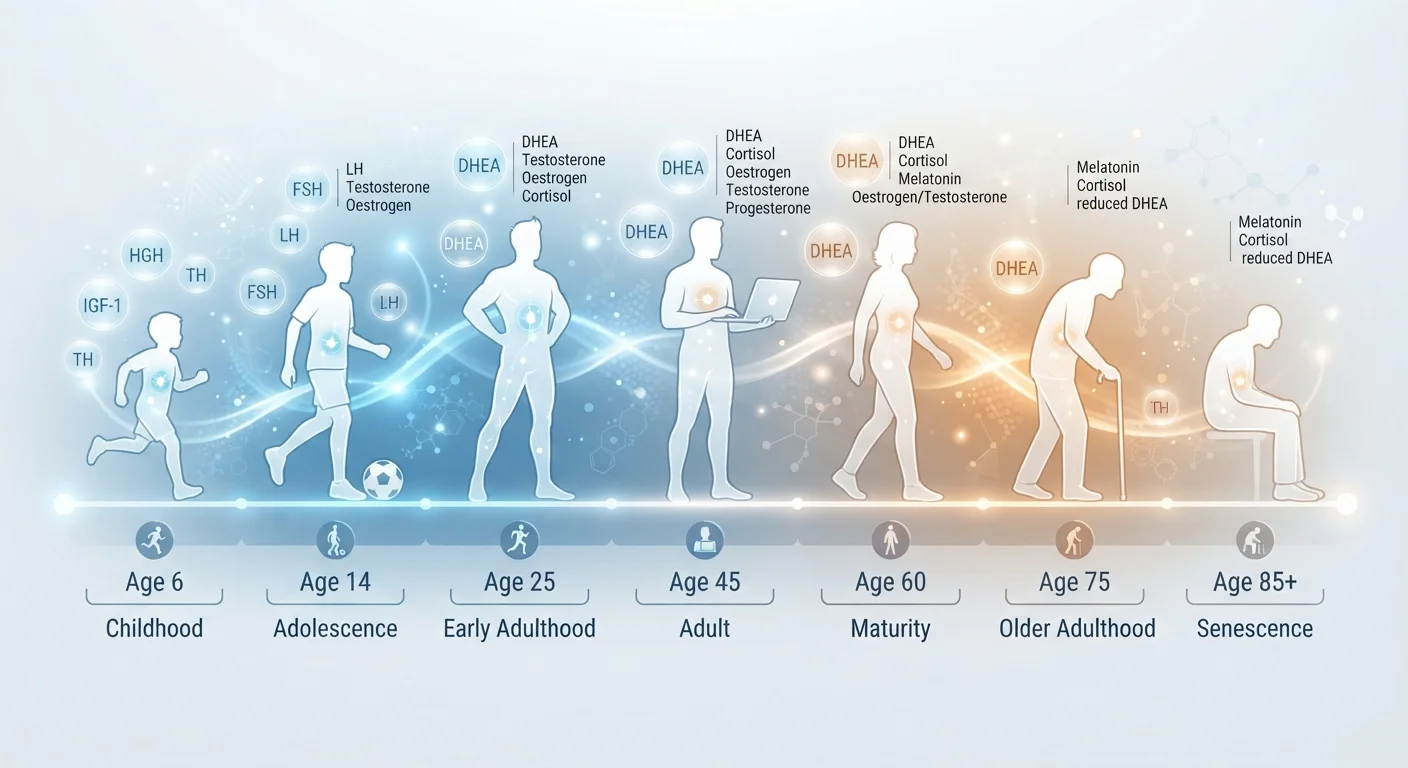
Puberty is driven by the hypothalamic-pituitary-gonadal (HPG) axis, the signaling chain that connects the brain to the gonads. The hypothalamus releases gonadotropin-releasing hormone (GnRH), which prompts the pituitary to release luteinizing hormone (LH) and follicle-stimulating hormone (FSH). These signals stimulate the ovaries or testes to produce estrogen or testosterone.
The result is a surge of sex hormones that drives physical maturation: skeletal growth, changes in body composition, development of secondary sex characteristics, and the onset of reproductive capacity. Growth hormone and insulin-like growth factor 1 (IGF-1) also peak during this window, coordinating the adolescent growth spurt.
Mood volatility during puberty has a real biological basis. Rapidly shifting estrogen and testosterone levels influence serotonin and dopamine signaling, which partly explains the emotional variability that adolescents and their families commonly notice.
Reproductive years and hormonal cycling
In people with ovaries, the reproductive years are characterized by a monthly cycle. During the follicular phase, rising estrogen thickens the uterine lining and triggers the LH surge that causes ovulation. After ovulation, the corpus luteum produces progesterone. If fertilization does not occur, both hormones drop, the lining sheds, and the cycle restarts.
This cycling has systemic effects. Estrogen influences bone density, vascular tone, and lipid metabolism. Progesterone has calming, sleep-promoting properties through its interaction with GABA receptors in the brain. When either hormone fluctuates sharply, symptoms such as mood changes, bloating, or sleep disruption can follow.
Pregnancy produces another hormonal reorganization: human chorionic gonadotropin (hCG) sustains the corpus luteum early on, while placental estrogen and progesterone reach concentrations never seen outside pregnancy. Postpartum, the sudden withdrawal of placental hormones is the primary driver of postpartum mood disturbance. This is general health information; consult a healthcare provider for guidance specific to pregnancy or postpartum health.
In people with testes, the reproductive years are characterized by relatively stable testosterone levels that begin a slow, gradual decline from roughly the early 30s onward. Testosterone supports muscle protein synthesis, red blood cell production, libido, and spatial cognition.
Midlife: perimenopause, andropause, and beyond
Perimenopause, which typically begins in the mid-to-late 40s and can last several years before the final menstrual period, is the most abrupt hormonal transition most people with ovaries will experience. Estrogen production becomes erratic before declining overall; progesterone often drops first because ovulation becomes inconsistent. Cycle irregularity, vasomotor symptoms (hot flashes and night sweats), disrupted sleep, and cognitive changes are common during this period.
Because these symptoms overlap substantially with anxiety, depression, thyroid dysfunction, and other conditions, they are frequently misattributed. The article why hormonal symptoms are so often mistaken for something else covers this diagnostic challenge in detail.
The testosterone decline in people with testes is slower and often called late-onset hypogonadism or, informally, andropause. Symptoms can include reduced energy, changes in mood, decreased libido, and loss of lean muscle mass. Unlike menopause, there is no single endpoint; the change is gradual and sometimes goes unrecognized.
Track patterns, not single readings
Hormone levels fluctuate throughout the day and across the menstrual cycle, so a single blood test provides limited information on its own. Clinicians often time tests to specific cycle days or take multiple readings to get a clearer picture. Keeping a symptom journal alongside any lab work gives your healthcare provider more useful context.
Shifting hormone levels in midlife also correlate with changes in cholesterol fractions and blood pressure readings. The article on blood pressure across the lifespan explains the cardiovascular dimension of these transitions.
Older adulthood and hormonal decline
After menopause, estrogen settles at a persistently low level. This accelerates bone resorption, which is why osteoporosis risk rises sharply in postmenopausal women. Cardiovascular protection previously provided by estrogen diminishes, contributing to changes in lipid profiles and arterial stiffness.
Testosterone in older men continues to decline, and free testosterone drops faster than total testosterone because sex hormone-binding globulin (SHBG) increases with age, binding more testosterone and leaving less biologically active. Growth hormone secretion also falls with age, as does DHEA (dehydroepiandrosterone), an adrenal precursor to sex hormones. Cortisol regulation can become less precise, with some older adults showing a flatter diurnal cortisol curve.
The gut microbiome also shifts across adulthood and interacts bidirectionally with hormonal status. The article on microbiome changes across life covers these parallel transitions.
Supporting hormonal balance across life stages
No lifestyle intervention replaces the endocrine system's biological trajectory, but several factors genuinely influence how that trajectory unfolds.
- Sleep: growth hormone is secreted primarily during slow-wave sleep. Chronic sleep restriction suppresses it and elevates cortisol, which has downstream effects on insulin sensitivity and sex hormone production.
- Physical activity: resistance training supports testosterone and growth hormone secretion and improves insulin sensitivity. Moderate aerobic exercise reduces circulating cortisol over time. For movement strategies that support physical resilience, mobility and recovery is a useful starting point.
- Dietary patterns: sufficient protein supports steroidogenesis (the production of steroid hormones). Chronically low caloric intake suppresses the HPG axis; this is a well-documented mechanism in athletes with low energy availability.
- Stress management: the HPA (hypothalamic-pituitary-adrenal) axis responds to perceived threat by producing cortisol. Sustained activation from chronic psychological stress suppresses reproductive hormone production through competitive signaling.
Individual variation is wide. Two people of the same age and sex can have meaningfully different hormone profiles. Symptoms that feel disruptive, or that don't resolve with basic lifestyle adjustments, warrant evaluation by a qualified healthcare provider rather than self-management alone.
This article is for informational purposes only and is not medical advice. Always consult a qualified healthcare professional before making changes to your health regimen, particularly regarding hormonal symptoms, medications, or supplementation.