

Key Takeaways
Gut-immune axis
The gut-immune axis refers to the continuous, two-way communication between the trillions of microorganisms living in your digestive tract and the immune cells that line it. The gut is home to a large share of the body's immune tissue, and bacteria there actively shape how the immune system responds to threats. This relationship begins at birth and continues throughout life.
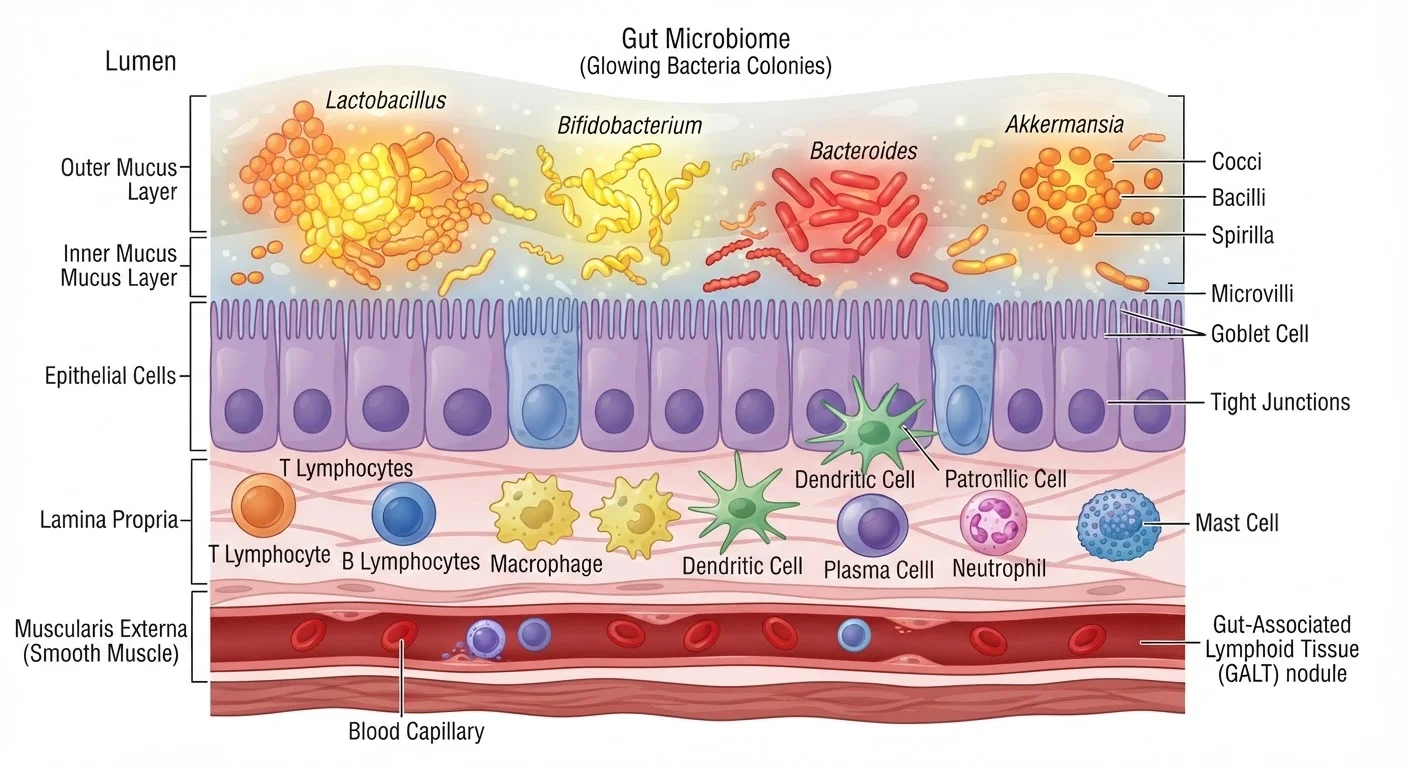
Gut-associated lymphoid tissue (GALT), including Peyer's patches and mesenteric lymph nodes, forms the anatomical foundation of this axis and contains the majority of the body's immunoglobulin-A-secreting cells.
Where immunity lives in the gut
The gastrointestinal tract is the body's largest interface with the external environment. Every day it processes food, water, and the microorganisms that arrive with them. To manage that exposure, the gut has developed the most extensive immune infrastructure in the body.
Gut-associated lymphoid tissue (GALT) includes Peyer's patches in the small intestine, isolated lymphoid follicles, and mesenteric lymph nodes. These structures house T cells, B cells, dendritic cells, and macrophages that monitor gut contents continuously. A specialized layer of epithelial cells separates the lumen from this immune tissue, and the bacteria living just above that layer communicate with immune cells through molecular signals that cross this barrier.
The lymphatic system is directly involved in this process. Mesenteric lymph nodes filter material from the gut and relay immune signals to the rest of the body. For more on how lymphatic drainage supports immune defense, see our overview of the lymphatic system.
How bacteria train immune responses
From birth, gut bacteria begin calibrating immunity. In early life, microbial colonization teaches immune cells what to attack and what to tolerate, a process called immune education. Bacteria present molecular patterns that dendritic cells and macrophages recognize, prompting them to adjust their inflammatory output accordingly.
One mechanism involves regulatory T cells (Tregs). Certain bacterial species, particularly from the Clostridia class, stimulate Treg development. Tregs suppress excessive immune activity, which matters for preventing autoimmune responses and chronic inflammation. Research published in journals including Nature and Immunity has documented this pathway in both animal models and human tissue.
Short-chain fatty acids (SCFAs) are another mechanism. When bacteria ferment dietary fiber, they produce butyrate, propionate, and acetate. These compounds bind to receptors on immune cells and reduce the production of pro-inflammatory cytokines. Low-fiber diets limit SCFA production, which removes this regulatory signal.
~70%
Of immune tissue located in the gut
Gastroenterology and immunology research consistently attributes roughly 70% of the body's immune tissue to gut-associated lymphoid tissue structures.
38 trillion
Estimated microbial cells in the human gut
A widely cited estimate published in <cite>Cell</cite> by Sender et al. (2016) placed the number of bacteria in the human body at approximately 3.8 x 10^13.
1,000+
Bacterial species identified in the human gut
Large-scale metagenomic projects including the Human Microbiome Project have catalogued over 1,000 distinct bacterial species across human gut samples.
The liver processes much of what crosses the gut barrier into the bloodstream. When microbial balance shifts, altered metabolites reach the liver, which is one reason gut health and liver health are closely related. Our liver health resource covers those connections in more detail.
What dysbiosis does to immune balance
Dysbiosis, an imbalance in microbial composition or diversity, disrupts the signals gut bacteria normally send to immune tissue. The effects can move in two directions: toward insufficient immune defense or toward excessive, misdirected immune activity.
A compromised gut barrier, sometimes called increased intestinal permeability, allows bacterial fragments such as lipopolysaccharide (LPS) to enter circulation. LPS activates immune receptors that drive systemic inflammation. This mechanism is one pathway connecting gut microbial imbalance to conditions characterized by chronic low-grade inflammation. The relationship between the microbiome and chronic inflammation is detailed in our article on gut health and chronic inflammation.
Autoimmune conditions, allergic diseases, and inflammatory bowel disorders all show altered microbiome profiles compared with healthy controls, though the research is observational in many cases and causality is not fully established. The direction of the relationship is still being studied.
Common factors that shift microbial composition include antibiotic courses, ultra-processed food consumption, chronic sleep disruption, and overuse of antibacterial products. Many of these are addressed in our guide to habits that undermine gut bacterial balance.
Supporting the gut-immune relationship through diet
Dietary fiber is the substrate gut bacteria use to produce SCFAs. Foods such as legumes, whole grains, vegetables, and fruit provide the variety of fibers that support a diverse microbial community. Diversity, rather than the presence of any single species, consistently appears as the feature most associated with a well-regulated immune system in microbiome research.
Fermented foods, including plain yogurt, kefir, kimchi, and sauerkraut, provide live bacteria that can transiently populate the gut and interact with immune tissue. A clinical trial published in Cell in 2021 found that a high-fermented-food diet increased microbiome diversity and reduced markers of immune activation compared with a high-fiber diet alone, though the researchers noted that individual responses varied considerably.
The gut also communicates with the brain, and stress hormones can alter microbial composition and gut barrier function. That bidirectional relationship is covered in our article on the gut-brain connection.
This article is for informational purposes only and is not medical advice. Consult a qualified healthcare professional before making significant changes to your diet, supplement routine, or treatment plan, particularly if you have a chronic health condition.