

Key Takeaways
What intestinal permeability actually means
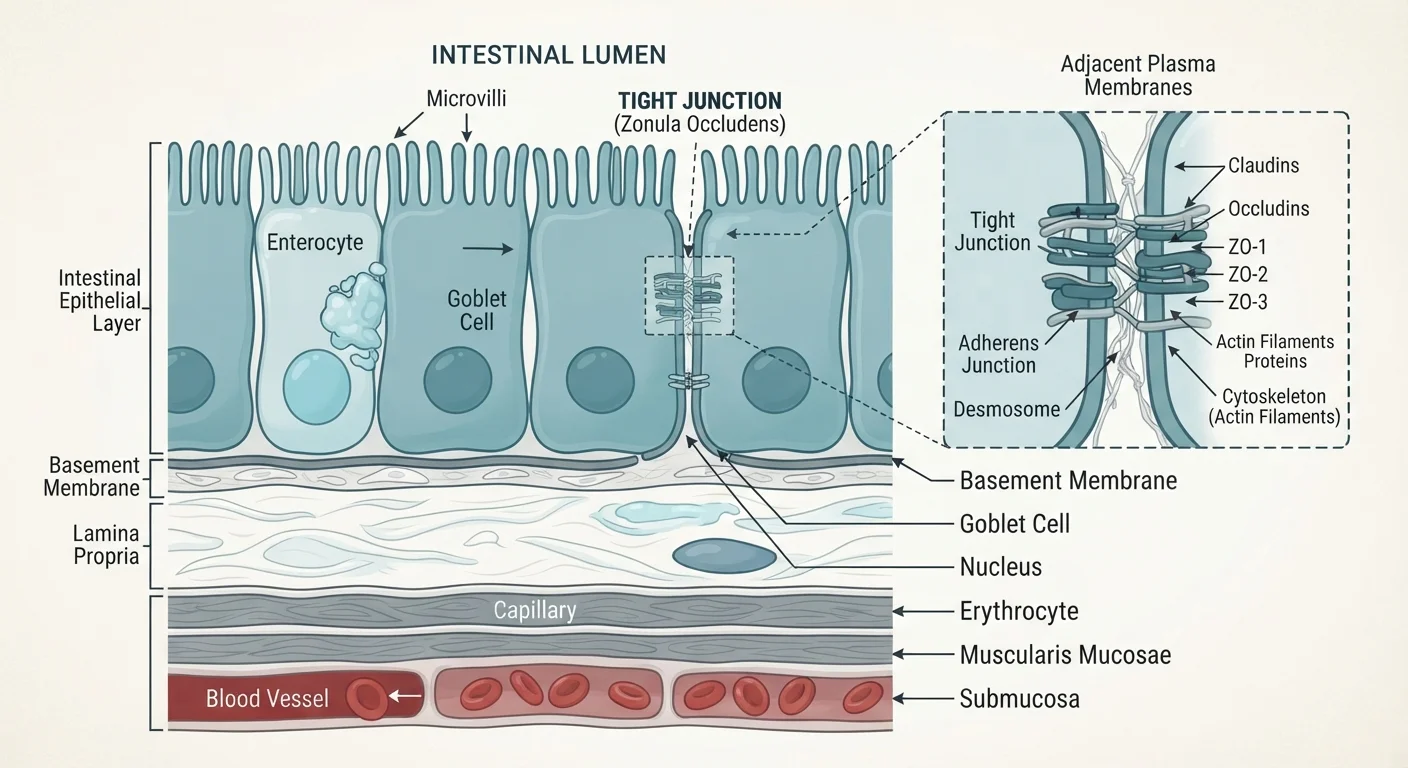
The intestinal lining is a single layer of epithelial cells connected by protein structures called tight junctions. These junctions control what passes from the gut lumen into the bloodstream, selectively allowing nutrients through while blocking pathogens, undigested food particles, and toxins. When those junctions loosen, permeability increases.
Researchers can measure this change using probes such as lactulose and mannitol, molecules of different sizes that pass through the gut at different rates depending on barrier integrity. The ratio of their urinary recovery gives a quantifiable index. This is established physiology, documented across peer-reviewed gastroenterology literature for decades.
Permeability changes are observed in several recognized conditions: celiac disease, Crohn's disease, ulcerative colitis, and acute infection. In these contexts, altered barrier function is part of a larger, well-characterized disease process. See how gut function shapes whole-body health for broader context on how the gut communicates with other organ systems.
Common myths and what the evidence shows
Despite a legitimate physiological basis, the popular concept of 'leaky gut syndrome' has attracted a large body of unverified claims. The myth-and-fact pairs below address the most common ones circulating in wellness media.
Myth
Leaky gut syndrome is a recognized medical diagnosis that doctors can test for and treat.
Fact
Increased intestinal permeability is a measurable physiological state, but 'leaky gut syndrome' is not a recognized clinical diagnosis in mainstream gastroenterology.
Medical organizations including the American Gastroenterological Association do not list leaky gut syndrome as a standalone diagnosis. Gastroenterologists measure intestinal permeability as part of research protocols or to characterize known diseases such as Crohn's, but there is no standard clinical test whose result yields a diagnosis of 'leaky gut syndrome' with an associated treatment protocol. That gap between measurable physiology and named diagnosis is significant: it means many commercially marketed tests and treatment programs lack validated clinical backing. See other gut health myths for related misconceptions in this space.
Myth
A leaky gut allows toxins to flood into the bloodstream, poisoning the body and causing widespread disease.
Fact
The liver and immune system screen blood from the portal vein continuously. Increased permeability does not mean unfiltered toxins freely circulate throughout the body.
Blood leaving the intestines travels through the portal vein to the liver before entering general circulation. The liver processes bacterial products, including lipopolysaccharides that can translocate when permeability is elevated, as part of its normal function. In conditions such as severe liver disease or sepsis, this system is overwhelmed, but for most people with modestly elevated gut permeability, the liver provides a substantial secondary barrier. Liver health and its filtering role are often omitted from popular leaky gut narratives, which creates a misleading picture of uncontrolled toxin exposure.
Myth
Leaky gut causes autism spectrum disorder.
Fact
Some children with autism show altered gut permeability, but this association does not establish causation, and the research base is small and inconsistent.
A number of small studies have reported differences in intestinal barrier markers in some individuals with autism spectrum disorder. Interpreting these findings is complicated by dietary differences, antibiotic use history, and microbiome variation that commonly accompany the condition. No large, well-controlled trial has demonstrated that increasing gut barrier function changes autism outcomes. Claiming a causal link between leaky gut and autism goes beyond what the current evidence supports and can direct families away from established therapeutic approaches.
Myth
You can heal a leaky gut quickly by cutting out gluten, even if you do not have celiac disease.
Fact
Gluten removal is evidence-based for celiac disease and non-celiac gluten sensitivity, but its effect on intestinal permeability in people without those conditions is not established.
In celiac disease, gluten triggers an immune response that measurably damages the intestinal lining, and a strict gluten-free diet allows that lining to recover. For people without celiac disease or diagnosed non-celiac gluten sensitivity, the evidence that gluten itself raises intestinal permeability is limited. Symptom improvement some people report after removing gluten may reflect other dietary changes made simultaneously, reduced intake of fermentable carbohydrates (FODMAPs found in wheat), or a placebo effect. Broad gluten elimination without medical assessment is not recommended by gastroenterology guidelines as a permeability intervention. Popular digestive health beliefs that lack full scientific support covers related dietary misconceptions.
Myth
Leaky gut is responsible for most chronic autoimmune diseases, and fixing it will reverse them.
Fact
Increased permeability is associated with some autoimmune conditions, but association does not confirm that permeability drives disease onset, and no intervention has reversed an autoimmune condition by targeting permeability alone.
Researchers have observed elevated intestinal permeability markers in type 1 diabetes, rheumatoid arthritis, and multiple sclerosis. The most plausible interpretation in most cases is bidirectional: systemic inflammation disrupts barrier function, and some degree of bacterial translocation may, in turn, sustain inflammatory signaling. This feedback relationship is not the same as leaky gut being the root cause. Autoimmune diseases involve genetic susceptibility, immune dysregulation, and environmental triggers working together. No randomized controlled trial has shown that restoring normal permeability reverses established autoimmune pathology. The lymphatic system also participates in immune surveillance in ways that interact with gut-derived signals. Lymphatic system function is one part of that broader immune picture.
Where the science is still developing
Researchers are actively investigating whether increased permeability is a cause or a consequence of systemic inflammation, or whether it is simply a marker that co-occurs with other changes. This distinction matters: if permeability is a downstream effect, then treating it directly may not change the underlying disease course.
Animal studies have produced compelling data on how microbiome disruption, dietary fat composition, and psychological stress alter tight junction proteins. Translating those findings to human clinical outcomes is a slower process, and many intervention trials remain small or short-term.
The gut-brain axis is one area where permeability research intersects with another active field. The gut-brain connection involves multiple signaling pathways, and barrier integrity is one factor researchers are examining. Current evidence is suggestive but not yet conclusive about the direction of effect.
For readers interested in how speculative claims attach to another misunderstood organism, the parallel with Candida is worth noting. Misconceptions about Candida follow a similar pattern: a real biological phenomenon becomes the explanation for a wide range of unrelated symptoms without sufficient evidentiary support.
This article is for informational purposes only and is not medical advice. Anyone experiencing persistent or severe digestive symptoms should seek evaluation from a qualified healthcare provider.