
Continuous Glucose Monitors vs. Traditional Finger-Prick Testing: What Each Tells You

Key Takeaways
Our Verdict
Finger-prick meters are accurate, low-cost tools well suited to periodic spot-checking and confirmed calibration of CGM readings. CGMs provide a continuous data stream that captures glucose trends, variability, and time-in-range in ways a single daily reading cannot. For people managing insulin-dependent diabetes or those whose clinicians need detailed trend data, a CGM offers clear advantages. For many people with type 2 diabetes or prediabetes who check glucose less frequently, a traditional meter remains a practical and clinically sound option.
| Best for | Recommended |
|---|---|
| People who need periodic spot-checks without ongoing sensor wear | Finger-prick meter |
| Those managing insulin dosing or frequent hypoglycemia episodes | Continuous glucose monitor (CGM) |
| Anyone seeking to understand day-long glucose patterns and variability | Continuous glucose monitor (CGM) |
| Budget-conscious monitoring with confirmed clinical accuracy | Finger-prick meter |
How each method measures blood glucose
A traditional finger-prick meter uses a small blood sample drawn from a fingertip. The sample is applied to a test strip treated with glucose-reactive enzymes. The meter reads the resulting electrical signal and displays a blood glucose concentration in milligrams per deciliter (mg/dL). The process takes about five seconds and produces a single, discrete number.
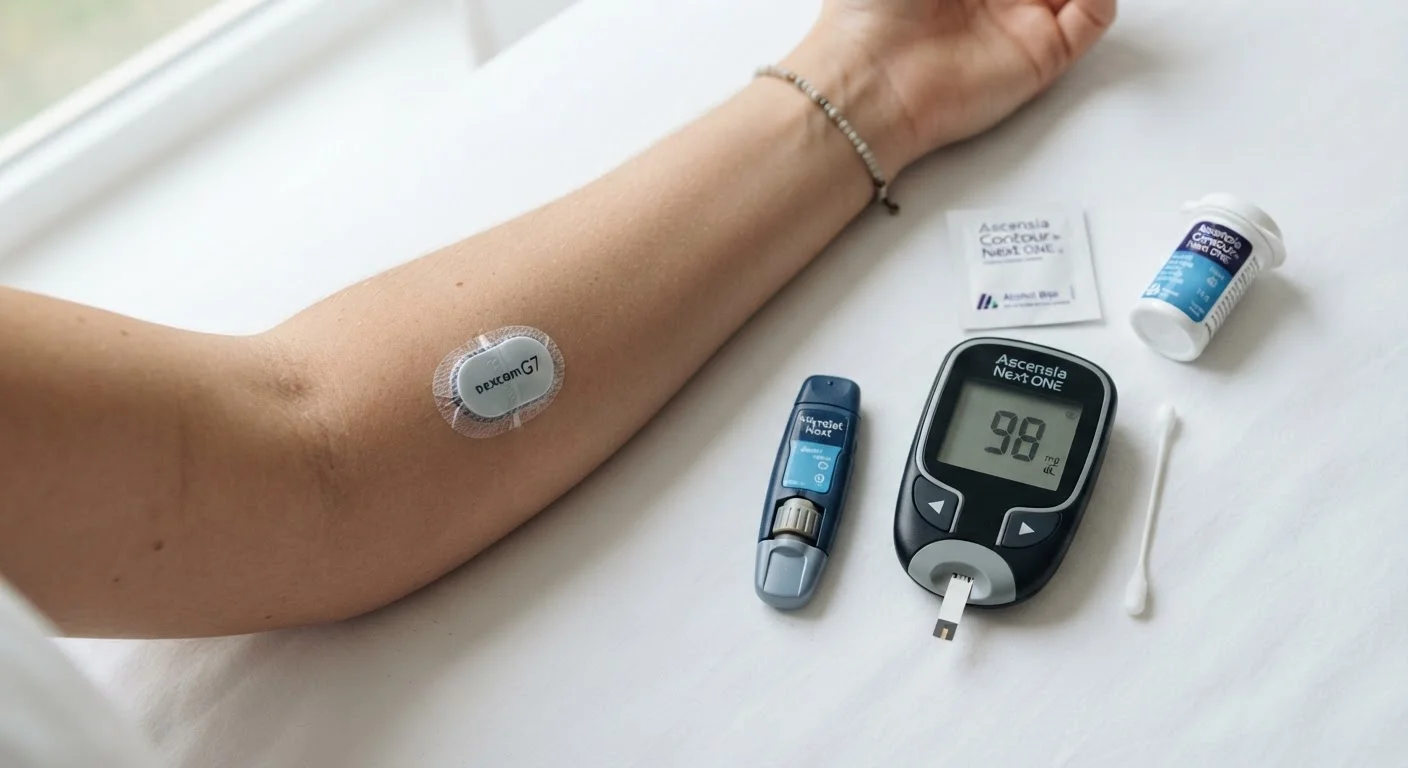
A continuous glucose monitor (CGM) works differently. A tiny sensor is inserted just beneath the skin, typically on the upper arm or abdomen. Rather than measuring blood glucose directly, the sensor measures glucose in the interstitial fluid (the fluid surrounding cells in tissue). An algorithm then converts that interstitial reading into an estimated blood glucose value, which is transmitted wirelessly to a receiver or smartphone every one to five minutes.
Because interstitial glucose lags behind blood glucose by roughly five to fifteen minutes, a CGM reading and a simultaneous finger-prick reading are measuring related but not identical things. This lag matters most when glucose is changing rapidly, such as during or shortly after exercise or a meal. For a deeper look at what happens to blood glucose between meals, see how your body regulates blood sugar between meals.
What finger-prick testing reveals
A finger-prick reading answers a specific, immediate question: what is my blood glucose right now? That precision is useful in defined situations. Someone taking mealtime insulin needs to know their pre-meal glucose before calculating a dose. A person experiencing symptoms of hypoglycemia (low blood sugar) needs a confirmed number quickly. In both cases, the fingertip reading is direct and accurate, typically within plus or minus 15 percent of a laboratory venous blood draw under FDA standards for home meters.
The limitation is coverage. A reading taken at 7 a.m. before breakfast says nothing about what happened at 2 a.m., or how high glucose climbed at 90 minutes after dinner. Building a picture from finger-prick readings alone requires disciplined testing at multiple time points throughout the day, which most people do not sustain consistently.
Meters also require consumables: test strips and lancets that carry ongoing costs. Strip accuracy can degrade if stored outside recommended temperature ranges, and coding errors or insufficient blood volume on the strip are common sources of inaccurate readings. Understanding what those numbers mean in context is equally important. A reference guide to blood sugar ranges and what they signal explains fasting, postprandial, and target values used in clinical practice.
What a CGM reveals that a meter cannot
The defining advantage of a CGM is the data it generates over time. Rather than isolated snapshots, a CGM produces a continuous glucose curve. Clinicians and patients can identify time-in-range (the percentage of readings within a target glucose band), glucose variability, nocturnal hypoglycemia, and the shape and duration of post-meal glucose responses.
These metrics change clinical decision-making in ways a finger-prick log cannot. A person who checks fasting glucose daily and sees consistent normal-range readings may have significant glucose spikes after meals that go completely undetected. Conversely, someone whose A1C looks acceptable could have frequent low-glucose episodes overnight. Both patterns carry health implications that aggregate metrics can obscure.
| Finger-prick meter | Continuous glucose monitor (CGM) | |
|---|---|---|
| What it measures | Blood glucose at one moment | Interstitial glucose every 1-5 minutes |
| Data output | Single mg/dL value | Continuous glucose trend curve |
| Detects overnight lows | Only if tested then | Yes, with alerts available |
| Post-meal spike visibility | Only if tested at correct intervals | Full curve captured automatically |
| Accuracy vs. lab reference | Within ~15% (FDA standard) | Within ~9-10% MARD (current models) |
| Typical cost (ongoing) | Lower; strips and lancets | Higher; sensor replacement every 7-14 days |
| Prescription required (US) | No | Yes for most models |
| Skin wear or insertion | Fingertip only, no sensor | Subcutaneous sensor worn continuously |
The breadth of CGM data also means that what food does to your glucose is more visible. For context on how different foods drive different glucose responses, glycemic index vs. glycemic load explains why the same carbohydrate quantity can produce very different blood sugar curves depending on food type and preparation.
Accuracy, access, and practical limitations
CGMs are accurate enough for most clinical decisions, but they are not as precise as a simultaneous finger-prick reading. Most current-generation CGMs carry a mean absolute relative difference (MARD) of around 9 to 10 percent compared to reference blood glucose, which is clinically acceptable for trend monitoring and insulin dosing guidance in many contexts. Some devices still require occasional finger-prick calibration. During rapid glucose changes, the interstitial lag can cause the CGM to display a value that trails reality, which is relevant for anyone adjusting insulin in real time.
Access is a practical barrier. CGMs carry a higher upfront and ongoing cost than a basic meter and test strips. Insurance coverage in the US varies considerably by insurer, plan type, and diagnosis. People without insulin-dependent diabetes may find coverage limited or unavailable. Sensor adhesion, skin reactions, and sensor failures are also reported by a portion of users.
Finger-prick meters, by contrast, are available without a prescription, cost little to purchase, and use widely available strips. For people who check infrequently, the total cost is lower. The data generated is less, but it is direct and immediately actionable.
Neither technology replaces HbA1c testing. HbA1c reflects average glucose exposure over approximately three months and is still the primary long-term marker used in diabetes diagnosis and management. For a broader view of how blood glucose connects to other metabolic markers, metabolic health and blood sugar situates glucose monitoring within a wider set of cardiovascular and metabolic measures.
This article is for general informational purposes only and is not medical advice. Speak with a qualified healthcare provider before making changes to your glucose monitoring approach or diabetes management plan.