
Your Cholesterol Panel Decoded: A Plain-Language Guide to Lab Results

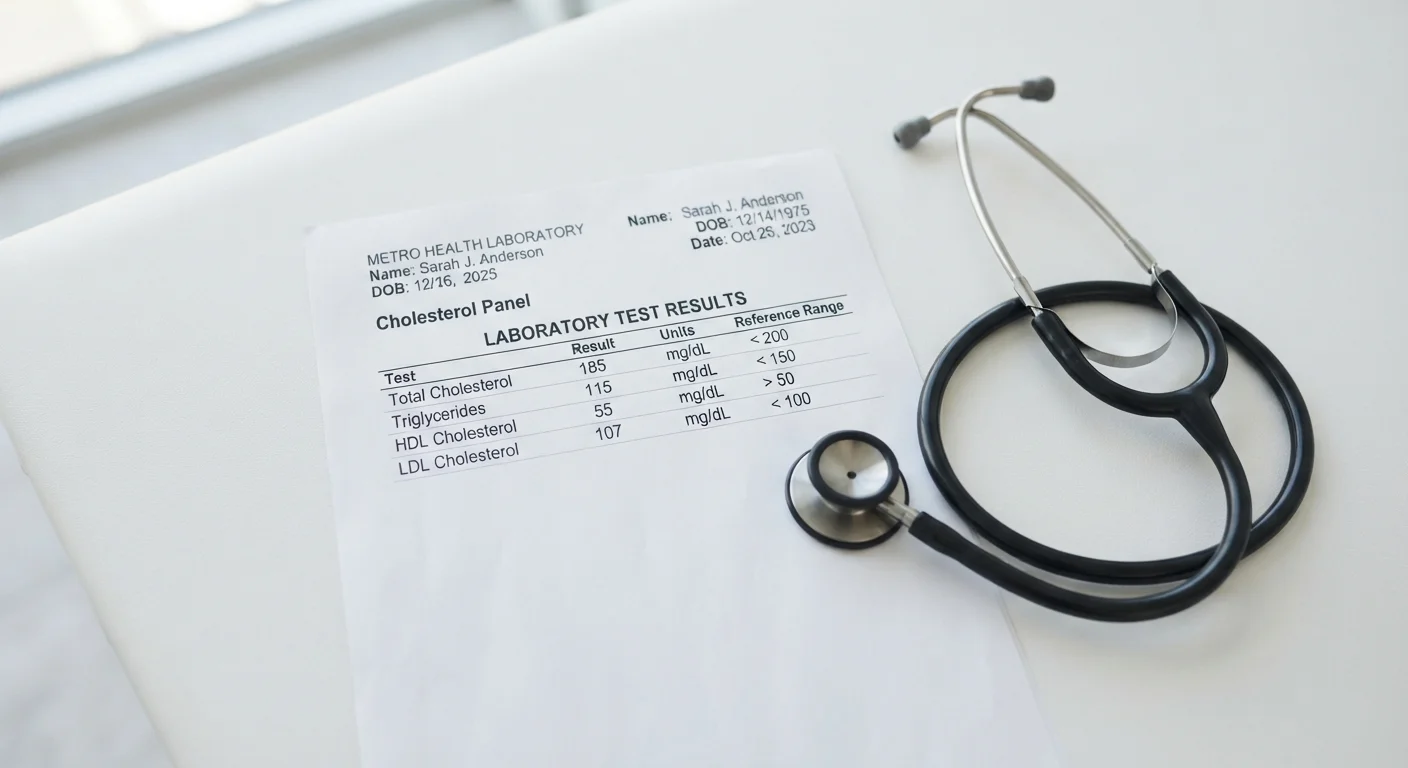
| Desirable total cholesterol | Below 200 mg/dL (American Heart Association guidelines) |
| Optimal LDL cholesterol | Below 100 mg/dL (ACC/AHA guidelines; lower targets apply for high-risk individuals) |
| Protective HDL threshold (general) | 60 mg/dL or above (American Heart Association) |
| Normal fasting triglycerides | Below 150 mg/dL (National Institutes of Health, National Heart, Lung, and Blood Institute) |
| Fasting required before test | 9-12 hours (for triglycerides; some panels do not require fasting) |
| How often adults should test | Every 4-6 years for average-risk adults; more often if risk factors are present (U.S. Preventive Services Task Force) |
What a cholesterol panel actually measures
A lipid panel, sometimes called a lipid profile, is a blood test that measures the fats and fat-like substances circulating in your bloodstream. It does not measure a single thing called "cholesterol" but rather four separate values, each with its own biological role and risk implication. Understanding what each value represents is the first step toward reading your results without confusion or alarm.
| Desirable total cholesterol | Below 200 mg/dL (American Heart Association guidelines) |
| Optimal LDL cholesterol | Below 100 mg/dL (ACC/AHA guidelines; lower targets apply for high-risk individuals) |
| Protective HDL threshold (general) | 60 mg/dL or above (American Heart Association) |
| Normal fasting triglycerides | Below 150 mg/dL (National Institutes of Health, National Heart, Lung, and Blood Institute) |
| Fasting required before test | 9-12 hours (for triglycerides; some panels do not require fasting) |
| How often adults should test | Every 4-6 years for average-risk adults; more often if risk factors are present (U.S. Preventive Services Task Force) |
Cholesterol itself is a waxy molecule produced mainly by the liver. It is essential for building cell membranes, producing certain hormones, and synthesizing vitamin D. Because fat and water do not mix, cholesterol cannot travel through blood on its own. It rides inside protein-wrapped particles called lipoproteins, and the type of lipoprotein carrying the cholesterol determines whether the result appears under HDL, LDL, or VLDL on your report.
For a deeper look at how triglycerides sit alongside cholesterol on the same panel, see our guide to triglycerides and cholesterol.
The four core values explained
Total cholesterol is the sum of all cholesterol carried by every lipoprotein particle in the sample. A high total figure draws attention, but it can be elevated because HDL (protective cholesterol) is high, not because LDL (often called harmful cholesterol) is high. This is why clinicians rarely act on total cholesterol alone.
LDL cholesterol (low-density lipoprotein) is the value most associated with atherosclerosis, the process in which fatty deposits accumulate inside artery walls. When LDL particles are present in excess, they can lodge in artery walls and trigger inflammation. Most cardiovascular guidelines focus LDL reduction as the main treatment target.
HDL cholesterol (high-density lipoprotein) carries cholesterol away from artery walls and back to the liver for disposal. Higher HDL values are generally associated with lower cardiovascular risk, though research has shown that artificially raising HDL through certain drugs does not always translate to fewer heart events, so HDL is better understood as a marker than a standalone target.
Triglycerides are not a form of cholesterol but appear on every lipid panel because they share the same circulation pathway. They are the storage form of dietary fat and excess calories. Elevated triglycerides in combination with low HDL is a pattern frequently seen in metabolic syndrome and insulin resistance. For more detail, the article on triglycerides and overlapping cardiovascular risks breaks down how these two fats interact.
Lipoprotein
A particle made of fat and protein that carries cholesterol and triglycerides through the bloodstream. Different types, such as LDL and HDL, have distinct structures and cardiovascular effects.
LDL (low-density lipoprotein)
The lipoprotein that carries cholesterol from the liver to tissues throughout the body. Excess LDL in circulation is associated with plaque buildup in artery walls and increased cardiovascular risk.
HDL (high-density lipoprotein)
A lipoprotein that transports cholesterol from tissues and artery walls back to the liver for processing. Higher HDL levels are generally associated with lower cardiovascular risk.
Triglycerides
The main form in which the body stores fat, derived from dietary fat and excess calories. Elevated fasting triglycerides on a lipid panel are associated with metabolic and cardiovascular risk.
Atherosclerosis
A condition in which cholesterol-rich plaques accumulate inside artery walls, narrowing them over time and reducing blood flow. It is the underlying process in most heart attacks and strokes.
Lipid panel
A blood test that measures total cholesterol, LDL, HDL, and triglycerides, providing a snapshot of circulating blood fats used to assess cardiovascular risk.
Why context determines what your numbers mean
Reference ranges printed on lab reports are population averages. A total cholesterol of 210 mg/dL carries very different clinical weight depending on whether that person smokes, has diabetes, has a family history of early heart disease, or has already experienced a cardiac event. Clinicians use validated risk calculators, such as the American College of Cardiology Pooled Cohort Equations, to estimate 10-year cardiovascular event probability before deciding whether a number warrants intervention.
Age, sex, blood pressure, smoking status, and existing conditions all feed into that estimate alongside your lipid values. A 35-year-old with borderline LDL and no other risk factors is in a different situation than a 60-year-old with hypertension and the same LDL number.
The article on interpreting a lipid panel covers ratios and particle size, which are additional dimensions your clinician may consider beyond these four standard values. And if you received a borderline result, reading your cholesterol results without jumping to conclusions explains why one measurement rarely settles the question.
Diet also plays a role, though the relationship between food and blood lipids is more specific than most people assume. The research on diet and cholesterol levels separates well-established findings from common misconceptions.
This article is for informational purposes only and is not medical advice. Always consult a qualified healthcare professional about your individual lab results, cardiovascular risk, or any decision to change a treatment plan.