
Interpreting a Lipid Panel: Numbers That Matter and Numbers That Need Context

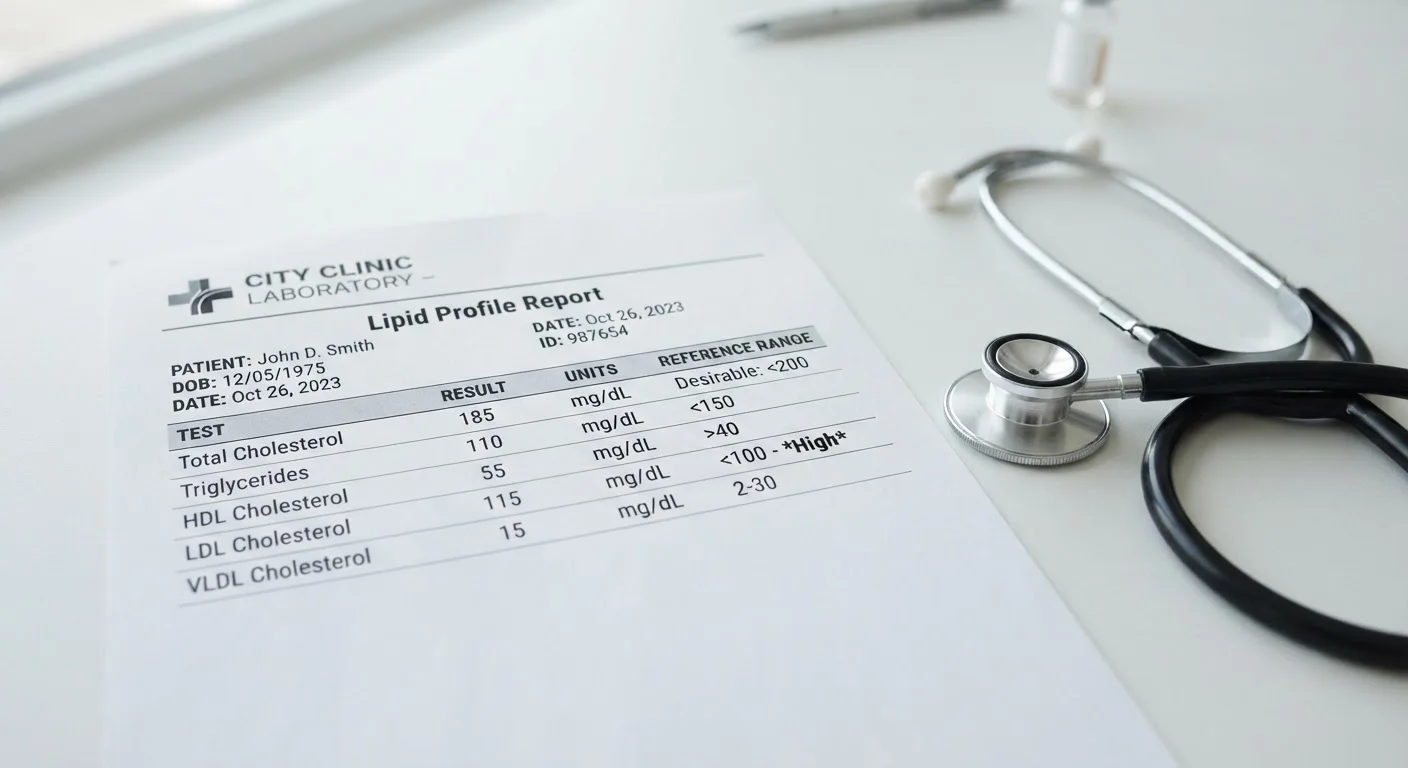
| Optimal LDL for most adults | Below 100 mg/dL (American College of Cardiology / American Heart Association guidelines) |
| Low HDL threshold (men) | Below 40 mg/dL (American Heart Association reference ranges) |
| Low HDL threshold (women) | Below 50 mg/dL (American Heart Association reference ranges) |
| Normal fasting triglycerides | Below 150 mg/dL (American Heart Association / National Cholesterol Education Program) |
| Favorable total cholesterol-to-HDL ratio | Below 3.5 (General clinical reference; individual targets vary) |
| Fasting requirement for standard panel | Typically 9 to 12 hours (Standard pre-test protocol; confirm with your clinician) |
What a lipid panel actually measures
A lipid panel is a blood test that quantifies the major fat-like molecules circulating in your bloodstream. The standard report includes total cholesterol, low-density lipoprotein (LDL) cholesterol, high-density lipoprotein (HDL) cholesterol, and triglycerides. Some extended panels also report non-HDL cholesterol and certain lipoprotein fractions.
Each figure is measured in milligrams per deciliter (mg/dL) and reflects a snapshot taken at the time of the blood draw. That snapshot is shaped by recent meals, physical activity, hydration, and even acute illness, which is why most clinicians request a fasting sample and interpret results alongside a full clinical picture.
For a plain-language walkthrough of each individual marker, see your cholesterol panel decoded.
LDL cholesterol
Low-density lipoprotein cholesterol, often called 'bad' cholesterol because LDL particles transport cholesterol into arterial walls where it can accumulate. Elevated LDL is a well-established risk factor for cardiovascular disease.
HDL cholesterol
High-density lipoprotein cholesterol, associated with a protective effect because HDL particles carry cholesterol from arterial tissue back to the liver for processing. Higher HDL levels are generally favorable.
Triglycerides
A type of fat stored in the body and circulated in the blood. High fasting triglycerides are linked to increased cardiovascular risk and, at very high levels, to pancreatitis.
Non-HDL cholesterol
Total cholesterol minus HDL cholesterol. This figure captures all lipoprotein types that can deposit cholesterol in arterial walls, including LDL, VLDL, and IDL.
Apolipoprotein B (apoB)
A protein found on every atherogenic lipoprotein particle. Measuring apoB gives an approximate count of artery-damaging particles, which may differ from the LDL-cholesterol concentration.
Lipoprotein(a) [Lp(a)]
A genetically determined lipoprotein not included in standard lipid panels. Elevated Lp(a) is an independent cardiovascular risk factor, particularly relevant for people with a family history of early heart disease.
Numbers with established reference ranges
Some lipid panel values carry well-studied reference thresholds supported by decades of cardiovascular outcome data.
LDL cholesterol is the figure clinicians watch most closely because LDL particles deposit cholesterol in arterial walls. General population targets differ by individual risk, but clinical guidelines from the American College of Cardiology and the American Heart Association typically classify an LDL below 100 mg/dL as optimal for most adults, with lower targets for people who have established cardiovascular disease.
HDL cholesterol runs in the opposite direction: higher is generally better. HDL carries cholesterol away from arterial tissue toward the liver for processing. Values below 40 mg/dL in men or below 50 mg/dL in women are associated with increased cardiovascular risk.
Triglycerides are a separate class of blood fat. A fasting level below 150 mg/dL is considered normal; levels above 500 mg/dL carry a risk of pancreatitis in addition to cardiovascular concerns. The relationship between triglycerides and cholesterol is explored further in triglycerides and cholesterol: two distinct blood fats with overlapping risks.
| Optimal LDL for most adults | Below 100 mg/dL (American College of Cardiology / American Heart Association guidelines) |
| Low HDL threshold (men) | Below 40 mg/dL (American Heart Association reference ranges) |
| Low HDL threshold (women) | Below 50 mg/dL (American Heart Association reference ranges) |
| Normal fasting triglycerides | Below 150 mg/dL (American Heart Association / National Cholesterol Education Program) |
| Favorable total cholesterol-to-HDL ratio | Below 3.5 (General clinical reference; individual targets vary) |
| Fasting requirement for standard panel | Typically 9 to 12 hours (Standard pre-test protocol; confirm with your clinician) |
Numbers that need context before they mean anything
Total cholesterol is the figure most people remember from a routine check, yet it is the least informative number on the panel when read in isolation. A total cholesterol of 220 mg/dL in someone with high HDL and low triglycerides carries a very different risk profile than the same number in someone with low HDL and elevated LDL.
The total cholesterol-to-HDL ratio (total cholesterol divided by HDL) is one way clinicians condense that complexity into a single figure. A ratio below 3.5 is generally considered favorable; above 5.0 signals a pattern worth addressing. However, no ratio replaces an individualized assessment.
Non-HDL cholesterol (total cholesterol minus HDL) captures all atherogenic, or artery-damaging, lipoproteins in one number, including LDL, very low-density lipoprotein (VLDL), and intermediate-density lipoprotein (IDL). Because it does not require a fasting sample to remain accurate, some guidelines now favor it over LDL alone as a primary target.
How diet contributes to these patterns is covered in the role of diet in cholesterol levels.
Advanced markers sometimes ordered beyond a standard panel
When a standard panel leaves a clinician uncertain about true risk, additional tests may follow.
Apolipoprotein B (apoB) counts the number of atherogenic lipoprotein particles directly, since each LDL, VLDL, and IDL particle carries exactly one apoB molecule. Particle count can diverge from LDL-cholesterol concentration: two people with identical LDL-C values may have very different particle burdens. Elevated apoB is associated with higher cardiovascular risk independent of the standard LDL figure.
Lipoprotein(a), or Lp(a), is a genetically determined lipoprotein that standard panels do not measure. High Lp(a) is an independent risk factor for atherosclerosis and may warrant additional clinical attention, particularly in people with a family history of early heart disease.
LDL particle size is sometimes discussed in relation to risk. Smaller, denser LDL particles may penetrate arterial walls more readily than larger particles. However, apoB measurement captures much of the relevant information without requiring a separate particle size assay.
Cholesterol is only one input into overall cardiovascular risk. Blood pressure, inflammation, glucose metabolism, and lifestyle factors all contribute to the picture described in understanding cardiovascular health: how cholesterol fits the bigger picture.
This article is for informational purposes only and is not medical advice. Consult a qualified healthcare professional before making any decisions about your health, lab results, or treatment.