

Key Takeaways
Our Verdict
Neither complete rest nor active recovery is universally superior. Acute or structurally serious injuries require initial rest to protect damaged tissue, while most foot conditions benefit from a controlled return to movement once acute inflammation subsides. The decision depends on injury severity, tissue involvement, and individual symptom response.
| Best for | Recommended |
|---|---|
| Severe acute injuries with significant swelling or suspected fracture | Complete rest |
| Plantar fasciitis, tendinopathy, or mild soft-tissue strain after the acute phase | Active recovery |
| Readers unsure of their injury type or experiencing worsening symptoms | Complete rest with prompt professional evaluation |
What sets these two approaches apart
Complete rest means removing load from the injured foot entirely, which may involve non-weight-bearing with crutches, offloading with a boot, or simply avoiding activities that compress or stress the affected structures. Active recovery, by contrast, uses low-intensity, purposeful movement to support the healing process without overloading damaged tissue.
The distinction matters because tissue healing is not a passive event. Tendons, fascia, and cartilage respond to mechanical signals. Some degree of controlled loading, once the acute phase passes, can improve collagen organization and restore tissue tolerance. Complete immobilization beyond the initial window can lead to stiffness, atrophy, and delayed return to function.
That said, movement applied too early or too aggressively to an injury that needs structural rest can extend recovery or cause re-injury. The two approaches are not competing philosophies; they map onto different phases and injury types. For a broader look at how these principles apply across the body, see active recovery vs. passive rest.
When complete rest is the right call
Certain clinical scenarios require that the foot bear no weight and that movement be kept to a minimum. These include suspected or confirmed stress fractures, acute ligament tears, significant joint trauma, and any injury producing severe pain with even partial weight-bearing. In these cases, early loading can disrupt tissue repair and delay bone or ligament consolidation.
The standard initial window for rest after an acute soft-tissue injury is roughly 48 to 72 hours, a period during which swelling, warmth, and sharp pain are most pronounced. During this phase, standard RICE principles (rest, ice, compression, elevation) help manage inflammation and protect the site. However, RICE is a management strategy, not a diagnosis. Any injury that causes significant structural concern, persists beyond a few days, or worsens despite rest needs professional assessment.
Do not self-diagnose before choosing an approach
Pain location and intensity alone cannot confirm whether a foot injury involves bone, tendon, ligament, or fascia. A stress fracture can feel similar to plantar fasciitis in early stages. Starting active recovery on an undiagnosed fracture can delay healing significantly. If you are uncertain about your diagnosis, seek evaluation from a physical therapist or orthopedic clinician before deciding which approach to follow.
Complete rest should not become prolonged immobilization by default. Research in musculoskeletal rehabilitation consistently shows that extended inactivity slows functional recovery for most soft-tissue injuries. If symptoms have not meaningfully improved after several days of rest, consult a physical therapist or orthopedic specialist rather than continuing to wait.
When active recovery supports healing
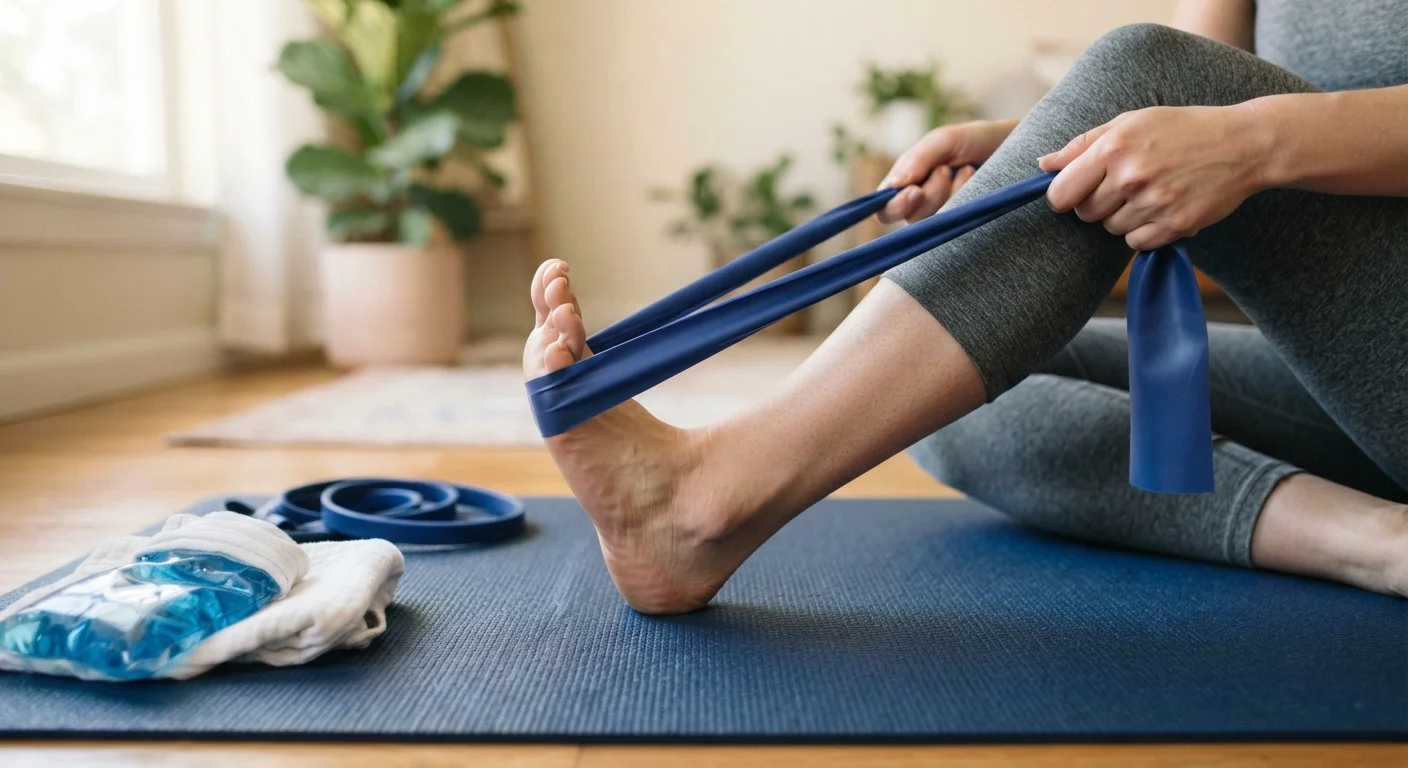
Once acute inflammation has subsided and the foot can tolerate gentle load, controlled movement is usually beneficial. Active recovery for foot injuries commonly involves range-of-motion exercises for the ankle and toes, non-weight-bearing strengthening (such as seated calf raises or towel scrunches), aquatic exercise, and progressive return to standing or walking on even surfaces.
Plantar fasciitis is a well-studied example. Physical therapy programs that include intrinsic foot muscle strengthening, plantar fascia stretching, and gradual load progression have shown better long-term outcomes than rest alone. Achilles tendinopathy similarly responds to eccentric loading protocols once the acute phase resolves. The goal is to apply enough stimulus to prompt tissue adaptation without exceeding the structure's current tolerance.
Pain behavior guides this process. A mild, temporary increase in discomfort during or after exercise that resolves within 24 hours is generally considered acceptable in rehabilitation. Pain that intensifies during activity, spikes acutely, or lingers well into the following day signals that the load is too high. For movement strategies with more detail on progressive foot rehabilitation, see movement strategies for long-term foot recovery.
Making the transition from rest to movement
The shift from complete rest to active recovery is rarely a single moment. Most clinicians use a stepwise approach: non-weight-bearing exercise first, then partial weight-bearing with support, then full weight-bearing on flat surfaces, then gradual reintroduction of varied terrain and higher-demand activities.
Footwear and orthotics can be part of this transition. Supportive shoes or temporary orthotic inserts reduce stress on healing structures while allowing the foot to tolerate upright activity earlier than it otherwise might. These are practical tools, not permanent solutions, and their appropriateness varies by injury type.
Adjunct approaches such as heat and cold can complement both phases. Cold therapy helps manage acute swelling; controlled heat in the sub-acute and chronic phases can improve tissue extensibility before exercise. The comparison of cold and heat therapy outlines how these modalities differ physiologically and when each is appropriate.
General recovery principles, including sleep quality and nutrition, also affect tissue repair. The Mobility and Recovery hub covers a range of supporting habits that apply during foot injury rehabilitation.
This article is for informational purposes only and is not a substitute for professional medical advice, diagnosis, or treatment. Always consult a qualified healthcare provider before beginning any rehabilitation program or making changes to how you manage a foot injury.