

Key Takeaways
Sciatic nerve pain
Sciatic nerve pain, often called sciatica, is discomfort that originates when the sciatic nerve is compressed, irritated, or inflamed somewhere along its path. The pain typically travels from the lower back through the buttock and into one leg, sometimes reaching the foot. It is a symptom, not a diagnosis in itself: something is placing mechanical or chemical pressure on the nerve.
Clinically, sciatica refers to radiculopathy of the L4 to S3 nerve roots, which together form the sciatic nerve. The character and location of symptoms often reflect which root level is affected.
The anatomy behind the pain
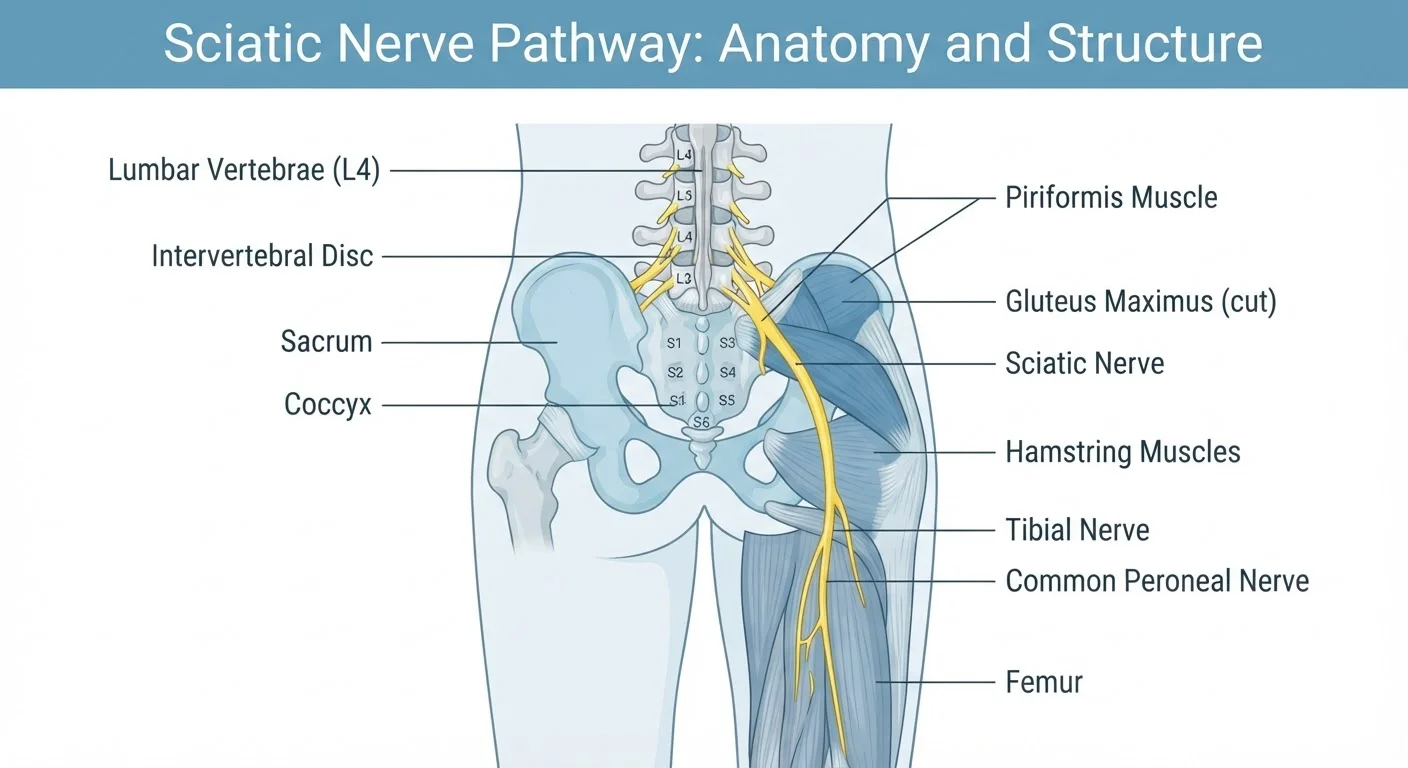
The sciatic nerve is the largest peripheral nerve in the human body. It forms from five nerve roots that exit the lower lumbar spine (L4 and L5) and upper sacrum (S1, S2, and S3), converge in the pelvis, and travel as a single cord about the width of a thumb through the buttock and down the back of the thigh. Near the knee, it branches into the tibial nerve and the common fibular (peroneal) nerve, which continue into the calf, ankle, and foot.
Because the nerve spans such a long distance and passes through narrow anatomical corridors, it has many potential points of vulnerability. Any structure that presses on or chemically irritates the nerve or its roots can set off symptoms far from the actual problem site. That is why a compressed nerve root in the lumbar spine can produce burning pain in the calf, or why buttock tightness can send tingling into the toes.
If you are new to this diagnosis, the introductory guide to sciatica covers what to expect in the early stages and where to begin.
What actually irritates the sciatic nerve
Compression is the most discussed mechanism. A herniated lumbar disc, where the inner gel-like nucleus pushes through the outer ring and contacts an adjacent nerve root, is the most common structural cause in adults under 50. Degenerative changes such as bone spurs or narrowing of the spinal canal (stenosis) become more common with age and can produce similar pressure.
Mechanical compression, however, is not the whole picture. Research in spinal pain has shown that inflammatory proteins released from damaged disc tissue can directly sensitize nearby nerve roots, generating pain signals even when there is no physical contact. This explains why symptoms can be intense even when imaging shows only mild disc changes, and why they can improve quickly when inflammation settles.
Outside the spine, the piriformis muscle in the deep buttock can tighten and press on the sciatic nerve as it passes through or near that muscle. This specific pattern, sometimes called piriformis syndrome, produces buttock-centered pain rather than back pain, with radiation into the leg. The full range of causes and risk factors that lead to sciatic nerve irritation goes broader than these two examples.
Imaging does not always match symptoms
MRI and CT scans can show disc bulges, bone spurs, or other structural changes in people with no pain at all, and can show relatively mild changes in people with severe symptoms. This mismatch is well-documented in spinal research. A scan result should always be interpreted alongside clinical symptoms and history by a qualified provider, not in isolation.
How the nerve translates pressure into symptoms
Peripheral nerves carry two types of signals: sensory (information from the body to the brain) and motor (commands from the brain to muscles). The sciatic nerve carries both. When it is compressed or inflamed, both pathways can be disrupted.
Disrupted sensory signals produce the most recognizable symptoms: pain, burning, electric-shock sensations, numbness, and tingling. The exact location of these sensations follows a predictable map called a dermatome, which reflects which nerve root is most affected. Pain tracking along the outer calf and top of the foot often points to L5 involvement, while pain running down the back of the calf and into the heel more often reflects S1 involvement.
When motor fibers are affected, muscle weakness can develop. Difficulty lifting the front of the foot (foot drop), reduced calf strength, or trouble with balance can accompany the pain in more significant compressions. These motor symptoms are a signal to seek evaluation promptly.
Why posture, movement, and load matter
The spine is not a static structure. Lumbar discs change shape under load, and the spaces through which nerve roots exit narrow or widen depending on body position. Prolonged sitting compresses lumbar discs and reduces the height of the intervertebral foramina (the openings where nerve roots exit). Bending forward under load places the posterior disc under particularly high stress.
These mechanics explain why certain positions or movements reliably worsen symptoms for many people. Sitting for long periods, bending forward, or coughing and sneezing can spike pain by momentarily increasing pressure on an already irritated root. Understanding this relationship is practically useful: it informs why movement strategies and postural adjustments are a first-line part of conservative management.
Daily habits carry more influence than many people realize. The connection between lifestyle factors and sciatica covers how body weight, sedentary time, and occupational demands interact with nerve irritation over time.
When to treat this as an emergency
The vast majority of sciatica episodes are painful but not dangerous. A small number of presentations, however, require immediate medical care. Cauda equina syndrome occurs when nerve roots in the lower spinal canal are severely compressed, and it can cause loss of bladder or bowel control, numbness across the inner thighs and groin, and rapidly worsening leg weakness. These signs constitute a medical emergency.
Outside that scenario, symptoms that worsen progressively despite conservative management, or that begin after significant trauma, also warrant prompt evaluation. A healthcare provider can determine whether imaging or other investigation is needed and rule out less common causes such as spinal tumors or infection.
Being aware of which habits can unintentionally aggravate sciatic pain helps during recovery. The common aggravating habits people overlook is a practical reference for that.
This article is for informational purposes only and is not medical advice. Always consult a qualified healthcare professional for any personal health concerns, diagnosis, or treatment decisions.