
Why Sciatica Feels Different for Everyone: Causes, Triggers, and Risk Factors Explained

Key Takeaways
Sciatica causes and risk factors
Sciatica is not a diagnosis in itself but a symptom pattern produced when something compresses or irritates the sciatic nerve or the spinal nerve roots that form it. The underlying cause can be a structural problem in the lumbar spine, a muscle pressing on the nerve, or changes in surrounding tissues. Because the cause varies from person to person, the pain, its location, and its triggers vary too.
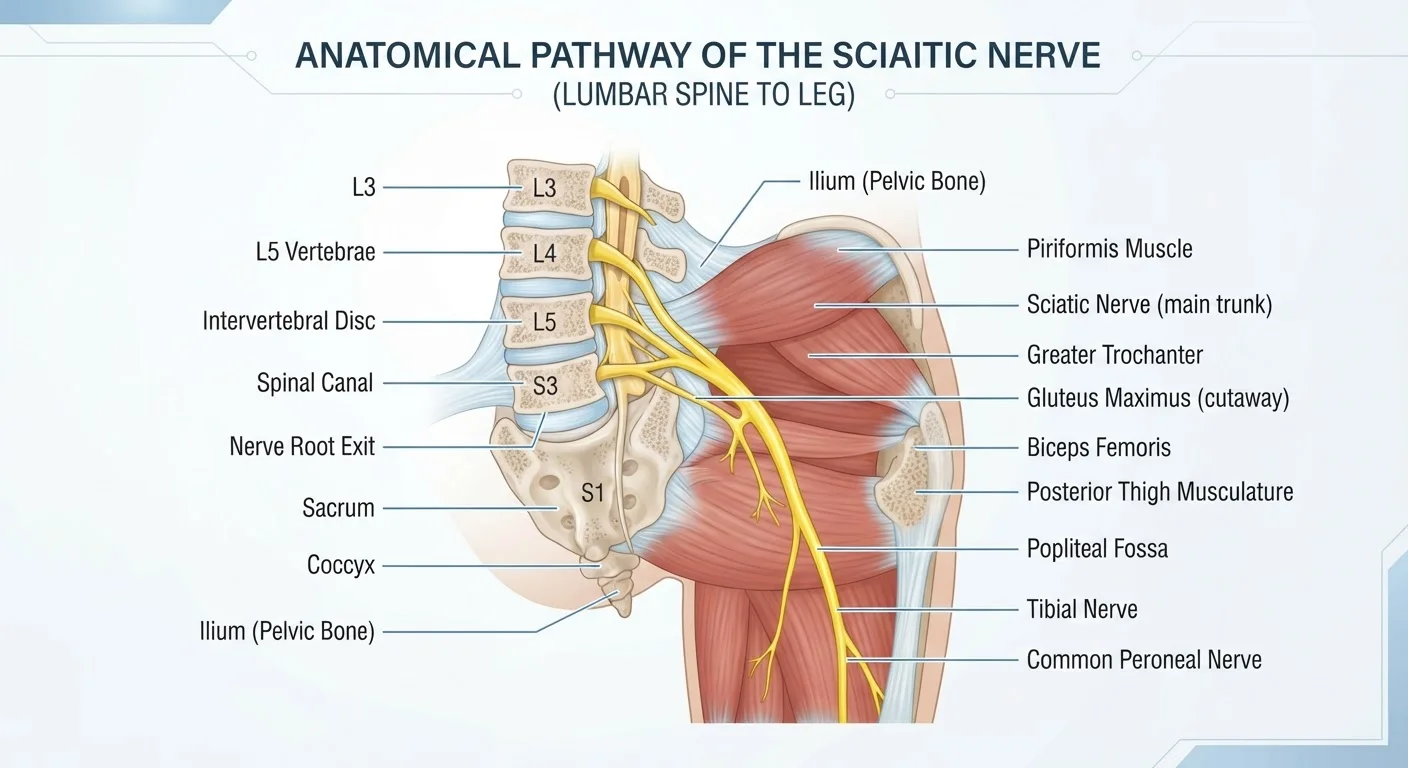
The sciatic nerve forms from the L4 through S3 nerve roots; which root is affected determines which part of the leg experiences symptoms, which is why clinicians classify sciatica by dermatomal distribution.
Why the same nerve produces so many different experiences
Two people can both have sciatica and describe entirely different experiences. One has a sharp, burning streak from the lower back to the calf; another has a dull ache in the buttock with occasional foot tingling. Both descriptions are accurate because the sciatic nerve is the longest in the body, and what compresses it, where that compression occurs, and which nerve root is involved all change the symptom picture. Understanding how the sciatic nerve works is a useful starting point for making sense of those differences.
The nerve itself forms from five lumbar and sacral nerve roots (L4, L5, S1, S2, S3). Irritation at L4 tends to produce pain along the inner calf and weakness with ankle flexion. Irritation at L5 commonly causes pain and numbness along the outer shin and top of the foot. S1 involvement often produces symptoms along the sole and heel, with reduced ankle reflex. This is why clinicians describe sciatica by which root is affected, not simply by where the pain appears.
Structural causes rooted in the lumbar spine
A herniated lumbar disc is the cause identified in the majority of sciatica cases. The intervertebral disc has a tough outer layer (the annulus fibrosus) and a gel-like center (the nucleus pulposus). When the outer layer weakens, the inner material can bulge or rupture toward the spinal canal, pressing on a nearby nerve root. The L4-L5 and L5-S1 levels are the most commonly affected.
Spinal stenosis is a narrowing of the canal through which spinal nerves travel. It occurs most often from age-related thickening of ligaments and bone spurs on the facet joints. Unlike disc-related sciatica, which tends to worsen with bending forward, stenosis-related symptoms often improve when a person leans forward and worsen when standing or walking. This pattern is sometimes called neurogenic claudication.
Spondylolisthesis occurs when one vertebra slips forward over the one below it, narrowing the opening through which nerve roots exit. It can be degenerative (from joint wear) or structural (from a stress fracture in the vertebra). Either type can produce persistent nerve root irritation without any disc herniation.
Getting the cause right matters for treatment
Piriformis syndrome and lumbar disc herniation can produce similar leg pain, but they respond to different interventions. Manual therapy targeting the piriformis muscle may help one and do little for the other. A clinician who performs a physical examination, rather than relying on imaging alone, is better positioned to identify which structure is involved. Bring a detailed account of when symptoms started, what positions worsen or ease them, and whether any weakness is present.
Non-spinal causes: when the problem is outside the spine
Piriformis syndrome is the most discussed non-spinal cause of sciatic symptoms. The piriformis is a small muscle deep in the buttock that runs close to, or in some individuals directly through, the sciatic nerve. When that muscle is chronically tight or inflamed from overuse, direct trauma, or prolonged sitting on hard surfaces, it can compress the nerve and produce buttock and leg pain that mirrors disc-related sciatica.
Distinguishing piriformis syndrome from spinal causes matters because the treatment approach differs. Imaging of the lumbar spine is often unremarkable in these cases. Clinicians typically use specific physical tests that reproduce symptoms by stretching or contracting the piriformis to support the diagnosis. Recognising the symptom patterns specific to each cause helps guide appropriate evaluation.
Risk factors that increase vulnerability
Several factors are consistently associated with higher rates of sciatica in the research literature, though no single factor guarantees the condition will develop.
5-10%
Lifetime prevalence of sciatica in adults
Population-based studies published in spine medicine journals estimate that between 5 and 10 percent of adults will experience sciatica at some point, with incidence highest between ages 40 and 60.
~90%
Cases attributed to lumbar disc herniation
Clinical epidemiology data consistently identify disc herniation as the underlying cause in approximately 90 percent of confirmed sciatica diagnoses, according to reviews published in pain and neurology literature.
- Age: Disc dehydration and facet joint degeneration accumulate over decades, with incidence peaking between ages 40 and 60.
- Prolonged sitting and sedentary work: Sustained lumbar flexion increases intradiscal pressure and can accelerate disc wear over time.
- Occupational whole-body vibration: Operating heavy machinery or driving for long hours transmits repetitive stress to lumbar discs and is associated with higher rates of disc herniation.
- Excess body weight: Additional load on lumbar structures increases mechanical stress on discs and facet joints.
- Weak or poorly conditioned trunk muscles: The muscles of the abdomen, back, and pelvis support lumbar spine stability. When those muscles are deconditioned, discs and ligaments bear more load.
Genetics also appears to influence disc health; disc degeneration has a heritable component. This means some people develop disc-related sciatica without obvious lifestyle risk factors.
For practical guidance on movement habits that reduce physical discomfort, a structured approach to conditioning is more useful than simply avoiding activity. It is also worth knowing which common habits can aggravate sciatic nerve pain, since some well-meant responses to flare-ups can slow recovery.
This article is for informational purposes only and is not medical advice. If you are experiencing sciatica symptoms, consult a qualified healthcare professional for an accurate diagnosis and appropriate treatment plan.