
Sciatica Symptom Patterns: When Leg Pain, Numbness, and Tingling Point to the Sciatic Nerve

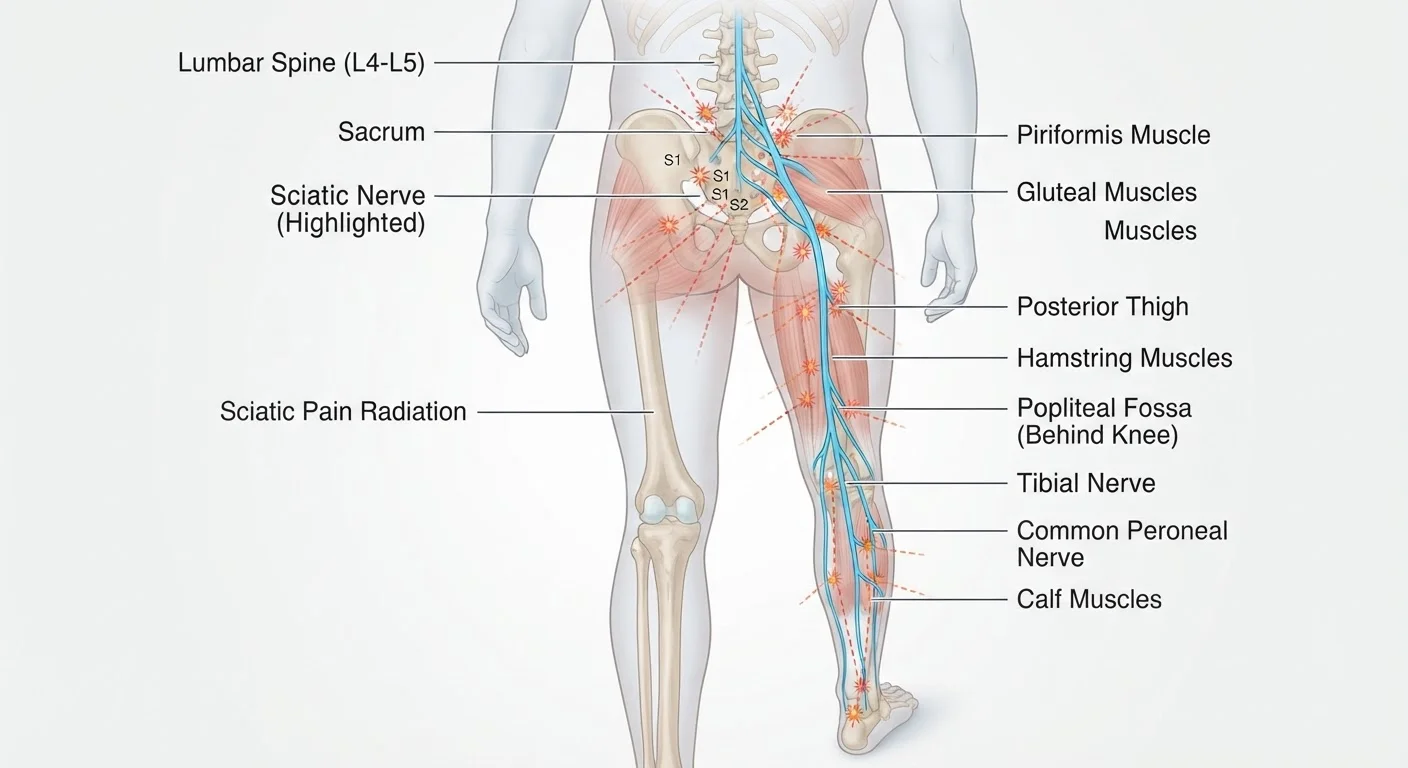
| Nerves forming the sciatic nerve | L4, L5, S1 (and sometimes L3, S2) |
| Typical pattern | Unilateral: one leg at a time |
| Most common cause | Lumbar disc herniation pressing on a nerve root |
| S1 reflex change | Reduced or absent Achilles tendon reflex |
| Emergency warning sign | Bladder or bowel dysfunction alongside leg pain |
| Duration in most cases | Improves within 4-12 weeks with conservative care (Consistent with clinical guidelines on acute radiculopathy) |
What sciatica symptoms actually feel like
Sciatica is not a single sensation. Depending on which part of the sciatic nerve is under pressure, a person may feel a sharp, burning pain in the buttock, an electric-shock sensation shooting down the back of the thigh, a deep ache in the calf, or a numb patch on the top of the foot. These sensations can occur alone or together, and they shift with posture, movement, or rest.
The most recognizable feature is unilateral radiation: symptoms typically follow one leg rather than spreading to both sides. Pain that wraps around the outer shin, bypasses the knee, or skips directly to the foot often points to a specific nerve root. This patterned distribution is what clinicians call a dermatome, the skin region supplied by a given spinal nerve.
For a fuller explanation of what is occurring at the nerve level, see how the sciatic nerve gets irritated.
Dermatome
A defined area of skin supplied by sensory fibers from a single spinal nerve root. Pain or numbness confined to a dermatome helps clinicians identify which nerve root is affected.
Paresthesia
Abnormal sensations such as tingling, pins-and-needles, or burning caused by disrupted nerve signaling. In sciatica, paresthesia usually follows the path of the compressed nerve root.
Nerve root compression
Mechanical pressure on a spinal nerve root, commonly from a herniated disc or bony spur, that reduces normal nerve conduction and produces pain, numbness, or weakness along that nerve's distribution.
Cauda equina syndrome
A rare but serious condition caused by compression of the nerve bundle at the base of the spinal cord, producing bilateral leg weakness, and bladder or bowel dysfunction. It requires immediate emergency evaluation.
Foot drop
Inability to lift the front part of the foot normally during walking, caused by weakness or paralysis of the muscles that dorsiflex the ankle. It signals motor nerve involvement and requires prompt clinical attention.
Piriformis syndrome
A condition in which the piriformis muscle in the buttock compresses the sciatic nerve as it passes underneath or through the muscle, producing buttock and posterior thigh pain that mimics disc-related sciatica.
How symptoms differ by nerve root level
The sciatic nerve is formed from spinal nerve roots at levels L4, L5, S1, and sometimes L3 and S2. Compression at each level produces a distinguishable pattern:
- L4 involvement: pain and numbness at the inner knee and shin; weakened knee extension; reduced patellar reflex.
- L5 involvement: pain across the outer shin and top of the foot; numbness between the first and second toe; possible foot drop with severe compression.
- S1 involvement: pain along the outer heel and sole; numbness on the outer edge of the foot; reduced Achilles reflex; difficulty rising on the tiptoe of the affected side.
A single herniated disc can press on one or two roots simultaneously, so symptom patterns sometimes overlap. Piriformis-related compression, which traps the nerve lower in the buttock, tends to produce more diffuse posterior thigh and buttock pain without the sharp dermatomal cutoffs seen with disc herniation. The range of conditions that compress the sciatic nerve explains why presentations vary so widely between individuals.
| Nerves forming the sciatic nerve | L4, L5, S1 (and sometimes L3, S2) |
| Typical pattern | Unilateral: one leg at a time |
| Most common cause | Lumbar disc herniation pressing on a nerve root |
| S1 reflex change | Reduced or absent Achilles tendon reflex |
| Emergency warning sign | Bladder or bowel dysfunction alongside leg pain |
| Duration in most cases | Improves within 4-12 weeks with conservative care (Consistent with clinical guidelines on acute radiculopathy) |
Sensory changes: numbness and tingling explained
Numbness and tingling (medically, paresthesia) occur when nerve compression disrupts the steady electrical signals the sciatic nerve carries. Intermittent pressure creates tingling; sustained or severe pressure can produce a persistent numb zone that the person describes as a patch of skin that feels like wearing a sock or bandage. Pins-and-needles that appear only when sitting for prolonged periods differ meaningfully from numbness present even at rest: the latter suggests more sustained nerve involvement and warrants prompt clinical evaluation.
Muscle weakness accompanying sensory changes is a red flag. Difficulty lifting the front of the foot, instability when descending stairs, or noticeable grip weakness when gripping with the toes all indicate motor fiber involvement. These findings should be evaluated by a healthcare professional without delay.
Symptoms that worsen with certain postures or activities are covered in detail in habits that aggravate sciatic nerve pain.
When to seek professional evaluation
Most acute sciatica improves with conservative management over several weeks, but certain presentations require urgent assessment. Contact a healthcare provider promptly if any of the following are present:
- Loss of bladder or bowel control alongside leg pain (possible cauda equina syndrome, a medical emergency).
- Progressive leg weakness or foot drop developing over hours or days.
- Symptoms affecting both legs at the same time.
- Pain severe enough to prevent sleep or that is unresponsive to rest and position changes after several days.
- Onset following significant trauma such as a fall or vehicle accident.
For people managing chronic or recurring symptoms, how body weight and daily activity interact with sciatica offers context on longer-term influences worth discussing with a clinician. Movement strategies in mobility and recovery may also provide useful structural guidance for everyday management.
Applying heat or cold at home is one of the most common first steps; when to use heat versus ice for sciatica breaks down the evidence behind each approach.
This article is for informational purposes only and is not medical advice. Always consult a qualified healthcare professional for personal medical decisions, new or worsening symptoms, or any suspected emergency.