

Key Takeaways
Start here
What sciatica actually is
Understand the cause
Why the sciatic nerve gets irritated
Recognize your symptoms
What the symptoms feel like
Learn the process
How sciatica is diagnosed
Take early action
First steps in managing discomfort
Know your limits
When to seek care promptly
What sciatica actually is
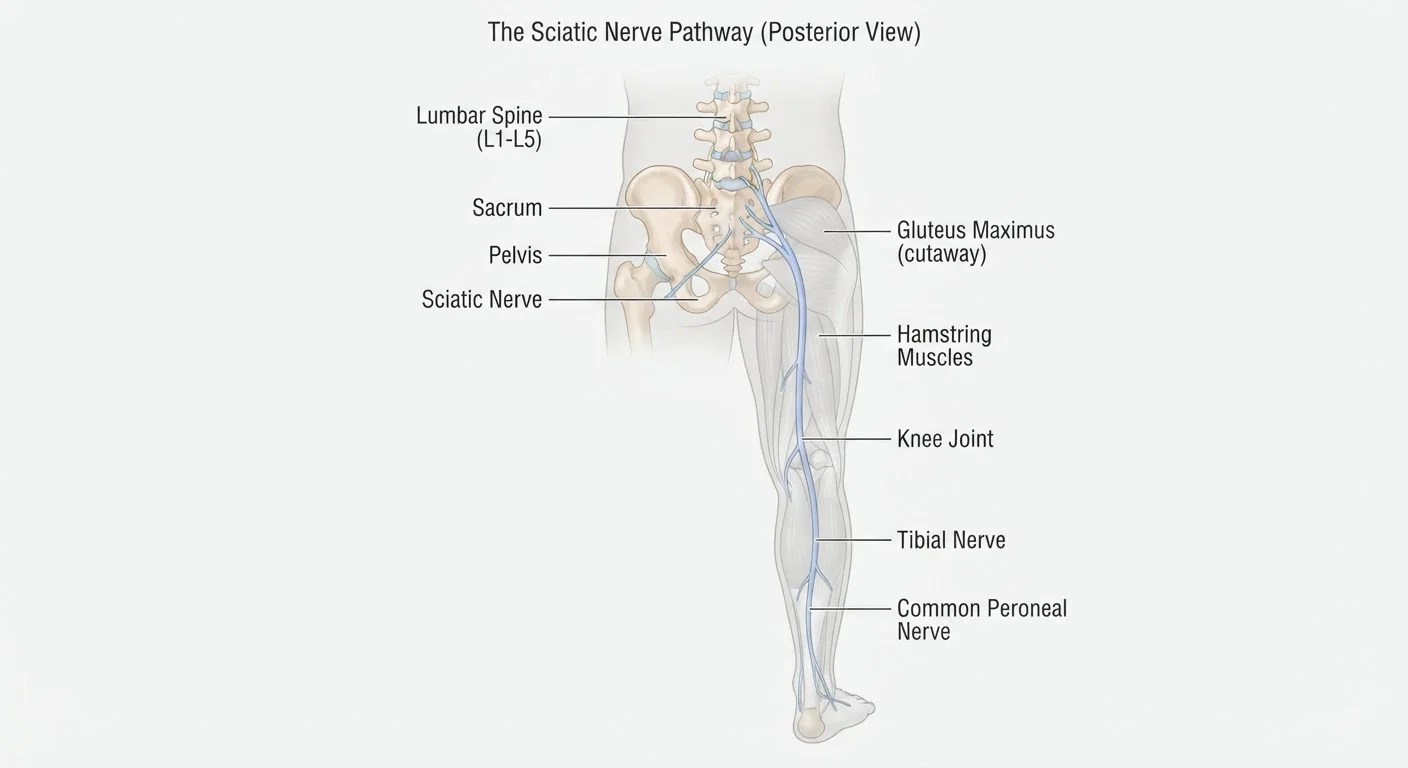
Sciatica is not a disease. It is a description of symptoms caused by irritation or compression of the sciatic nerve. The sciatic nerve is the largest and longest nerve in the human body. It originates from several nerve roots in the lower lumbar and sacral spine (roughly the L4 through S3 levels), merges into a single nerve, and travels through the buttock, down the back of the thigh, and into the lower leg and foot.
When something presses on or inflames one of those nerve roots or the nerve itself, pain, numbness, or tingling follows the nerve's path. That radiating quality is what distinguishes sciatica from ordinary low back pain. To understand how this process works at a tissue level, see what is actually happening in your body.
Sciatic nerve
The longest nerve in the body, formed from several nerve roots in the lower spine and running through the buttock and down each leg.
Nerve root
The point where a nerve exits the spinal cord through a small opening between vertebrae. Compression here is a common source of radiating leg pain.
Herniated disc
A spinal disc whose soft inner material has pushed through the tougher outer layer, potentially pressing on a nearby nerve root.
Lumbar spinal stenosis
A narrowing of the spinal canal in the lower back that can squeeze nerve tissue and produce leg pain or weakness.
Piriformis syndrome
A condition where the piriformis muscle in the buttock tightens or spasms and irritates the sciatic nerve running beneath or through it.
Cauda equina syndrome
A rare, serious condition caused by severe compression of the bundle of nerves at the base of the spine, requiring emergency medical attention.
Why the sciatic nerve gets irritated
Several structural conditions can compress or inflame the sciatic nerve roots. A herniated disc, where the soft inner material of a spinal disc bulges through the outer layer and contacts a nerve root, is the most frequently documented cause. Lumbar spinal stenosis, a narrowing of the spinal canal that occurs more often with age, can produce the same radiating pattern. Degenerative disc disease, spondylolisthesis (where one vertebra slips forward over the one below it), and piriformis syndrome (where the piriformis muscle in the buttock compresses the nerve) are additional sources.
Risk factors include prolonged sitting, heavy occupational lifting, obesity, and advancing age, though none of these guarantees sciatica will develop. For a full breakdown of causes and individual risk factors, why sciatica feels different for everyone covers the range in detail.
What the symptoms feel like
The defining feature of sciatica is pain that radiates from the lower back or buttock into one leg. People describe it variously as burning, shooting, electric, or stabbing. Numbness and tingling are common alongside the pain, and some people notice muscle weakness in the affected leg or foot.
Symptoms typically appear on one side only. They often worsen with sitting, coughing, or sneezing, because these actions increase pressure inside the spinal canal. Standing or walking sometimes provides temporary relief. The intensity ranges from a dull, persistent ache to sharp pain that limits basic movement.
The specific pattern of symptoms, which part of the leg is affected and whether weakness is present, depends on which nerve root is compressed. This is why two people with sciatica can have noticeably different experiences.
How sciatica is diagnosed
No single test confirms sciatica on its own. A clinician will take a detailed history of your symptoms, where the pain travels, what worsens or eases it, and how it began. A physical examination typically includes neurological tests to check reflexes, muscle strength, and sensation. The straight leg raise test, where the clinician raises your leg while you lie flat, is a commonly used maneuver that can reproduce nerve-related leg pain when the sciatic nerve is involved.
Imaging, such as an MRI or CT scan, is not always ordered immediately. Clinicians often reserve it for cases where symptoms persist beyond several weeks, where neurological deficits are present, or where a more serious cause is suspected. An X-ray shows bone structure but does not visualize soft tissues like discs or nerves, so it has limited use in isolation.
Receiving a working diagnosis of sciatica is a starting point, not a final verdict. Accurate identification of the underlying cause shapes the most appropriate management path.
First steps in managing discomfort
Conservative, non-invasive care is the standard starting point for most people with sciatica. Staying moderately active generally produces better outcomes than bed rest. Short periods of rest during severe flares are reasonable, but avoiding all movement for days at a time can stiffen the spine and slow nerve recovery.
Gentle movement, positional adjustments, and targeted stretching are the foundation of early self-management. Applying cold packs in the first 48 to 72 hours of a flare can help manage localized inflammation, while heat may be more helpful after that initial phase. Choosing the right therapy at the right time explains how to approach that decision.
Some common habits, including prolonged sitting with poor posture or certain stretches done incorrectly, can aggravate symptoms without the person realizing it. things that make sciatica worse outlines what to watch for. For a broader view of evidence-based options, non-invasive approaches and their trade-offs covers the available approaches honestly.
Keep movement manageable, not zero
Short, frequent walks, even 10 to 15 minutes at a comfortable pace, are often more helpful during an acute episode than complete rest. The goal is to avoid postures that compress the nerve while maintaining enough circulation and muscle engagement to support recovery. Avoid positions that increase pain, and stop any activity that noticeably worsens leg symptoms.
When to seek care promptly
Most sciatica is painful but not medically urgent. However, some symptoms signal a condition that requires immediate evaluation. Loss of bladder or bowel control, numbness in the groin or inner thighs (sometimes called saddle anesthesia), or rapidly progressing weakness in one or both legs may indicate cauda equina syndrome, a rare but serious compression of the nerve bundle at the base of the spine. These symptoms warrant emergency care without delay.
Outside of those red flags, contact a healthcare provider if your pain is severe and not improving after a few days, if you have any numbness or weakness that is new, if your symptoms began after a fall or injury, or if you have a history of cancer, osteoporosis, or long-term corticosteroid use. A qualified clinician should guide all treatment decisions based on your specific presentation.
For a complete reference covering the full arc of sciatica management, the complete sciatica guide provides structured detail on causes, diagnosis, and long-term strategies.
This article is for informational purposes only and is not medical advice. Consult a qualified healthcare professional for diagnosis, treatment, or any questions about your specific condition.