

Key Takeaways
Our Verdict
Topical antifungals are appropriate for surface-level, localized infections and carry a lower side-effect burden. Oral antifungals are necessary when the infection involves hair follicles, nails, or widespread skin, where topical products cannot penetrate reliably. The decision belongs with a healthcare provider who can match the treatment to the specific organism, site, and patient history.
| Best for | Recommended |
|---|---|
| Mild, localized skin infections such as athlete's foot or ringworm | Topical antifungal |
| Nail fungus or scalp ringworm requiring deeper tissue penetration | Oral antifungal |
| Patients who want to minimize systemic exposure and side effects | Topical antifungal |
| Widespread or recurrent infections not responding to topical therapy | Oral antifungal |
How the two treatment routes work
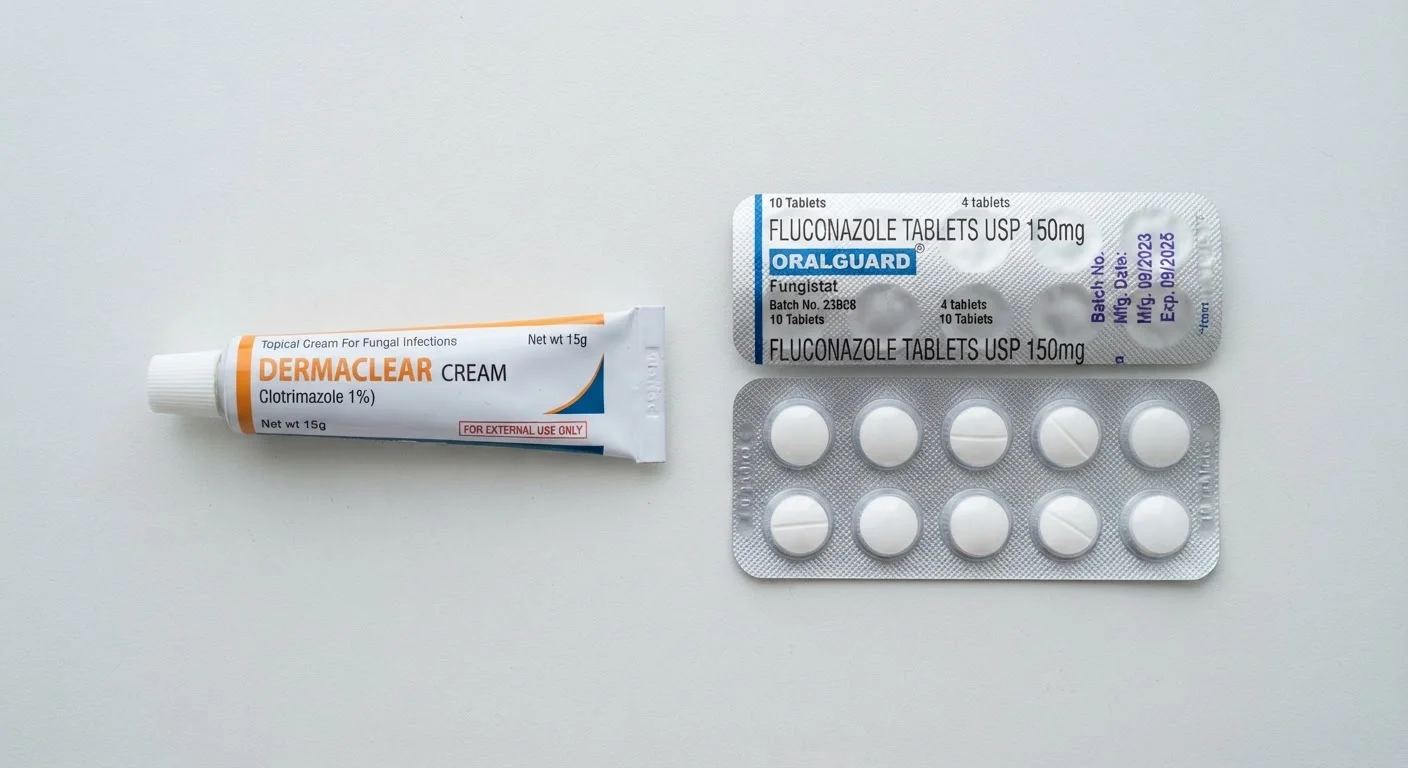
Antifungal treatments fall into two broad categories based on how they reach the site of infection. Topical formulations, including creams, gels, sprays, lacquers, and shampoos, are applied directly to the skin or affected surface. The active ingredient works at or near the point of contact, limiting systemic absorption.
Oral antifungals, whether in tablet or capsule form, are absorbed through the digestive tract and distributed via the bloodstream. This systemic delivery allows the medication to reach tissues that a topical product physically cannot, including the nail plate, hair follicle shafts, and deeper layers of skin.
Both routes target fungal cell membranes or cell-wall synthesis. Most antifungals in clinical use inhibit ergosterol, a compound found in fungal cell membranes but not in human cells, which is why antifungal drugs can act selectively. For a broader explanation of how fungi differ biologically from bacteria and why they resist many common antibiotics, see Fungal Infections Explained.
When topical treatment is appropriate
Topical antifungals are the standard starting point for infections confined to the outer layers of the skin. Conditions such as tinea pedis (athlete's foot), tinea corporis (ringworm of the body), tinea cruris (jock itch), and mild cases of cutaneous candidiasis typically respond well to topical azoles or allylamines applied over a consistent period.
The main advantages are local action and a low likelihood of systemic side effects. Absorption through intact skin is minimal, so the risk of drug interactions or organ-level effects is much lower than with oral therapy.
Topical treatment does have limits. Nail infections are generally not curable with cream alone because the drug cannot penetrate the nail plate at therapeutic concentrations. Scalp ringworm (tinea capitis) also resists topical-only treatment because dermatophytes invade the hair follicle, which sits below the reachable surface. A body-site reference for common fungal infections outlines which conditions tend to need which approach.
| Topical antifungal | Oral antifungal | |
|---|---|---|
| Route of delivery | Applied directly to skin or nails | Swallowed, absorbed via bloodstream |
| Depth of penetration | Outer skin layers only | Nails, follicles, deep tissues |
| Best suited for | Mild, localized surface infections | Nail, scalp, widespread, or persistent infections |
| Side-effect risk | Low; mostly local irritation | Higher; includes liver and drug interactions |
| Typical treatment duration | 2 to 6 weeks daily application | 2 to 12+ weeks depending on site |
| Requires prescription | Not always; OTC options exist | Yes, in most cases |
When oral treatment becomes necessary
Oral antifungals are indicated when the infection is located in a tissue that topical drugs cannot adequately reach, when the surface area is too large for practical topical coverage, or when prior topical treatment has failed. Onychomycosis (fungal nail infection) is the most common example. Drugs such as terbinafine and itraconazole accumulate in the nail plate via the nail matrix over weeks, which is why oral courses for nail infections often run for several months.
Tinea capitis requires oral treatment in most cases because the causative organism lives inside the hair shaft, beyond the reach of any topical product. Widespread or deeply seated dermatophyte infections, invasive candidiasis, and some cases of pityriasis versicolor that cover large body areas may also need systemic management.
The trade-off is a broader side-effect profile. Oral antifungals are metabolized by the liver, and some, particularly azoles like itraconazole and fluconazole, interact with a wide range of other medications through cytochrome P450 enzyme pathways. Terbinafine carries a lower interaction burden but still requires monitoring in patients with pre-existing liver conditions. Anyone considering oral antifungal therapy should discuss their full medication list and medical history with a prescribing clinician.
Oral antifungals and liver health
Some oral antifungal medications can affect liver enzyme levels, particularly with prolonged use. Clinicians may order baseline liver function tests and periodic monitoring during longer courses. Anyone with a history of liver disease should inform their provider before starting oral antifungal therapy. Symptoms such as unusual fatigue, yellowing of the skin, or dark urine during treatment warrant prompt medical attention.
Practical factors that influence the choice
Beyond the site and depth of infection, several other factors shape the treatment decision. The causative organism matters because not all antifungals cover the same species. Terbinafine is highly active against dermatophytes but has limited efficacy against Candida species. Fluconazole is effective against many Candida infections but has variable activity against dermatophytes. A clinician may request a skin scraping, nail clipping, or culture to identify the organism before selecting a drug.
Patient factors also matter. Liver function, kidney function, pregnancy status, and concurrent medications all affect whether oral therapy is safe. For those who are pregnant, elderly, or managing chronic conditions, the risk-benefit calculation is different and requires professional input rather than general guidance.
Adherence is a consistent challenge with both routes. Topical regimens require daily application over two to six weeks. Oral courses for nail infections can run twelve weeks or longer. Stopping early is one of the most common reasons infections return or become harder to treat. Common errors that can slow fungal infection recovery covers this in more detail, including the problem of misidentifying conditions in the first place.
Antifungal resistance is also a growing concern. Repeated or incomplete courses of any antifungal, topical or oral, can contribute to reduced susceptibility. For context on why this matters at a broader level, see why antifungal resistance is a public health concern.
This article provides general health information only and is not a substitute for professional medical advice, diagnosis, or treatment. Always consult a qualified healthcare provider before starting any antifungal therapy.