

| Most common fungal infection in adults | Tinea pedis (athlete's foot) |
| Primary cause of tinea infections | Dermatophyte fungi (Trichophyton, Microsporum, Epidermophyton genera) |
| Nail infection treatment duration | Typically 3 to 12 months depending on site and treatment type |
| Tinea capitis: who is most affected | Children more than adults; oral antifungal required |
| Candidiasis risk factors | Antibiotic use, immune suppression, poorly controlled diabetes, moist skin folds |
| Tinea versicolor pigment change | Hypo- or hyperpigmented patches; not related to hygiene |
How to use this reference
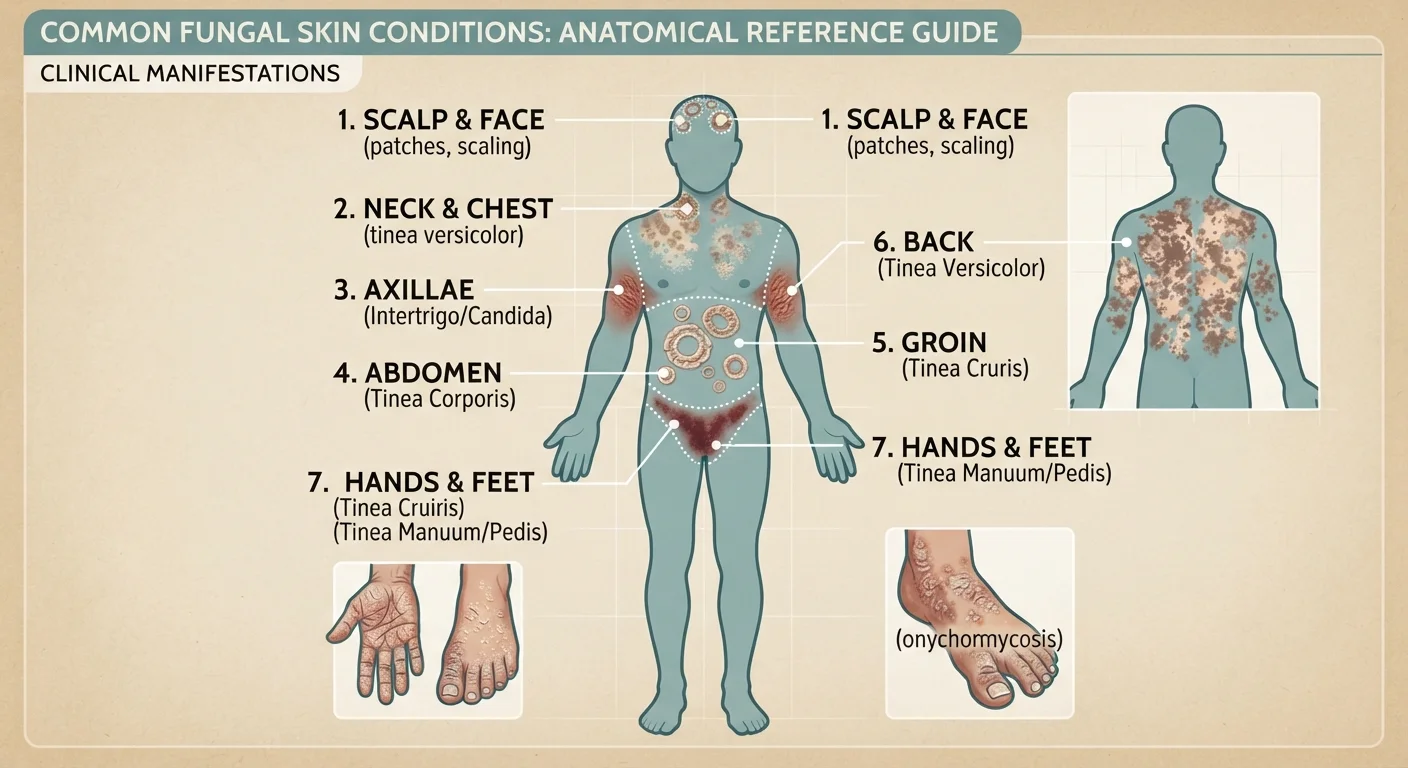
This guide organizes common fungal conditions by body location, from the scalp to the toenails. For each site, you will find the typical name, characteristic signs, and general notes on management. This is general health information, not medical advice. Consult a qualified healthcare provider for any diagnosis or treatment decision.
For a broader explanation of how fungal infections develop and why some people are more vulnerable, see what fungal infections are and why they happen. For a structured overview of the evidence behind care options, a complete overview of fungal skin health covers the full picture.
| Most common fungal infection in adults | Tinea pedis (athlete's foot) |
| Primary cause of tinea infections | Dermatophyte fungi (Trichophyton, Microsporum, Epidermophyton genera) |
| Nail infection treatment duration | Typically 3 to 12 months depending on site and treatment type |
| Tinea capitis: who is most affected | Children more than adults; oral antifungal required |
| Candidiasis risk factors | Antibiotic use, immune suppression, poorly controlled diabetes, moist skin folds |
| Tinea versicolor pigment change | Hypo- or hyperpigmented patches; not related to hygiene |
Scalp and hair: tinea capitis and seborrheic dermatitis
Tinea capitis (scalp ringworm) is a dermatophyte infection that penetrates the hair shaft, producing scaly patches, broken hairs, and sometimes a boggy, tender lesion called a kerion. It is far more common in children than adults. Because the fungus invades the hair follicle, topical antifungals alone generally do not clear it; oral treatment prescribed by a clinician is typically required.
Seborrheic dermatitis of the scalp involves an overgrowth of Malassezia yeast (naturally present on skin) and produces flaking, redness, and itching. It is chronic and recurrent rather than a straightforward infection. Medicated shampoos containing antifungal agents are a common management strategy, though a clinician should confirm the diagnosis before treatment begins.
Understanding the tinea family explains how dermatophytes cause different presentations depending on body site.
Face, neck, and beard area
Tinea faciei affects the smooth skin of the face and can be misidentified as eczema or rosacea because the ring-shaped pattern is less obvious there. Sun exposure may worsen redness, complicating recognition.
Tinea barbae involves the beard area in adults who shave. It often presents as folliculitis-like pustules or deep, crusted plaques, and may require oral antifungal therapy prescribed by a clinician.
Oral candidiasis (thrush) appears inside the mouth as creamy white plaques on the tongue or inner cheeks that can be wiped away, leaving a raw, sometimes bleeding surface. It is common in people using inhaled corticosteroids, those with immune compromise, or individuals taking broad-spectrum antibiotics. Rinsing the mouth after inhaler use reduces risk.
Trunk and skin folds: tinea corporis, tinea versicolor, and candidiasis
Tinea corporis (ringworm of the body) produces the classic expanding ring with a raised, scaly border and central clearing. It spreads by direct skin contact or contact with contaminated surfaces. Recognizing ringworm, athlete's foot, and jock itch provides a more detailed symptomatic guide for these related conditions.
Tinea versicolor is caused by Malassezia overgrowth on the trunk and shoulders. It produces discrete patches that may appear lighter or darker than surrounding skin, because the yeast alters local pigmentation. It is not contagious and does not signal poor hygiene.
Cutaneous candidiasis in skin folds (inframammary, abdominal, groin, and axillary areas) appears as bright red, macerated plaques with satellite pustules at the edges. Heat, moisture, obesity, and diabetes all raise risk. Keeping folds dry and applying antifungal powders or creams as directed by a clinician are the primary management approaches. For more on how systemic conditions affect susceptibility, see conditions that raise fungal infection risk.
Groin, feet, and nails
Tinea cruris (jock itch) affects the groin, inner thighs, and buttocks, producing a red, scaly, sharply bordered rash. It rarely involves the scrotum, which helps distinguish it from candidal intertrigo. Moisture management and loose-fitting clothing are standard supportive measures alongside antifungal treatment.
Tinea pedis (athlete's foot) is among the most prevalent fungal infections in adults. Three patterns occur: interdigital (between toes, with maceration and fissuring), moccasin-type (diffuse, silvery scaling across the sole), and vesicular (blistering on the arch or sole). Bare feet on communal pool or shower surfaces are a common exposure route.
Onychomycosis (nail fungus) causes yellowing, thickening, crumbling, or separation of the nail from its bed. Toenails are affected far more often than fingernails. Because nails grow slowly, treatment periods are long, often months, and recurrence is common. Oral antifungals prescribed by a clinician are generally more effective than topical options for established nail infections. The choice between topical and oral strategies is covered in detail in antifungal treatments: topical versus oral approaches.
This article is for informational purposes only and is not medical advice. Always consult a qualified healthcare professional for diagnosis and treatment of any health condition.