
Scalp Biology 101: What Your Follicles Are Actually Doing Beneath the Surface

Key Takeaways
Start here
How scalp skin differs from skin elsewhere on your body
Next
Anatomy of a hair follicle
Build on it
The hair growth cycle explained
Connect the dots
How internal health shapes what happens at the follicle
Apply it
What disrupts normal scalp function
How scalp skin differs from skin elsewhere on your body
The scalp is not simply hairy forehead skin. Its structure differs from other body regions in several measurable ways that matter for both hair production and scalp health.
Follicle density on the scalp reaches approximately 700 to 900 follicles per square centimeter, far exceeding most other body sites. Sebaceous glands, which produce the oily substance called sebum, are correspondingly dense here. Because sebum production is partly driven by androgens (male hormones present in all sexes), the scalp is among the first places hormonal changes become visible.
The scalp's epidermal turnover rate, the speed at which skin cells renew and shed, is also faster than on the torso or arms. When this turnover becomes irregular, visible flaking can appear. Scalp skin also sits close to the skull with limited subcutaneous fat, which means its blood supply and lymphatic drainage run through a relatively thin tissue layer. Circulation efficiency matters here more than on areas with thicker padding.
Sebum
An oily substance produced by sebaceous glands that lubricates the hair shaft and forms part of the skin's protective barrier.
Dermal papilla
A cluster of specialized cells at the base of each follicle that connects to blood capillaries and directs hair growth.
Anagen phase
The active growth stage of the hair cycle during which cells in the follicle divide rapidly to produce the hair shaft.
Telogen effluvium
A form of temporary hair shedding that occurs when a large number of follicles enter the resting phase at the same time, often triggered by physical or nutritional stress.
Androgenetic alopecia
A genetically influenced form of hair thinning driven by the hormone DHT causing follicles to progressively produce shorter, finer hairs over time.
Acid mantle
A thin, mildly acidic film on the skin surface that protects against microbial overgrowth and keeps the outer skin layer intact.
Anatomy of a hair follicle
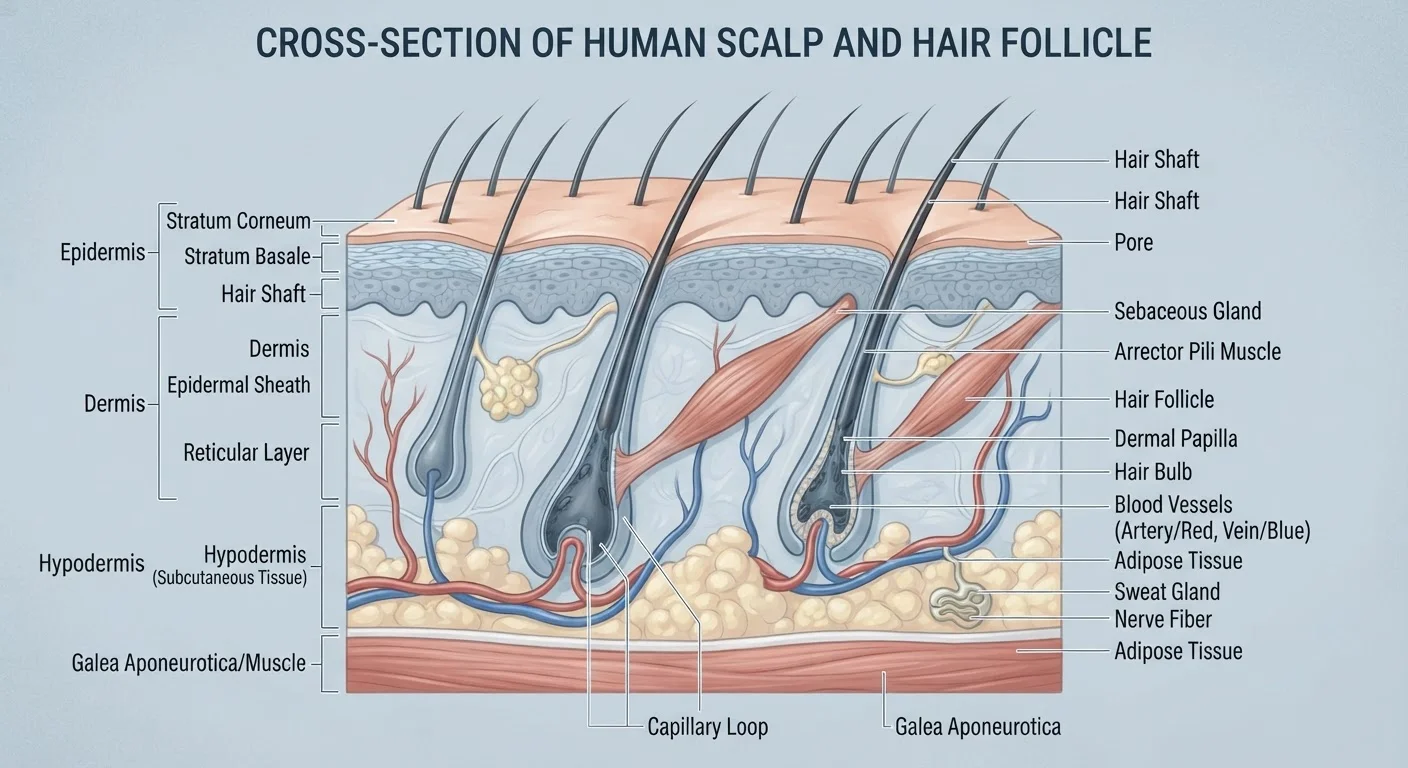
Each follicle is a self-contained organ embedded in the dermis, the deeper layer of skin below the surface epidermis. At its base sits the dermal papilla, a cluster of connective tissue cells surrounded by a looped capillary network. These blood vessels carry the amino acids, vitamins, and oxygen that fuel hair production.
Just above the papilla is the hair matrix, a zone of rapidly dividing keratinocytes (keratin-producing cells). As new cells form, older ones are pushed upward and harden into the hair shaft. Surrounding the growing shaft is the inner and outer root sheath, which acts as a structural sleeve. Higher up the follicle, the sebaceous gland attaches and empties sebum onto the emerging hair. A small muscle called the arrector pili connects the follicle to the surface; its contraction causes the familiar sensation of hair standing on end.
For a closer look at what happens when this structure begins to fail, see the biology of hair loss.
The hair growth cycle explained
Follicles do not grow hair continuously. Each one cycles through three distinct phases, and at any given time different follicles are in different phases, which is why healthy shedding of 50 to 100 hairs per day is normal.
- Anagen (growth phase): Active cell division in the matrix pushes the hair shaft outward. This phase spans roughly two to seven years and determines how long hair can grow before it is shed.
- Catagen (transition phase): Cell division stops. The lower follicle detaches from the papilla and shrinks upward over about two to three weeks.
- Telogen (rest phase): The follicle is dormant for approximately three months. The old hair shaft is held loosely in the follicle until the new anagen cycle begins and pushes it out.
A fourth phase, exogen, refers specifically to the active shedding of the telogen hair. Some researchers treat this as part of telogen; others distinguish it separately.
When a systemic stressor, whether illness, surgery, nutritional deficit, or prolonged psychological stress, pushes a large proportion of follicles into telogen simultaneously, the result is a condition called telogen effluvium. Shedding typically becomes noticeable two to four months after the triggering event because that is when the resting follicles reach exogen.
How internal health shapes what happens at the follicle
Follicle cells divide faster than most cells in the body, which makes them unusually sensitive to what circulates in the bloodstream. Iron, for instance, is required for the enzyme ribonucleotide reductase, which drives DNA synthesis in dividing cells. Low ferritin levels, even without clinical anemia, have been linked to disrupted anagen duration in some studies.
Zinc supports the structural integrity of keratins, the proteins that form the hair shaft. Deficiency can cause the shaft to become brittle and the growth cycle to shorten. Protein intake matters because hair is approximately 95 percent keratin by weight, and inadequate dietary protein can shift follicles toward catagen earlier than normal.
Hormone balance shapes follicle behavior in a more complex way. Dihydrotestosterone (DHT), a derivative of testosterone, binds to receptors in the dermal papilla and, in genetically susceptible follicles, causes progressive miniaturization: each successive anagen phase produces a shorter, finer hair. This is the mechanism behind androgenetic alopecia, sometimes called pattern hair loss. The hair regrowth hub covers approaches for addressing this process.
Liver function also connects to this picture. The liver metabolizes hormones including androgens and estrogens. Impaired clearance can shift hormonal ratios, affecting how much DHT is available to act on follicle receptors. Liver health is therefore not separate from scalp biology.
Nutrition and follicle timing
Because the hair growth cycle operates on a delay of months, nutritional changes you make today may not show visible results for several hair-growth cycles. Consistency over weeks and months matters more than short-term intervention. Work with a healthcare provider if you suspect a specific deficiency before supplementing.
What disrupts normal scalp function
Beyond nutrition and hormones, several common factors alter the scalp environment in ways that affect both the skin surface and the follicles beneath it.
pH disruption occurs when cleansing products with a high alkaline pH strip the scalp's acid mantle. This opens the cuticle, increases susceptibility to microorganism overgrowth, and can provoke inflammation around follicle openings. The scalp microbiome, covered in detail in the scalp microbiome introduction, depends on a stable pH to stay balanced.
Chronic scalp inflammation, whether from seborrheic dermatitis, psoriasis, or contact reactions, can eventually compress follicle openings and alter the signaling environment around the papilla. Long-standing perifollicular inflammation is associated with follicle miniaturization in some forms of hair loss.
Poor scalp circulation limits the nutrient delivery the dermal papilla depends on. Prolonged physical tension on the scalp, as occurs with certain hairstyles, can reduce local microvascular flow in the areas under traction.
Understanding these mechanisms is the first step toward a care routine that addresses root causes rather than surface symptoms. Building a physiology-grounded scalp routine translates this biology into practical daily steps.
This article is for informational purposes only and is not medical advice. Consult a qualified healthcare professional for any concerns about hair loss, scalp conditions, or changes in your health.