

Key Takeaways
Skin barrier function
Skin barrier function refers to the skin's ability to act as a selective wall between the body and its environment. The outermost layer of the skin holds in moisture, blocks pathogens, and limits the entry of allergens and irritants. When this barrier works properly, skin stays hydrated and resistant to infection. When it breaks down, inflammation, dryness, and sensitivity can follow.
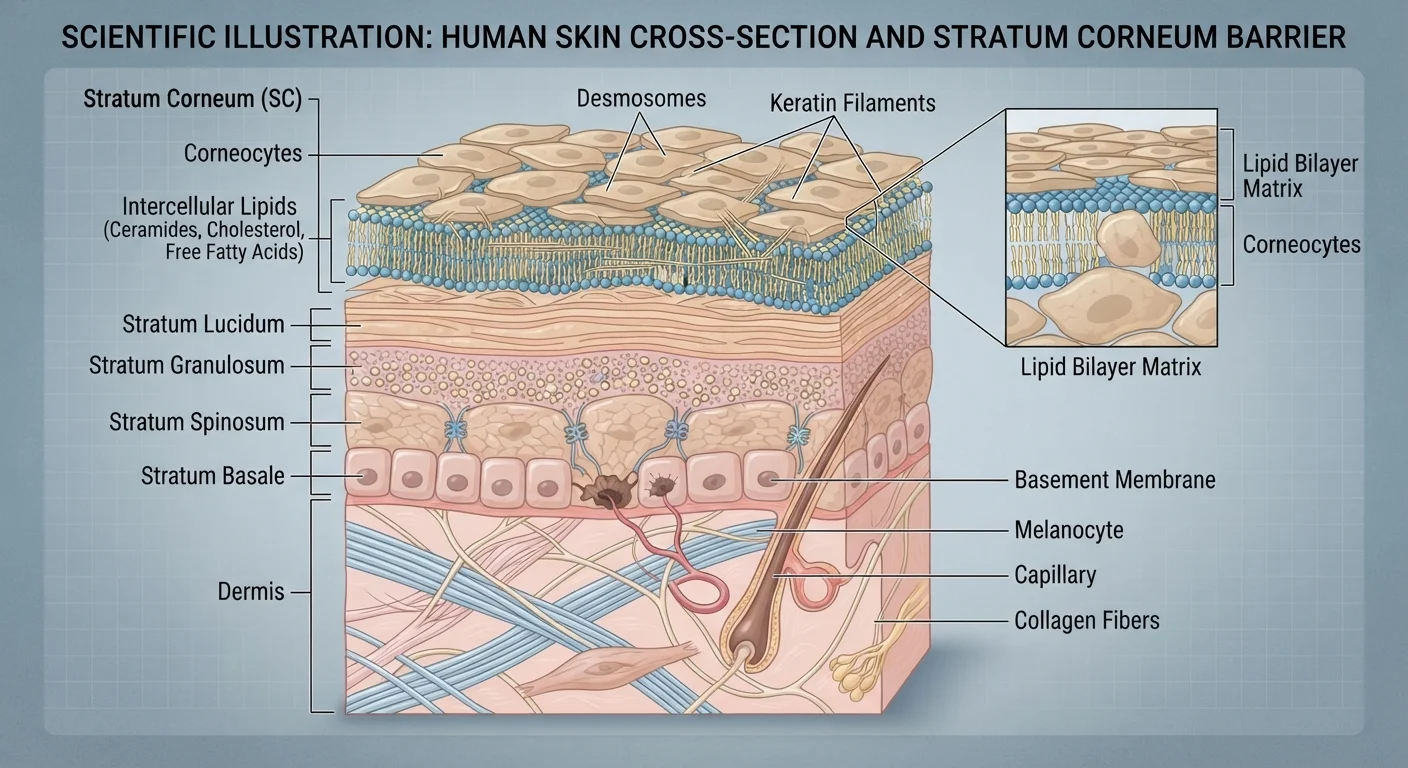
The barrier is primarily maintained by the stratum corneum, a layer of flattened, protein-rich dead cells (corneocytes) held together by a matrix of lipids including ceramides, free fatty acids, and cholesterol.
What the skin barrier actually is
The phrase 'skin barrier' is often used loosely in skincare marketing, but the biology behind it is specific. The barrier is built within the stratum corneum, the outermost layer of the epidermis. Beneath that layer, living keratinocyte cells produce and then die in a controlled process, flattening into corneocytes and releasing lipids into the spaces between them. The result is what researchers sometimes describe with a 'brick and mortar' model: the corneocytes are the bricks, and the lipids are the mortar.
That lipid mortar is not uniform. It contains ceramides (roughly 50 percent by weight), cholesterol, and free fatty acids in a ratio that, when disrupted, measurably impairs water retention. The barrier's job is two-directional: it limits water loss from inside the body (called transepidermal water loss, or TEWL) and resists the entry of microorganisms, environmental allergens, and chemical irritants from outside.
Beyond the physical layer, the skin maintains a chemical barrier through its acid mantle, a thin film with a pH between 4.5 and 5.5. This acidity deters many bacterial and fungal pathogens and supports the enzymes responsible for normal skin shedding. Disrupting this pH is one mechanism by which over-cleansing damages skin over time.
The microbial layer and immune signaling
The skin is also colonized by a diverse community of bacteria, fungi, and viruses collectively called the skin microbiome. In a healthy state, this community is in balance: Staphylococcus epidermidis, for example, competes with more harmful species like Staphylococcus aureus and produces antimicrobial peptides that strengthen local immune defense. When barrier integrity declines and pH shifts, the microbial balance can shift too, allowing opportunistic organisms to proliferate.
The skin's immune function also operates through specialized cells in deeper epidermal layers. Langerhans cells act as sentinels that sample the environment and trigger immune responses when foreign antigens breach the barrier. This is why a compromised barrier does not simply cause dryness; it can trigger cycles of inflammation by allowing low-grade antigen exposure to continue.
Barrier permeability across organ systems
The concept of a protective barrier that can become 'leaky' appears in both skin biology and gut physiology. While the mechanisms differ, both barriers rely on tight junctions and lipid-based structures to control what passes through. For a look at intestinal permeability and the evidence behind it, see the leaky gut syndrome explainer. The analogy is useful, but the two systems respond to different triggers and require different clinical approaches.
For readers interested in how intestinal barrier health parallels skin barrier biology, the science behind leaky gut syndrome offers a useful comparison of how permeable barriers function differently across organ systems.
How barrier breakdown connects to common skin conditions
Atopic dermatitis (eczema) has one of the most studied connections to barrier dysfunction. Loss-of-function mutations in the filaggrin gene reduce the production of a protein that is central to corneocyte structure and the formation of natural moisturizing factors inside the skin. Without adequate filaggrin, TEWL rises, the skin pH shifts upward, and the microbial balance tilts toward S. aureus dominance, which amplifies immune-mediated inflammation.
Rosacea involves a different mechanism: an overproduction of antimicrobial peptides called cathelicidins, which in rosacea-prone skin are processed into forms that trigger vascular and inflammatory responses rather than simply defending against infection. Fungal overgrowth on the scalp, as seen in seborrheic dermatitis, also exploits a weakened acid mantle and altered lipid environment. These conditions are not caused solely by external exposure; the barrier's biochemical state creates the conditions that allow them to develop.
The gut-skin relationship adds another layer. Research on the gut-skin axis shows that intestinal microbiome composition can influence systemic inflammation and affect how skin immune responses are calibrated. Similarly, the skin-gut axis article examines how digestive imbalances can surface as skin-level inflammation.
Internal health, nutrition, and barrier integrity
Barrier lipids are synthesized from dietary and metabolic precursors. Essential fatty acids, particularly linoleic acid found in plant oils, are incorporated directly into ceramide structure. Deficiency in linoleic acid produces ceramides with altered chain lengths that do not pack as tightly in the lipid matrix, increasing permeability. Zinc supports the enzymes involved in fatty acid metabolism and skin cell turnover. Vitamins A and D influence keratinocyte differentiation, the process by which new skin cells develop into the organized barrier structure.
Hormonal status also matters. Estrogen supports ceramide synthesis and collagen density, which is part of why skin tends to become drier and thinner after menopause. Thyroid hormones regulate epidermal turnover rate; both hypothyroidism and hyperthyroidism alter the texture and hydration of skin in measurable ways.
The relationship between topical and internal skin care is worth understanding here: topical products can supplement the lipid layer from the outside, but they cannot fully compensate for deficiencies in the raw materials the body needs to build that layer internally. Supporting lymphatic drainage and maintaining the liver's capacity to process metabolic waste, discussed in the liver health hub, form part of the broader biological environment that skin relies on.
This article is for informational purposes only and is not medical advice. Consult a qualified healthcare professional for personal health concerns, symptoms, or before making changes to your health routine.