

Key Takeaways
Our Verdict
Estrogen and testosterone are not opposites. They work through different receptor systems to govern overlapping functions, and both are necessary for full physiological health in all adults. Neither hormone is categorically 'male' or 'female'; their relative concentrations and tissue-level sensitivity determine their effects.
| Best for | Recommended |
|---|---|
| Those primarily concerned with bone, cardiovascular, and mood health | Estrogen-focused understanding and monitoring |
| Those focused on muscle mass, libido, and metabolic energy | Testosterone-focused understanding and monitoring |
| Anyone experiencing multi-system symptoms without a clear cause | Comprehensive hormonal panel reviewed with a clinician |
Both hormones, both sexes: clearing up a persistent misconception
Estrogen and testosterone are frequently described as if each belongs exclusively to one sex. This framing is biologically inaccurate. Adult human bodies of all sexes synthesize both hormones, primarily through the gonads and adrenal glands, with peripheral conversion occurring in adipose tissue and the liver. What differs is concentration and receptor sensitivity, not presence or absence.
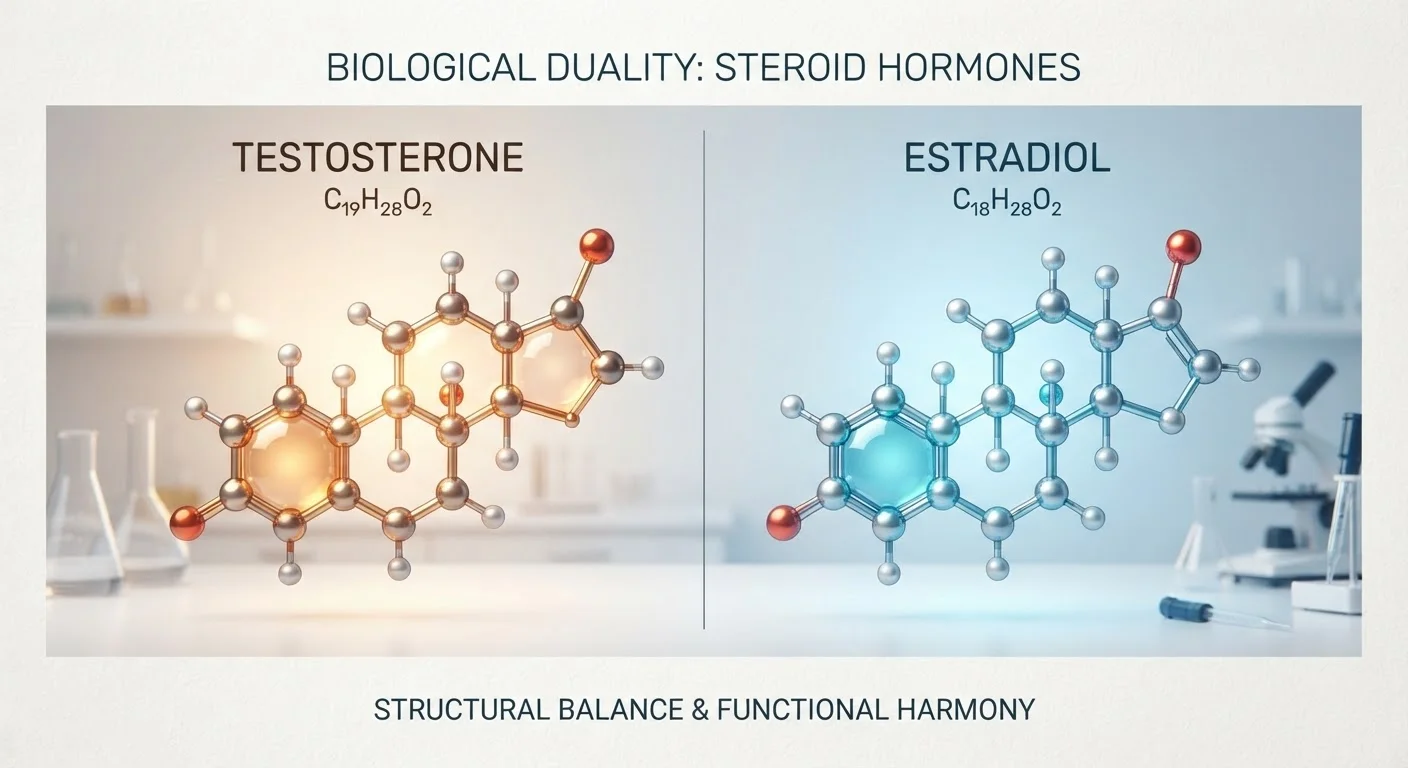
Estrogen circulates as three primary forms: estradiol (the most potent), estrone, and estriol. Testosterone is a single androgen, though it converts peripherally to dihydrotestosterone (DHT) and to estradiol via aromatase enzymes. This conversion pathway means the two hormones are biochemically linked, not separate systems. For a broader view of how these and other hormones shift over time, see hormonal fluctuations across a lifetime.
What estrogen does in the body
Estradiol binds to estrogen receptors alpha and beta, which are distributed across bone, the cardiovascular system, the central nervous system, and reproductive tissue. This broad receptor distribution explains why estrogen affects so many systems simultaneously.
In bone, estrogen suppresses osteoclast activity, the process that breaks down bone matrix. When estrogen levels fall, as they do during menopause, bone resorption accelerates, raising fracture risk. In the cardiovascular system, estrogen supports endothelial function and influences lipid profiles by raising HDL cholesterol and reducing LDL oxidation, though this relationship is more complex than often presented. The article on HDL and LDL cholesterol explains the underlying mechanisms in more detail.
Estrogen also modulates serotonin and dopamine signaling in the brain, which connects fluctuations in estrogen to mood variability, sleep architecture, and cognitive function. This is not a trivial effect: estrogen receptor beta is found in hippocampal neurons involved in memory consolidation.
| Estrogen | Testosterone | |
|---|---|---|
| Primary receptor type | Estrogen receptors alpha and beta | Androgen receptors |
| Bone health effect | Suppresses osteoclast activity | Stimulates osteoblast activity |
| Cardiovascular influence | Supports endothelial function, raises HDL | Influences red blood cell production |
| Mood and cognition | Modulates serotonin and dopamine pathways | Supports spatial cognition and drive |
| Muscle and body composition | Influences fat distribution | Stimulates muscle protein synthesis |
| Metabolic conversion | Converted from testosterone via aromatase | Converts to estradiol and DHT peripherally |
| Present in which adults | All adult sexes | All adult sexes |
What testosterone does in the body
Testosterone acts primarily through androgen receptors found in skeletal muscle, bone, the brain, the liver, and reproductive organs. Its most recognized function is stimulating muscle protein synthesis, but the hormone's reach extends well beyond body composition.
Testosterone promotes erythropoiesis, the production of red blood cells, by stimulating erythropoietin release from the kidneys. It also supports libido in both sexes, bone mineral density through a pathway partly independent of estrogen, and spatial cognition in certain brain regions. In the liver, testosterone influences metabolic enzyme activity and lipid handling. Disruptions to testosterone levels can therefore affect triglyceride and cholesterol metabolism.
Low testosterone in adults is associated with fatigue, reduced lean muscle mass, impaired glucose regulation, and mood disturbances. These symptoms overlap substantially with estrogen imbalance, which makes clinical assessment necessary before attributing symptoms to one hormone specifically. See key facts about hormonal testing for guidance on what lab results can and cannot confirm.
Shared functions and where the hormones overlap
Both hormones contribute to bone mineral density, though through different receptor pathways. Both affect mood and cognitive function by modulating neurotransmitter systems, though the specific circuits involved differ. Both influence fat distribution and metabolic rate, and both decline with age in ways that have measurable physiological consequences.
The liver processes both hormones for excretion, converting them into water-soluble metabolites that leave the body through bile and urine. Liver function therefore affects circulating levels of both. For context on how the liver's metabolic role extends to hormonal clearance, the liver health hub covers relevant background.
Physical activity interacts with both hormones. Resistance training acutely raises testosterone, while adequate recovery is necessary to avoid cortisol-driven suppression of both estrogen and testosterone. The relationship is detailed further in the article on exercise and hormonal health.
Supporting hormonal balance: general, evidence-informed principles
No single intervention governs hormonal balance. The evidence points to a cluster of modifiable factors that influence both estrogen and testosterone levels through distinct but interrelated mechanisms.
- Sleep quality affects the pulsatile release of luteinizing hormone (LH), which signals the gonads to produce both testosterone and estrogen. Chronically disrupted sleep reduces this signaling.
- Body composition matters because adipose tissue contains aromatase, the enzyme that converts androgens to estrogens. Higher adipose volume raises this conversion rate, altering the estrogen-to-testosterone ratio.
- Chronic psychological stress elevates cortisol, which competes with testosterone for the same precursor molecule (pregnenolone) and can suppress gonadotropin-releasing hormone (GnRH) pulsatility, reducing downstream sex hormone output.
- Dietary adequacy, particularly zinc, magnesium, and vitamin D status, is associated with normal testosterone synthesis. Severe caloric restriction suppresses reproductive hormone output in both sexes.
These are general, population-level associations. Individual responses vary, and anyone experiencing symptoms consistent with hormonal imbalance should discuss them with a qualified healthcare provider rather than self-managing based on general information.
This article is for informational purposes only and does not constitute medical advice. Consult a licensed healthcare professional for evaluation, diagnosis, or treatment of any hormonal health concern.