

Key Takeaways
Option A
HDL (High-Density Lipoprotein)
The reverse transporter: carries cholesterol away from arteries.
Best for: Readers who want to understand why higher HDL levels are generally associated with lower cardiovascular risk.
Option B
LDL (Low-Density Lipoprotein)
The primary delivery vehicle: moves cholesterol to cells throughout the body.
Best for: Readers who want to understand why elevated LDL is a target for cardiovascular risk management.
If you want to understand why your doctor watches your LDL number closely
LDL (Low-Density Lipoprotein)
LDL is the primary focus of cardiovascular risk assessment because elevated levels are consistently linked to atherosclerosis in large-scale clinical research.
If you are trying to understand what lifestyle habits support heart health
HDL (High-Density Lipoprotein)
Regular aerobic exercise and healthy dietary patterns are among the few lifestyle factors that can meaningfully raise HDL, making it a useful marker of metabolic health.
If your lipid panel shows normal LDL but low HDL
HDL (High-Density Lipoprotein)
Low HDL alongside other risk factors can still signal elevated cardiovascular risk, so the full picture of both numbers matters for your provider's assessment.
If you are managing a condition such as diabetes or metabolic syndrome
LDL (Low-Density Lipoprotein)
These conditions often alter LDL particle size and number in ways that increase risk, making LDL management a central part of care in consultation with a physician.
What HDL and LDL actually are
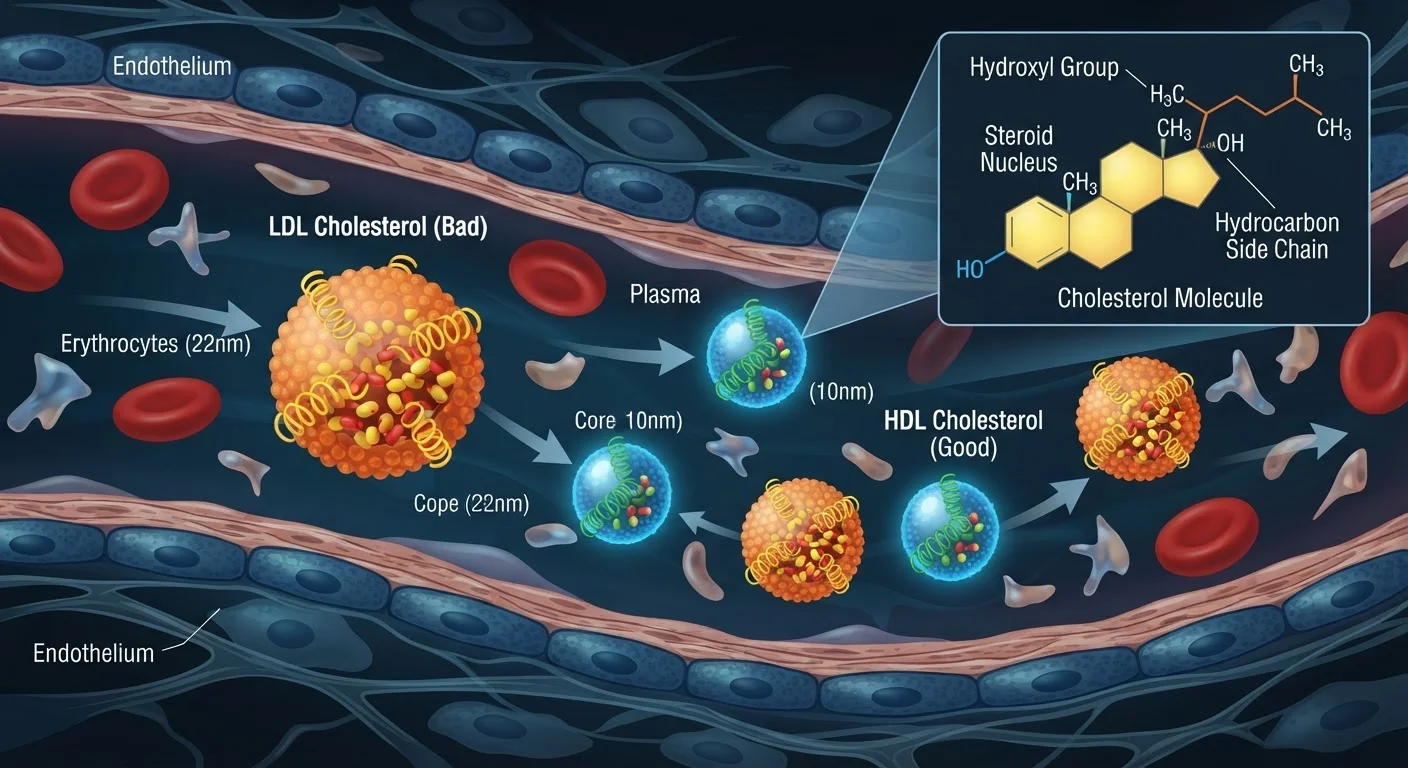
Cholesterol does not travel freely in the bloodstream. Because it is a fat-based molecule, it cannot dissolve in blood and must be packaged inside protein-coated carriers called lipoproteins. HDL and LDL are the two most clinically significant of these carriers, and they differ primarily in their density, size, and direction of travel.
LDL is a larger, lower-density particle. Its main job is to deliver cholesterol from the liver to cells throughout the body, where it is used to build cell membranes, produce hormones, and synthesize vitamin D. HDL is smaller and denser. It collects excess cholesterol from tissues and artery walls and transports it back to the liver for processing or excretion, a process researchers call reverse cholesterol transport.
Both particles are necessary. The problem arises when their levels move outside a healthy range. For more on how cholesterol fits into the broader picture of heart health, see how cholesterol interacts with blood pressure and inflammation.
How LDL contributes to cardiovascular risk
When LDL levels are elevated, more LDL particles circulate in the blood. Some of those particles penetrate the walls of arteries, where they can oxidize and trigger an immune response. White blood cells called macrophages engulf the oxidized LDL, eventually becoming foam cells that accumulate into fatty deposits known as atherosclerotic plaques. Over time, plaques narrow arteries and can rupture, triggering a heart attack or stroke.
This is why clinical guidelines from organizations such as the American Heart Association treat LDL as a primary target for cardiovascular risk reduction. Not every person with elevated LDL will develop heart disease, and not every heart attack occurs in someone with high LDL, but the association across large populations is well established.
LDL particle number and size also matter. Smaller, denser LDL particles appear to penetrate artery walls more readily than larger ones. Standard lipid panels measure LDL cholesterol concentration, not particle number, so some clinicians order additional tests such as apolipoprotein B (ApoB) or LDL particle number testing to get a fuller picture of risk.
| Criterion | HDL | LDL |
|---|---|---|
| Density and size | Small, high-density particle | Larger, low-density particle |
| Direction of cholesterol transport | Away from tissues, toward liver | From liver to body tissues |
| Association with cardiovascular risk | Higher levels linked to lower risk | Higher levels linked to higher risk |
| Clinical target | Raise if low (below 40-50 mg/dL) | Lower if elevated (above guideline threshold) |
| Primary lifestyle lever | Aerobic exercise, unsaturated fats | Diet, weight management, medication |
| Role in atherosclerosis | May remove cholesterol from plaques | Contributes to plaque formation when oxidized |
| Genetic influence | Moderate; some raise HDL regardless of lifestyle | Strong; familial hypercholesterolemia can cause very high LDL |
How HDL affects the same system
HDL has long been called 'good' cholesterol, and the label has a biological basis: HDL removes cholesterol from artery walls and returns it to the liver. In population studies, higher HDL cholesterol levels correlate with lower rates of cardiovascular disease.
However, clinical trials testing drugs that raise HDL have not consistently reduced heart attack risk. This has led researchers to conclude that HDL function, not just HDL quantity, matters. A high HDL number in the context of inflammation or metabolic dysfunction may not confer the expected protection. Conversely, low HDL (below 40 mg/dL in men and 50 mg/dL in women, per standard clinical reference ranges) is considered an independent risk factor when combined with other markers.
Lifestyle factors that tend to raise HDL include regular aerobic exercise, replacing saturated fats with unsaturated fats in the diet, and avoiding smoking. For a detailed look at how dietary fat types affect both HDL and LDL, see how saturated and unsaturated fats influence cholesterol.
Reading your lipid panel in context
A standard lipid panel reports total cholesterol, LDL, HDL, and triglycerides. Total cholesterol alone is a poor guide: someone with high HDL and moderate LDL may have a better cardiovascular profile than someone whose total cholesterol is the same but is composed mostly of LDL.
The ratio of total cholesterol to HDL, or of LDL to HDL, gives a more informative picture. Triglycerides are a separate blood fat that also appears on the panel and interacts with both HDL and LDL in ways that affect overall risk. For more on that relationship, see how triglycerides and cholesterol differ on a lipid panel.
Genetics account for a substantial portion of individual variation in HDL and LDL levels. Familial hypercholesterolemia, for example, is a genetic condition that causes very high LDL regardless of diet or lifestyle. Diet does influence cholesterol, and what the research shows about diet and cholesterol is worth understanding, but dietary changes alone cannot normalize levels in everyone.
Interpretation of a lipid panel should always involve a qualified healthcare provider who can weigh your numbers alongside your full medical history, other risk factors, and any relevant symptoms.
This article is for general informational purposes only and does not constitute medical advice. Always consult a qualified healthcare professional before making decisions about your health, medications, or treatment.