

Key Takeaways
Our Verdict
Unsaturated fats have a more favorable effect on cholesterol than saturated fats, with research consistently linking substitution of saturated for unsaturated fat to lower LDL and reduced cardiovascular risk. Saturated fat is not uniformly harmful in all contexts, but current evidence supports limiting it in favor of unsaturated sources for most adults. No dietary change replaces personalized guidance from a qualified clinician.
| Best for | Recommended |
|---|---|
| Adults seeking to lower elevated LDL through diet | Unsaturated fats (mono- and polyunsaturated) |
| Those who want to understand what to limit for heart health | Limiting saturated and trans fats |
| People with a complex lipid profile needing nuanced guidance | Consultation with a healthcare provider or registered dietitian |
What makes a fat saturated or unsaturated
All dietary fats are made of fatty acid chains attached to a glycerol backbone. The difference between saturated and unsaturated fat comes down to chemical structure: specifically, the number of double bonds between carbon atoms.
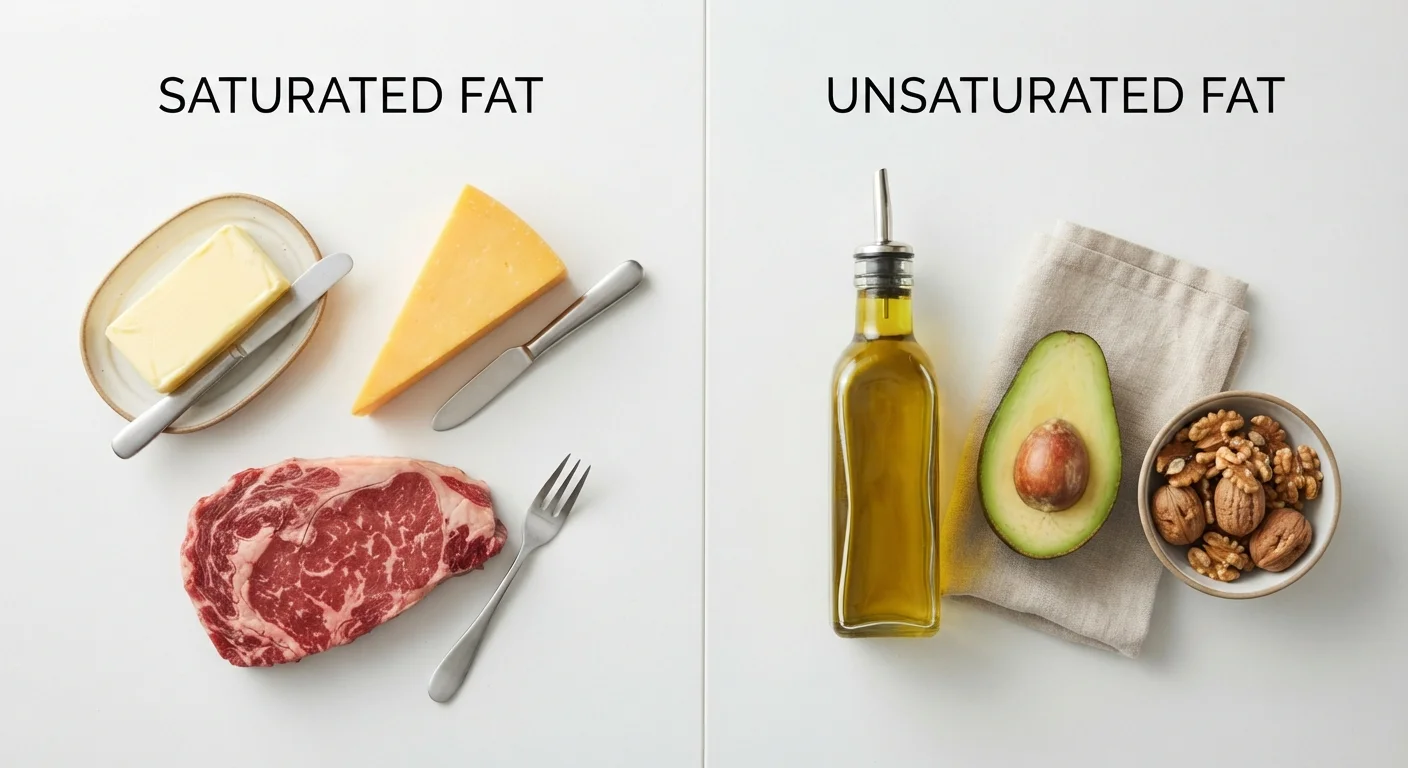
Saturated fatty acids have no double bonds. Their carbon chains are fully "saturated" with hydrogen atoms, which makes them solid at room temperature. Common sources include red meat, butter, cheese, and coconut oil. Unsaturated fatty acids have at least one double bond, which introduces a bend in the chain and keeps them liquid at room temperature.
Unsaturated fats divide into two categories. Monounsaturated fats (MUFAs) have one double bond; olive oil and avocados are well-known sources. Polyunsaturated fats (PUFAs) have two or more double bonds; examples include vegetable oils, fatty fish, walnuts, and flaxseed. Omega-3 and omega-6 fatty acids are both PUFAs. A third category, trans fats, can be formed artificially through partial hydrogenation and behave differently from both saturated and naturally occurring unsaturated fats.
For more on how diet shapes lipid numbers broadly, see the role of diet in cholesterol levels.
How saturated fat affects LDL and HDL
Saturated fat consumption raises low-density lipoprotein (LDL) cholesterol in most people. The mechanism involves reduced clearance of LDL particles from the bloodstream: saturated fats lower the activity of LDL receptors on liver cells, so circulating LDL stays elevated longer.
Different saturated fatty acids do not behave identically. Lauric, myristic, and palmitic acids (found in coconut oil, meat, and palm oil) are the subtypes most consistently linked to LDL elevation in controlled feeding studies. Stearic acid, found in beef and cocoa butter, appears to have a more neutral effect because the body converts it to oleic acid, a monounsaturated fat.
The effect on HDL cholesterol (high-density lipoprotein, often called "good" cholesterol) is more complex. Saturated fat can modestly raise HDL alongside LDL, but the net cardiovascular effect of that combined change is not beneficial according to current evidence. HDL and LDL behave differently in the body, and raising HDL through saturated fat intake does not offset the risks associated with elevated LDL.
| Saturated fat | Monounsaturated fat | Polyunsaturated fat | Trans fat | |
|---|---|---|---|---|
| Effect on LDL cholesterol | Raises LDL | Lowers LDL | Lowers LDL | Raises LDL significantly |
| Effect on HDL cholesterol | Modest raise | Neutral or slight raise | Slight lowering (omega-6) | Lowers HDL |
| Effect on triglycerides | Neutral to slight raise | Neutral | Omega-3s lower triglycerides | Raises triglycerides |
| Common food sources | Butter, red meat, cheese | Olive oil, avocado, almonds | Fatty fish, walnuts, flaxseed | Partially hydrogenated oils |
| State at room temperature | Solid | Liquid | Liquid | Solid or semi-solid |
| Overall cardiovascular profile | Less favorable | Favorable | Favorable | Most unfavorable |
How unsaturated fats compare
Monounsaturated fats lower LDL cholesterol when they replace saturated fat in the diet, and they do so without reducing HDL. This is one reason the Mediterranean dietary pattern, which is high in olive oil, is associated with favorable lipid profiles in observational research.
Polyunsaturated fats, particularly omega-6 linoleic acid and omega-3 fatty acids, also lower LDL. Omega-3 fatty acids (eicosapentaenoic acid and docosahexaenoic acid, found in fatty fish; and alpha-linolenic acid, found in plant sources) have an additional effect on triglycerides, reducing them at higher intakes. For context on how triglycerides relate to cholesterol risk, see triglycerides and cholesterol.
Trans fats occupy the worst position in this comparison. Artificially produced trans fats raise LDL and simultaneously lower HDL, a combination that worsens the lipid profile on both measures. Regulatory actions have largely removed partially hydrogenated oils from the US food supply, but small amounts can still appear in processed foods.
Common cholesterol myths sometimes conflate all dietary fat with harm. The evidence does not support that framing; fat type matters considerably more than total fat intake.
Practical implications for your lipid panel
Replacing saturated fat with unsaturated fat is the dietary change most consistently supported by lipid research. This does not require eliminating all saturated fat; it means shifting the proportion toward olive oil, nuts, seeds, and fatty fish in place of butter, fatty meat, and full-fat dairy where practical.
Context shapes individual response. Genetics, baseline lipid levels, overall dietary pattern, and other lifestyle factors all influence how much a person's LDL changes with dietary fat modification. Some individuals are "hyper-responders" who show larger LDL changes to saturated fat intake; others see more modest shifts. A lipid panel interpreted by a healthcare provider gives a clearer picture than population averages alone.
Other dietary components interact with fat intake. Soluble fiber and plant sterols can further support LDL reduction when combined with a diet lower in saturated fat. Physical activity also modifies the picture; exercise affects cholesterol in ways that complement dietary changes.
Cholesterol is one component in a broader cardiovascular risk picture. Understanding how cholesterol fits the bigger picture can help frame these dietary decisions within overall heart health. Inflammation also interacts with lipid risk; for that relationship, see cholesterol and inflammation.
This article is for informational purposes only and is not medical advice. Speak with a qualified healthcare provider before making changes to your diet, particularly if you have existing cardiovascular conditions or take medications that affect lipid levels.