
Microbiome Diversity: Why a Wider Bacterial Community Generally Signals Better Health

Key Takeaways
Microbiome diversity
Microbiome diversity refers to the variety of microbial species living in the gut. A diverse microbiome contains many different types of bacteria, each contributing distinct functions. Scientists generally regard higher diversity as a marker of a resilient, well-functioning gut ecosystem.
Diversity is measured using indices such as Shannon entropy or Simpson's index, which account for both species richness (how many different species are present) and evenness (how evenly distributed their populations are).
What microbiome diversity means and why it matters
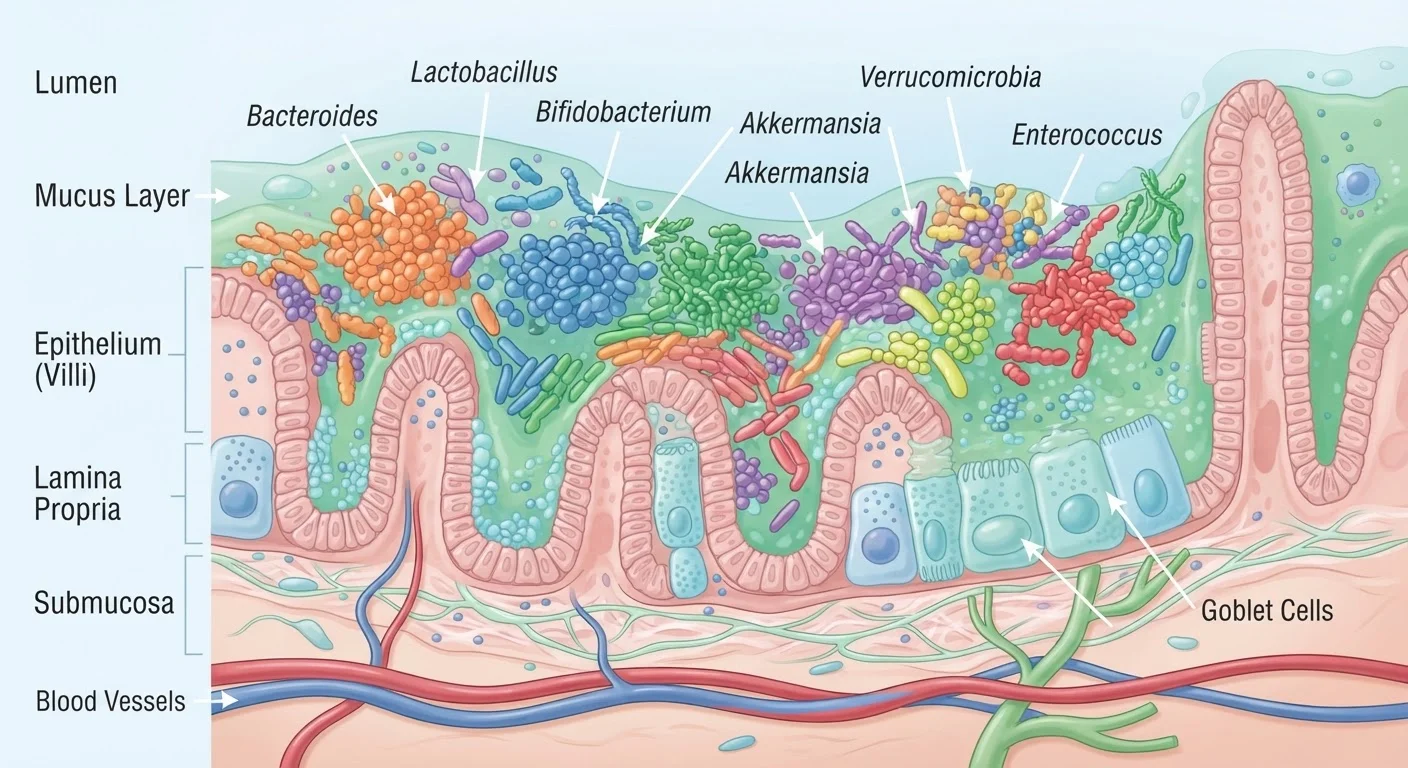
The human gut contains trillions of microorganisms, mostly bacteria, and the range of species present is what scientists call microbiome diversity. Think of it as the biodiversity of an ecosystem: a forest with hundreds of tree species withstands drought, disease, and disturbance better than a monoculture of one. The gut works similarly. When many different bacterial species occupy the intestinal environment, the community can perform a wider range of metabolic tasks, fill in for species that decline, and resist colonization by harmful organisms.
Diversity is typically split into two components. Species richness counts how many distinct types of bacteria are present. Evenness describes whether those species are distributed in balanced proportions or whether one or two dominate while others barely register. A gut with 500 species, most at meaningful levels, scores higher on standard diversity indices than one where 500 species are present but a single strain accounts for 90 percent of the population. For a fuller explanation of the vocabulary researchers use, see the microbiome science glossary.
Researchers measure diversity through DNA sequencing of stool samples. By identifying genetic sequences specific to different microbial species, labs can produce a profile of who is present and in what quantities. These measurements are then summarized using mathematical indices that collapse the complexity into a single score. Understanding what those scores can and cannot tell you is worth doing before drawing conclusions from any test result.
What the evidence says about diversity and health
A consistent pattern has emerged across population studies: lower gut bacterial diversity correlates with higher rates of conditions including obesity, type 2 diabetes, inflammatory bowel disease, allergies, and certain mood disorders. The correlation does not prove that low diversity causes these conditions; it may be that the conditions themselves alter the microbial environment. However, mechanistic research offers plausible reasons why diversity could matter independently.
Different bacterial species produce different metabolites. Short-chain fatty acids (SCFAs), including butyrate, propionate, and acetate, are produced when bacteria ferment dietary fiber. Butyrate, specifically, is the primary fuel source for colonocytes, the cells lining the colon wall. A diverse community is more likely to contain the full range of fiber-fermenting species needed to produce an adequate SCFA supply. A narrower community may leave certain fiber types unfermented, reducing SCFA output and leaving the gut lining less supported.
Immune calibration is another area of interest. Roughly 70 percent of immune tissue is located in or near the gastrointestinal tract, and early microbial colonization appears to influence how immune responses are calibrated. A diverse microbial community during development, and likely throughout adult life, is thought to send more varied signaling to immune cells, potentially reducing excessive inflammatory responses. This line of research is active and not yet settled, so treating it as established fact would overstate the current evidence.
~38 trillion
Estimated microbial cells in the human gut
A widely cited 2016 recalculation by Sender et al. in Cell estimated that microbial cells in the body are roughly equal in number to human cells, with gut bacteria making up the vast majority.
30+ plant foods
Weekly plant variety associated with higher diversity
The American Gut Project, one of the largest citizen-science microbiome studies, found that people consuming more than 30 different plant types per week had measurably higher gut diversity than those consuming 10 or fewer.
Up to 50%
Diversity reduction seen with some antibiotic courses
Multiple studies have documented diversity losses of 25 to 50 percent or more during broad-spectrum antibiotic treatment, with recovery times ranging from weeks to several months.
What reduces microbial diversity
Diet is the most documented modifiable factor. Diets high in ultra-processed foods and low in plant fiber are consistently associated with reduced diversity in observational research. Processed foods provide fewer substrates for bacterial fermentation, meaning many species lose their food source and their populations shrink. Fiber variety, not just fiber quantity, appears to matter: different bacterial species ferment different plant polysaccharides, so eating a wider range of plant foods feeds a wider range of microbes.
Antibiotic use is among the most potent disruptors. Broad-spectrum antibiotics reduce diversity rapidly, sometimes by more than half within days of starting a course. Recovery can take weeks to months, and some studies suggest certain species may not fully return after repeated courses. This is not an argument against antibiotics when they are medically necessary; it is a reason to avoid unnecessary use, as several common habits quietly erode the microbiome in ways that accumulate over time.
Chronic psychological stress, poor sleep, and physical inactivity each show associations with lower diversity, though the mechanisms are less fully characterized than dietary effects. The gut and brain communicate through the gut-brain axis, a bidirectional signaling pathway involving the vagus nerve and various neuroactive compounds. Stress hormones may alter gut motility and secretions in ways that shift the microbial environment. For a detailed look at how lifestyle factors interact with bacterial populations, see lifestyle factors that shape the gut microbial community.
How diversity changes across life and what to watch for
Microbial diversity is not static. It builds rapidly from birth through early childhood, influenced by mode of delivery, feeding method, and early food exposure. It tends to stabilize in adulthood and then decline in later life, a shift associated with narrowing diets, increased medication burden, and reduced physical activity among older adults. Each life stage brings distinct microbiome transitions worth understanding on their own terms.
No universal diversity threshold defines a healthy gut. What researchers observe are population-level associations, not individual cut-offs. Someone with moderately lower diversity but a stable, well-functioning gut may have better health outcomes than someone with high diversity but significant imbalance in specific bacterial groups. Diversity is one signal among many, not a standalone diagnostic. Protecting existing diversity through consistent dietary and lifestyle choices is more actionable than chasing a particular score.
This article is for informational purposes only and is not medical advice. Speak with a qualified healthcare provider before making changes based on microbiome test results or health concerns.