

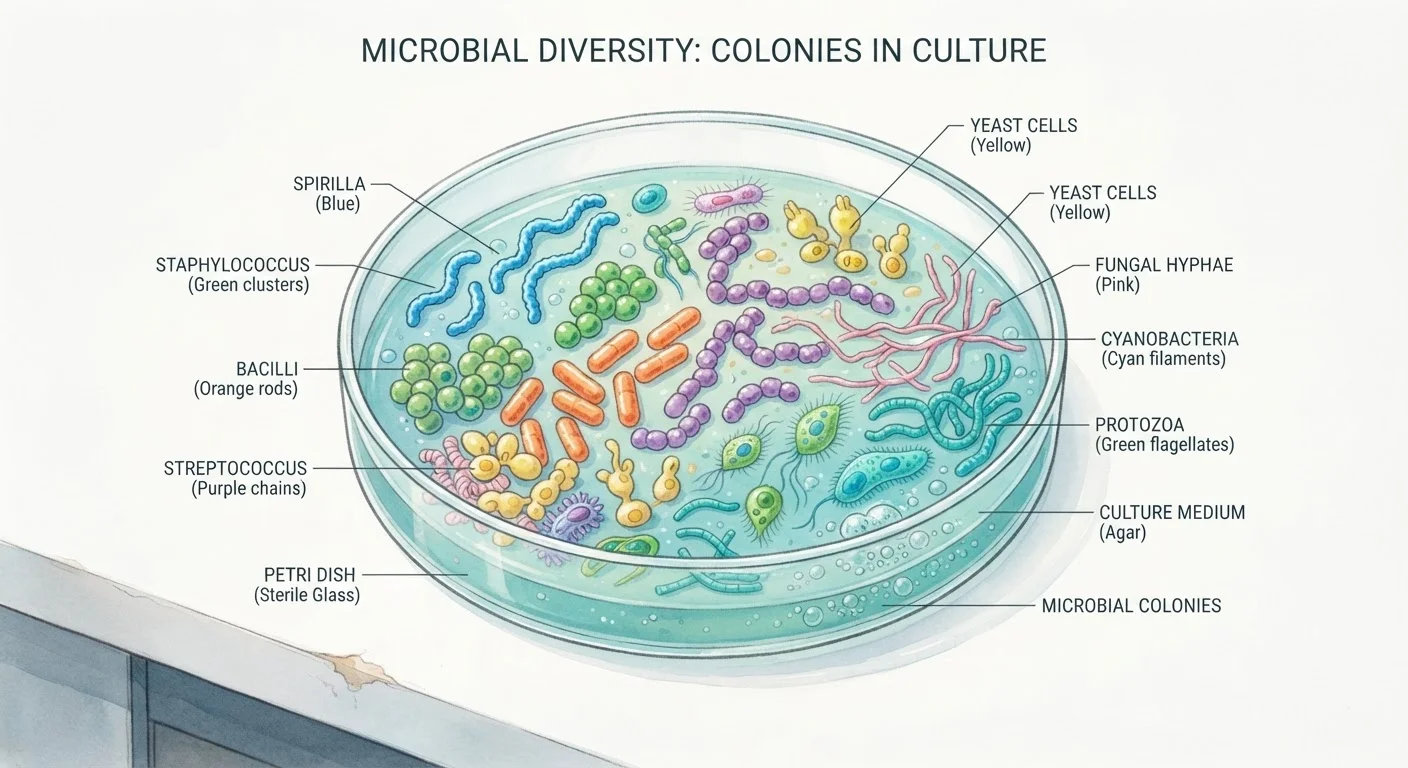
| Estimated gut microbial species | 500 to 1,000+ bacterial species (Human Microbiome Project estimates) |
| Primary site of microbial density | Large intestine (colon) |
| Main method for identifying gut bacteria | 16S rRNA gene sequencing |
| SCFA most studied for colon health | Butyrate (Gastroenterology research consensus) |
| Non-bacterial residents of the gut | Fungi, viruses, archaea, and protozoa |
| Primary factor shaping adult microbiome | Long-term dietary pattern (Repeated finding across observational nutrition studies) |
Why microbiome vocabulary matters
Conversations about gut health now appear regularly in clinical research, nutrition practice, and everyday wellness discussions. Terms like "dysbiosis" and "short-chain fatty acids" show up in health articles, lab reports, and supplement labels without much explanation. Understanding what these words actually mean is the starting point for evaluating any claim about gut health.
This glossary defines the core vocabulary used in microbiome science. It is organized to move from foundational concepts outward to more technical measurement and metabolic terms. For a broader introduction to what microorganisms actually live in the gut and what they do, see our plain-language guide to the microbiome.
This article is for informational purposes only and is not medical advice. Consult a qualified healthcare professional for questions about your personal health.
Microbiome
The complete collection of microorganisms and their genetic material found in a particular environment, most often the human gut. The gut microbiome includes bacteria, fungi, viruses, and archaea.
Microbiota
The living microorganisms themselves within a given environment. Microbiota refers to the community of organisms; microbiome includes their genes and the surrounding conditions.
Dysbiosis
An imbalance in the composition, diversity, or functional output of a microbial community. It is a descriptive term rather than a formal diagnosis and appears across many research contexts.
Metagenomics
The analysis of genetic material taken directly from environmental samples, such as stool. It allows researchers to identify microorganisms and their functions without culturing them in a laboratory.
16S rRNA sequencing
A molecular technique used to identify bacteria by analyzing a specific conserved gene region. It is the most common method for profiling bacterial communities in microbiome research.
Short-chain fatty acids (SCFAs)
Metabolic byproducts produced when gut bacteria ferment dietary fiber. The primary SCFAs are butyrate, propionate, and acetate, each with distinct roles in gut and systemic health.
Butyrate
A short-chain fatty acid produced by bacterial fermentation of fiber. It is the main energy source for colonocytes and is associated with intestinal barrier integrity and anti-inflammatory activity.
Intestinal permeability
A measure of how selectively the gut lining permits substances to pass into the bloodstream. Altered permeability is studied in relation to various inflammatory and metabolic conditions.
Colonocyte
The epithelial cells that line the inner surface of the colon. They absorb nutrients, maintain the gut barrier, and are fueled largely by butyrate produced by gut bacteria.
Enterotype
A proposed classification that groups people by the dominant bacterial genera in their gut. The concept is scientifically debated; most researchers now view microbiome composition as a continuum.
Gut-liver axis
The bidirectional communication pathway between the gut microbiome and the liver, mediated through the portal vein, bile acids, and microbial metabolites.
Archaea
Single-celled microorganisms distinct from bacteria that inhabit the gut. Methane-producing archaea called methanogens are the most studied group in human gut research.
Core terms: community, balance, and disruption
The most frequently used terms in gut health reporting cluster around how microbial communities are structured and what happens when that structure shifts.
| Estimated gut microbial species | 500 to 1,000+ bacterial species (Human Microbiome Project estimates) |
| Primary site of microbial density | Large intestine (colon) |
| Main method for identifying gut bacteria | 16S rRNA gene sequencing |
| SCFA most studied for colon health | Butyrate (Gastroenterology research consensus) |
| Non-bacterial residents of the gut | Fungi, viruses, archaea, and protozoa |
| Primary factor shaping adult microbiome | Long-term dietary pattern (Repeated finding across observational nutrition studies) |
Microbiome refers to the full collection of microorganisms and their genetic material found in a given environment, most commonly the gut. The gut microbiome includes bacteria, fungi, viruses, and archaea. The distinction between microbiome (genes and environment) and microbiota (the organisms themselves) matters in research contexts, though the two are often used interchangeably in general writing. For a detailed look at the non-bacterial residents, see the full cast of the gut microbiome.
Dysbiosis describes a state of imbalance in the microbial community, where the composition, diversity, or metabolic activity of the microbiome shifts away from a pattern associated with health. It is not a single defined disease state but a descriptive term used across a range of conditions. The mechanisms behind dysbiosis and the factors that drive it are covered in detail at what disrupts the gut microbiome.
Microbial diversity refers to the number and relative abundance of different species present in a community. Greater diversity is generally associated with more stable, resilient gut function, though the relationship is not simple. Why diversity matters and what reduces it is explored in a companion article.
For related vocabulary on the gut-body connection, including enteric nervous system terminology, see key terms in gut health research.
Measurement and metabolic terms
Researchers studying the microbiome rely on specific methods and measure specific outputs. These terms appear often in published studies and, increasingly, in consumer testing services.
Metagenomics is the study of genetic material recovered directly from a sample, such as stool, without culturing individual organisms in a lab. It allows scientists to identify which microorganisms are present and what genes they carry, even for species that cannot be grown outside the body.
16S rRNA sequencing is a common technique that identifies bacteria by analyzing a specific gene segment shared across bacterial species but variable enough to distinguish between them. It is widely used in microbiome research because it is relatively fast and cost-effective, though it does not capture fungi or viruses and provides genus-level rather than species-level identification in many cases.
Short-chain fatty acids (SCFAs) are compounds produced when gut bacteria ferment dietary fiber. The three most studied are butyrate, propionate, and acetate. Butyrate, in particular, is the primary energy source for colonocytes (the cells lining the colon) and is associated with intestinal barrier function. SCFAs are also absorbed into the bloodstream and may influence metabolism and immune signaling more broadly.
Intestinal permeability refers to how selectively the gut lining controls what passes from the intestinal cavity into the bloodstream. The term "leaky gut" is sometimes used colloquially for increased permeability, though this is not a formal clinical diagnosis. Research into how microbial activity relates to barrier integrity is ongoing.
Enterotype is a classification system proposed to group individuals by the dominant bacterial genera in their gut. The concept remains debated; current evidence suggests microbiome composition exists on a continuum rather than falling into fixed categories.
The gut-liver axis describes bidirectional communication between the gut microbiome and liver function, primarily through the portal vein and bile acid signaling. Microbial metabolites produced in the colon reach the liver directly, which connects gut health research to broader metabolic topics including liver health.