

Key Takeaways
Start here
What the gut microbiome actually is
Meet the residents
Who lives there: the residents of your gut
Understand the function
What your gut microbiome does for you
See what influences it
What shapes your microbial community
Learn about imbalance
When the balance shifts: dysbiosis
What the gut microbiome actually is
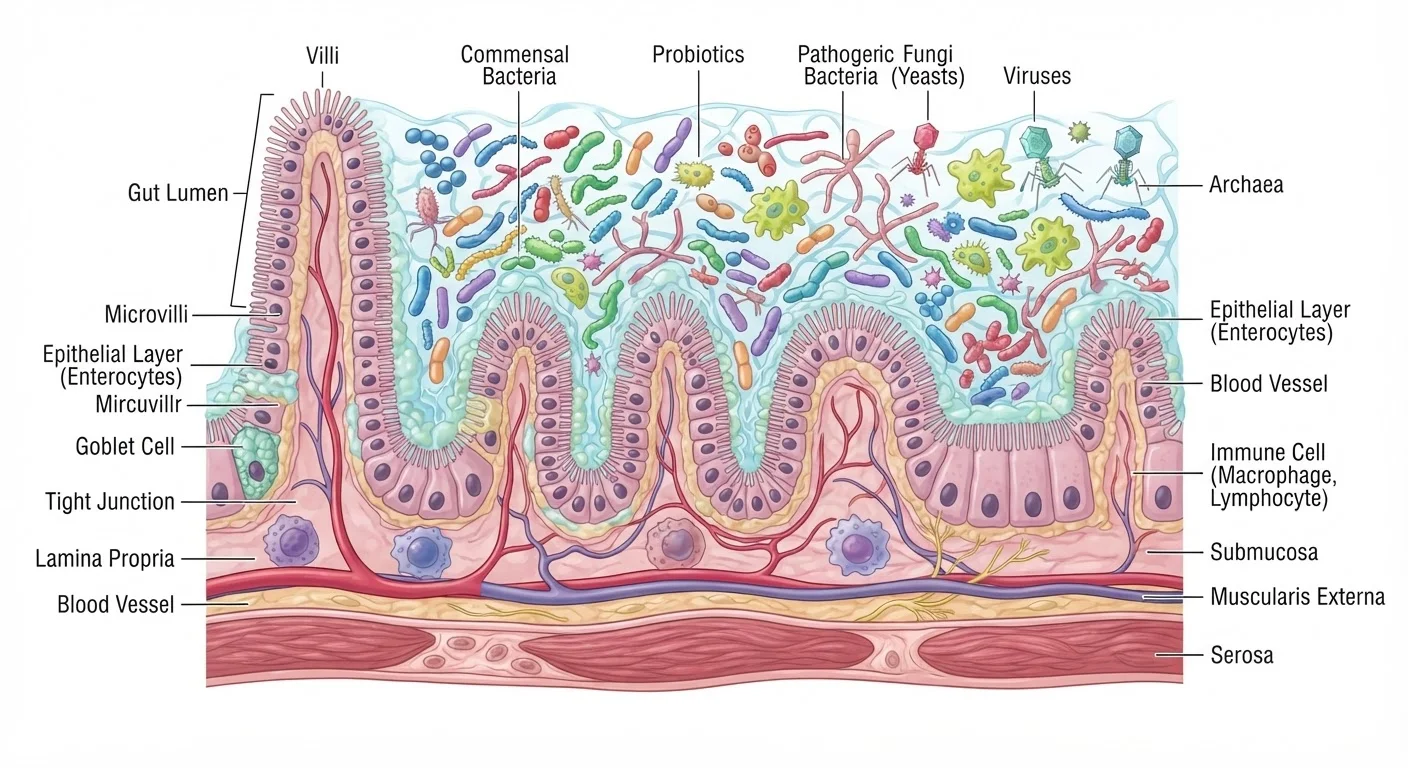
Your digestive tract is home to a vast community of microorganisms: bacteria, fungi, viruses, and archaea (single-celled organisms distinct from bacteria). Together, this community is called the gut microbiome. Most of its members live in the large intestine, where conditions favor their survival.
The word microbiome technically refers to the collective genetic material of all these organisms, while microbiota refers to the organisms themselves. In practice, the two terms are used interchangeably, and this guide follows that convention.
Each person's microbiome is unique, shaped by genetics, diet, where they live, and how they were born and fed as infants. If you are new to the broader topic of digestive wellness, the first-timer's overview of gut health covers the foundational context before you go deeper here.
Microbiome
The complete collection of microorganisms living in a specific environment, plus all of their genetic material. In everyday use, gut microbiome refers to the community of microorganisms in the digestive tract.
Microbiota
The actual living microorganisms (bacteria, fungi, viruses, archaea) that inhabit the gut. This term is often used interchangeably with microbiome.
Short-chain fatty acids (SCFAs)
Small molecules produced when gut bacteria ferment dietary fiber. Butyrate is the best studied and serves as a primary energy source for colon cells.
Dysbiosis
A state of imbalance in the gut microbial community, such as reduced diversity or overgrowth of certain species. It is a descriptive pattern, not a single diagnosed condition.
Colonization resistance
The ability of an established microbial community to prevent new, potentially harmful microorganisms from taking hold, largely through competition for resources.
Bacteriophage
A type of virus that infects bacteria rather than human cells. Bacteriophages are present in the gut and influence which bacterial species thrive.
Who lives there: the residents of your gut
Bacteria are by far the most studied residents. In a healthy adult gut, the two most abundant bacterial phyla (broad groupings) are Firmicutes and Bacteroidetes, which together account for the majority of bacterial species present. Other phyla, including Actinobacteria and Proteobacteria, are present in smaller numbers but still carry out meaningful functions.
Beyond bacteria, the gut also contains fungi (collectively called the mycobiome), bacteriophages (viruses that infect bacteria rather than human cells), and archaea. Each group interacts with the others in ways researchers are still mapping. For a fuller breakdown of all microbial groups and their individual roles, see the full cast of the gut microbiome.
Within any microbial community, some species provide direct benefits, some are neutral, and a small number can cause harm if they overgrow. Whether a species causes harm often depends on context: population size, available nutrients, and the state of the intestinal lining all factor in.
What your gut microbiome does for you
Gut microorganisms carry out several functions that human cells cannot perform alone.
- Fiber fermentation: bacteria in the colon break down dietary fiber into short-chain fatty acids (SCFAs), particularly butyrate, acetate, and propionate. Butyrate is a primary energy source for the cells lining the colon and has been studied for its role in maintaining the intestinal barrier.
- Vitamin production: certain gut bacteria synthesize vitamin K and some B vitamins, including folate and biotin, contributing to the body's overall supply.
- Immune education: the gut microbiome interacts continuously with the immune system. During early life especially, microbial exposure appears to help the immune system distinguish between harmless substances and genuine threats.
- Pathogen resistance: a dense, diverse microbial community competes for nutrients and space, making it harder for harmful organisms to establish themselves. This is sometimes called colonization resistance.
The gut microbiome also communicates with the central nervous system through the gut-brain axis. Learn how the gut shapes whole-body health, including its connections to immunity and mood.
Diversity is worth thinking about
Eating a wider variety of plant foods is consistently associated with greater microbial species diversity in research. Aiming for more distinct vegetables, legumes, and whole grains across the week is a practical, low-risk starting point. No specific target number is established as a universal recommendation, so work with what suits your health history and any guidance from a dietitian.
What shapes your microbial community
Several factors influence the composition of the gut microbiome over a lifetime.
Diet is the most modifiable factor. A diet high in diverse plant fiber feeds a wider range of bacterial species. Fermented foods introduce live microorganisms that may temporarily expand microbial diversity. Ultra-processed foods with low fiber content are associated with reduced microbial variety in observational studies, though causation is difficult to establish definitively.
Antibiotic use reduces bacterial populations broadly, including beneficial species. Recovery after a course of antibiotics varies by individual and by the antibiotic used.
Birth and early life have lasting effects. Infants born vaginally are exposed to maternal bacteria during delivery; those born by cesarean section have a different initial microbial exposure. Breastfeeding introduces additional microbial species and compounds that support early colonization.
Environment and lifestyle also matter. Physical activity, sleep quality, and stress levels all show associations with microbiome composition in research, though the mechanisms are not yet fully understood.
For practical guidance on eating patterns that support microbial diversity, see building a gut-friendly eating pattern.
When the balance shifts: dysbiosis
Dysbiosis refers to an imbalance in the gut microbial community, typically a reduction in beneficial species, an overgrowth of potentially harmful ones, or a loss of overall diversity. The term describes a pattern rather than a single defined condition, and researchers use it differently across studies.
Dysbiosis has been associated with conditions including irritable bowel syndrome, inflammatory bowel disease, and metabolic changes, though researchers are still working to determine whether microbial imbalance causes these conditions, results from them, or both. This is an active area of investigation, and findings should be interpreted with appropriate caution.
Common signs that may accompany disrupted gut balance include bloating, irregular bowel movements, and abdominal discomfort. These symptoms overlap with many other conditions, so a healthcare provider is best placed to evaluate them.
For precise definitions of terms used in gut health research, including dysbiosis, the plain-language gut health reference is a useful companion to this guide.
This article is for general informational purposes only and is not medical advice. Always consult a qualified healthcare professional for personal health concerns, diagnosis, or treatment decisions.