

Key Takeaways
Gut microbiome
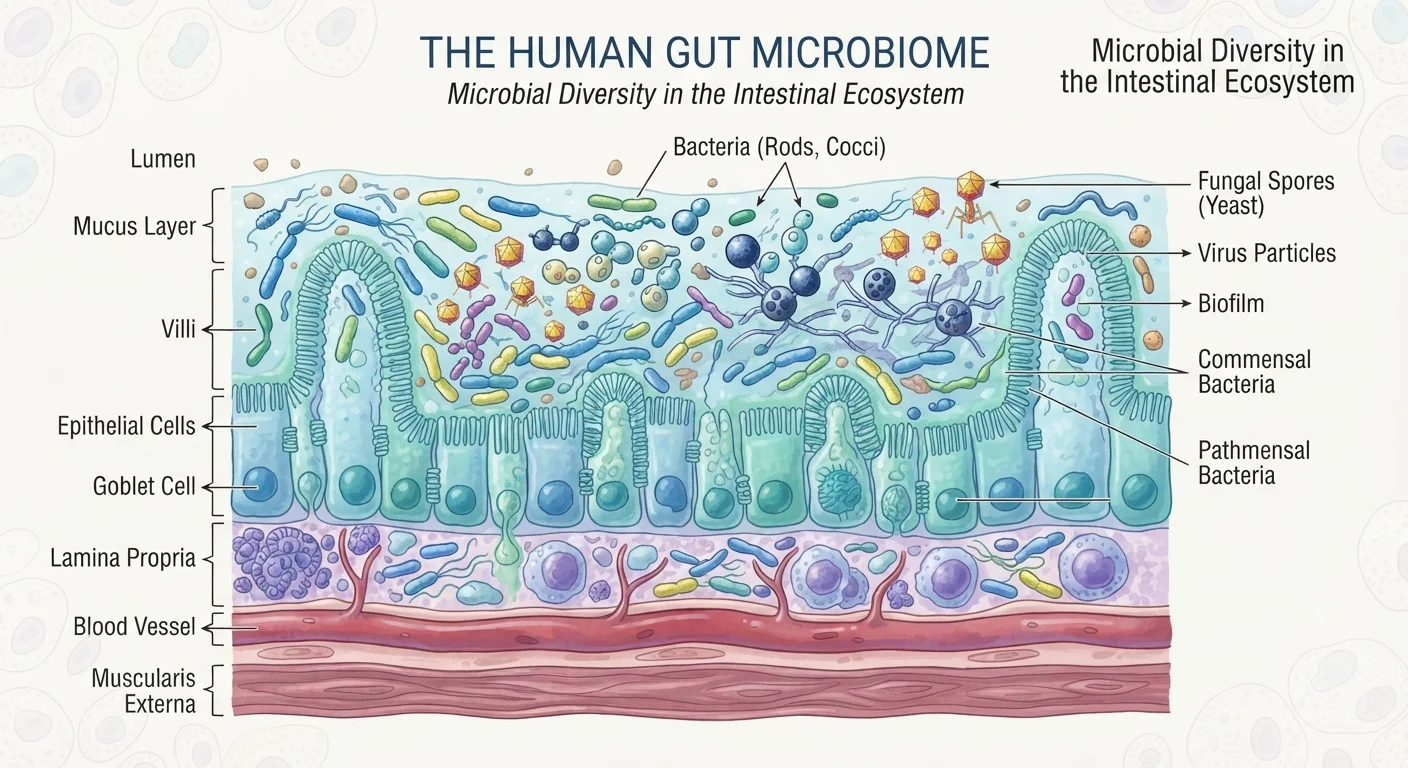
The gut microbiome is the full community of microorganisms living in the digestive tract, including bacteria, fungi, viruses, archaea, and protozoa. These organisms are not passive passengers. They digest certain foods, produce compounds the body uses, and interact constantly with immune tissue lining the gut wall. The composition of this community differs from person to person based on diet, genetics, age, and environment.
Researchers characterize the microbiome using metagenomic sequencing, which identifies microbial DNA from stool or tissue samples without requiring organisms to be cultured in a lab.
Why the microbiome is not just bacteria
Most coverage of gut health focuses on bacteria, and for good reason: bacteria make up the largest share of gut microbial biomass and have been studied longest. The full microbiome picture, however, includes at least four other distinct groups, each with its own biology and its own relationship to digestive function.
Framing the microbiome as bacteria-only leads to an incomplete understanding of how that community behaves, how it responds to disruption, and why interventions like antibiotics have effects that extend well beyond their bacterial targets. Recognizing the full cast matters for anyone trying to understand gut health with more than surface-level accuracy.
A note on microbiome research methods
Most knowledge about the gut microbiome comes from stool samples analyzed by DNA sequencing. This method captures genetic material from dead and living organisms alike and may not fully represent what is active in the gut at any moment. Results also vary depending on sequencing technology and the region of microbial DNA targeted. Findings should be interpreted with that methodological context in mind.
Bacteria: the most studied residents
The bacterial microbiome contains hundreds of species, though a relatively small number of phyla account for most of the population. Firmicutes and Bacteroidetes together make up the bulk of gut bacteria in adults. Actinobacteria, Proteobacteria, and Verrucomicrobia are present in smaller proportions but are functionally significant.
Bacteria perform many of the microbiome's best-documented functions. Certain species ferment dietary fiber into short-chain fatty acids (SCFAs) such as butyrate, propionate, and acetate. Butyrate in particular is the preferred energy source for colonocytes, the cells lining the colon wall. Other bacterial species synthesize B vitamins, modulate bile acid metabolism, and compete with potential pathogens for adhesion sites on the gut lining.
For a deeper look at how these bacteria interact with the body's defense systems, see our article on how gut bacteria influence immunity.
Fungi: a small but reactive community
Fungi colonize the gut in far smaller numbers than bacteria, but they are not trivial. The gut mycobiome includes genera such as Candida, Saccharomyces, Malassezia, and Aspergillus. In a balanced gut environment, these populations remain stable, kept in check partly by bacterial competitors and partly by host immune responses.
The mycobiome becomes clinically relevant when that balance shifts. Antibiotic use, for example, removes bacterial competitors and can allow fungal populations to expand. Research has connected disrupted mycobiome composition to inflammatory bowel conditions, though the direction of causality is not fully established. The gut-fungal connection is an active area of investigation, particularly regarding Candida species.
Viruses and phages: the overlooked majority
By particle count, viruses outnumber every other microbial group in the gut. The vast majority are bacteriophages, viruses that infect bacteria rather than human cells. Phages exert constant selective pressure on bacterial populations, killing certain strains while leaving others, which shapes which bacteria dominate at any given time.
The gut virome also includes eukaryotic viruses that infect host cells, but in healthy adults these are present at low levels and do not produce active disease. Some, such as members of the Anelloviridae family, appear to persist asymptomatically throughout life and may play regulatory roles in immune function, though research into the virome remains less developed than bacterial microbiome science.
~38 trillion
Estimated bacterial cells in the adult gut
A widely cited 2016 estimate by Sender et al. in Cell put the number of bacteria in the human body at roughly the same order as human cells.
10:1
Ratio of phages to bacteria in the gut
Phage populations are estimated to outnumber bacteria by approximately ten to one in the gastrointestinal tract, according to gut virome research reviews.
200+
Fungal species identified in the gut mycobiome
Metagenomic surveys have catalogued over 200 fungal species across healthy adult gut samples, with composition varying significantly between individuals.
Archaea and protozoa: the smaller roles
Archaea resemble bacteria in size and shape but belong to a completely separate domain of life. In the gut, the dominant archaea are methanogens, particularly Methanobrevibacter smithii. These organisms consume hydrogen generated as a byproduct of bacterial fermentation, converting it to methane. This process prevents hydrogen accumulation that would otherwise slow fermentation and reduce the gut's capacity to break down complex carbohydrates.
Protozoa are single-celled eukaryotes that round out the gut community. Most protozoa detected in the human gut outside of clinical infection are commensal, meaning they coexist without apparent harm. Their functional contributions are less characterized than those of bacteria or archaea, and research into their role in healthy gut ecology is still limited.
Understanding how all these groups interact helps explain why microbiome disruption often produces effects beyond what bacterial changes alone would predict.
How the groups interact with each other
These microbial groups do not operate in isolation. Bacteria and fungi compete for nutrients and adhesion sites. Bacteriophages determine which bacterial strains survive. Archaea depend on bacterial fermentation to produce the hydrogen they consume. The result is a web of dependencies that makes the microbiome more dynamic than a simple list of residents suggests.
This cross-kingdom ecology also has implications for how the microbiome communicates with the rest of the body. Compounds produced by bacteria influence fungal growth, phage activity affects the metabolic output of bacterial communities, and shifts in archaea alter the fermentation chemistry that downstream tissues respond to. For anyone tracking gut health, the takeaway is that no single group tells the whole story.
This article is for informational purposes only and is not medical advice. Consult a qualified healthcare professional before making changes related to any health condition.