

Key Takeaways
Hepatic cholesterol synthesis
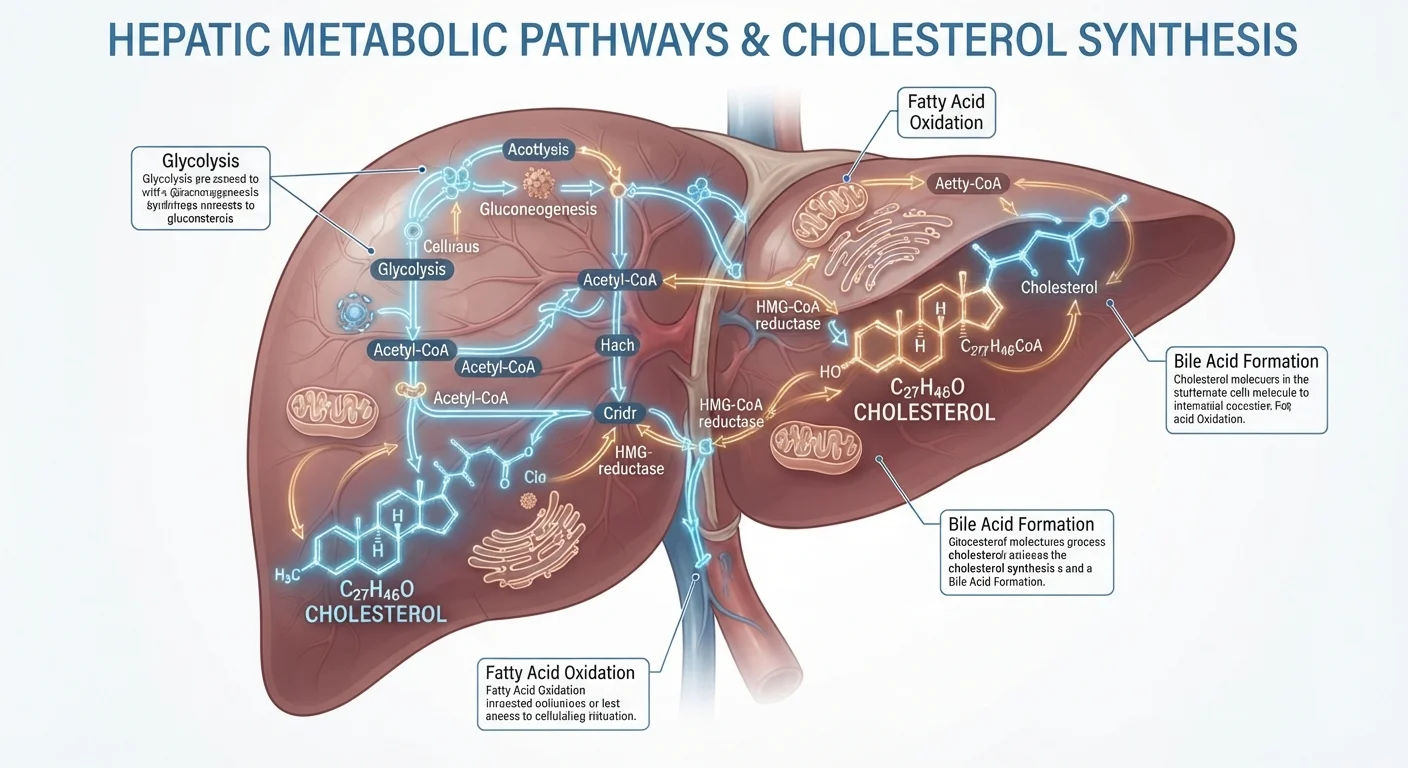
Hepatic cholesterol synthesis is the process by which liver cells manufacture cholesterol from simpler molecules, primarily acetyl-CoA. This internal production accounts for roughly 70 to 80 percent of the cholesterol in your bloodstream, with dietary intake contributing the remainder. The liver also regulates how much cholesterol circulates by adjusting its own output and clearing cholesterol-carrying particles from the blood.
The rate-limiting step is catalyzed by the enzyme HMG-CoA reductase, which converts HMG-CoA to mevalonate. Statin medications work by inhibiting this enzyme.
Why the liver, not your plate, drives most cholesterol
Most people assume that the cholesterol in their blood comes primarily from food. In practice, the liver synthesizes roughly 70 to 80 percent of circulating cholesterol on its own, adjusting output according to the body's needs. Dietary intake fills only the remaining fraction.
This matters because it changes how we interpret cholesterol management. Cutting back on eggs or red meat can influence blood lipids, but the liver's internal production is the dominant variable for most people. To understand that production, it helps to know the basic biochemical pathway involved.
For broader context on what cholesterol actually is and why the body needs it, see our overview of what cholesterol is and does.
How liver cells build cholesterol step by step
Cholesterol synthesis begins inside hepatocytes (liver cells) with acetyl-CoA, a molecule derived from the metabolism of carbohydrates, fats, and proteins. Through a multi-step pathway called the mevalonate pathway, acetyl-CoA is converted through a series of intermediates until cholesterol is assembled.
The central control point is an enzyme called HMG-CoA reductase. This enzyme converts HMG-CoA into mevalonate, a step that commits the cell to producing cholesterol. Because it is the slowest and most regulated step in the chain, it determines how much cholesterol the liver makes at any given time.
The liver can sense intracellular cholesterol levels through a family of proteins called SREBPs (sterol regulatory element-binding proteins). When cholesterol inside the cell falls low, SREBPs activate genes that increase HMG-CoA reductase activity and ramp up synthesis. When intracellular cholesterol is adequate, the reverse happens and production slows. This feedback loop is the liver's primary self-regulation mechanism.
70-80%
Cholesterol produced by the liver
Estimates from lipid metabolism research consistently attribute the majority of circulating cholesterol to endogenous (liver-based) synthesis rather than dietary intake.
~30
Steps in the cholesterol synthesis pathway
The mevalonate pathway that the liver uses to build cholesterol involves approximately 30 enzymatic steps from acetyl-CoA to the finished molecule.
1 in 250
Adults with familial hypercholesterolemia
The American Heart Association estimates that heterozygous familial hypercholesterolemia affects roughly 1 in 250 people, making it one of the most common inherited metabolic disorders.
How the liver clears cholesterol from circulation
Production is only half the equation. The liver also retrieves cholesterol from the bloodstream through LDL receptors on the surface of hepatocytes. These receptors bind to LDL particles (low-density lipoprotein, the main cholesterol carrier), pull them into the cell, and break them down for reuse.
The number of LDL receptors the liver expresses is a major determinant of how high LDL cholesterol climbs in the blood. When intracellular cholesterol is abundant, the liver produces fewer LDL receptors, so less LDL is cleared and more stays in circulation. This is why inherited conditions that reduce LDL receptor function, such as familial hypercholesterolemia, cause persistently high LDL even when diet is controlled.
Excess intracellular cholesterol is exported into bile as either free cholesterol or bile acids. These compounds travel through bile ducts into the small intestine, where they assist in fat digestion. A portion is reabsorbed and recycled; the rest is eliminated. Soluble dietary fiber can bind bile acids in the gut and block their reabsorption, which forces the liver to convert more cholesterol into new bile acids and thereby lowers the circulating pool. Soluble fiber and other dietary compounds that interact with this cycle are discussed in more detail elsewhere.
What disrupts normal regulation
Several factors can override the liver's feedback control, causing cholesterol production to stay elevated even when blood levels are already high.
- Genetics: Mutations in LDL receptor genes or in PCSK9 (a protein that degrades LDL receptors) reduce the liver's ability to clear LDL from circulation.
- Insulin resistance: When cells do not respond normally to insulin, the liver often increases cholesterol and triglyceride production. Non-alcoholic fatty liver disease, which is closely tied to insulin resistance, frequently alters lipid metabolism in this way. The liver's broader metabolic role is relevant context here.
- Thyroid function: The thyroid hormone T3 increases LDL receptor expression in the liver. Hypothyroidism (low thyroid activity) reduces receptor numbers and can raise LDL.
- Sex hormones: Estrogen tends to increase LDL receptor activity, which is one reason LDL often rises after menopause. This connects to broader patterns described in how cholesterol changes across the lifespan.
Talk to your provider about your liver's role
If your LDL remains high despite dietary changes, ask your healthcare provider whether liver-level factors such as genetics, thyroid function, or insulin resistance may be involved. A full lipid panel combined with liver function tests can give a more complete picture of what is driving your numbers.
This article is for informational purposes only and is not a substitute for professional medical advice, diagnosis, or treatment. Consult a qualified healthcare provider regarding any questions about your cholesterol or liver health.