
Cholesterol Across the Lifespan: How Levels Shift from Childhood to Later Life

Key Takeaways
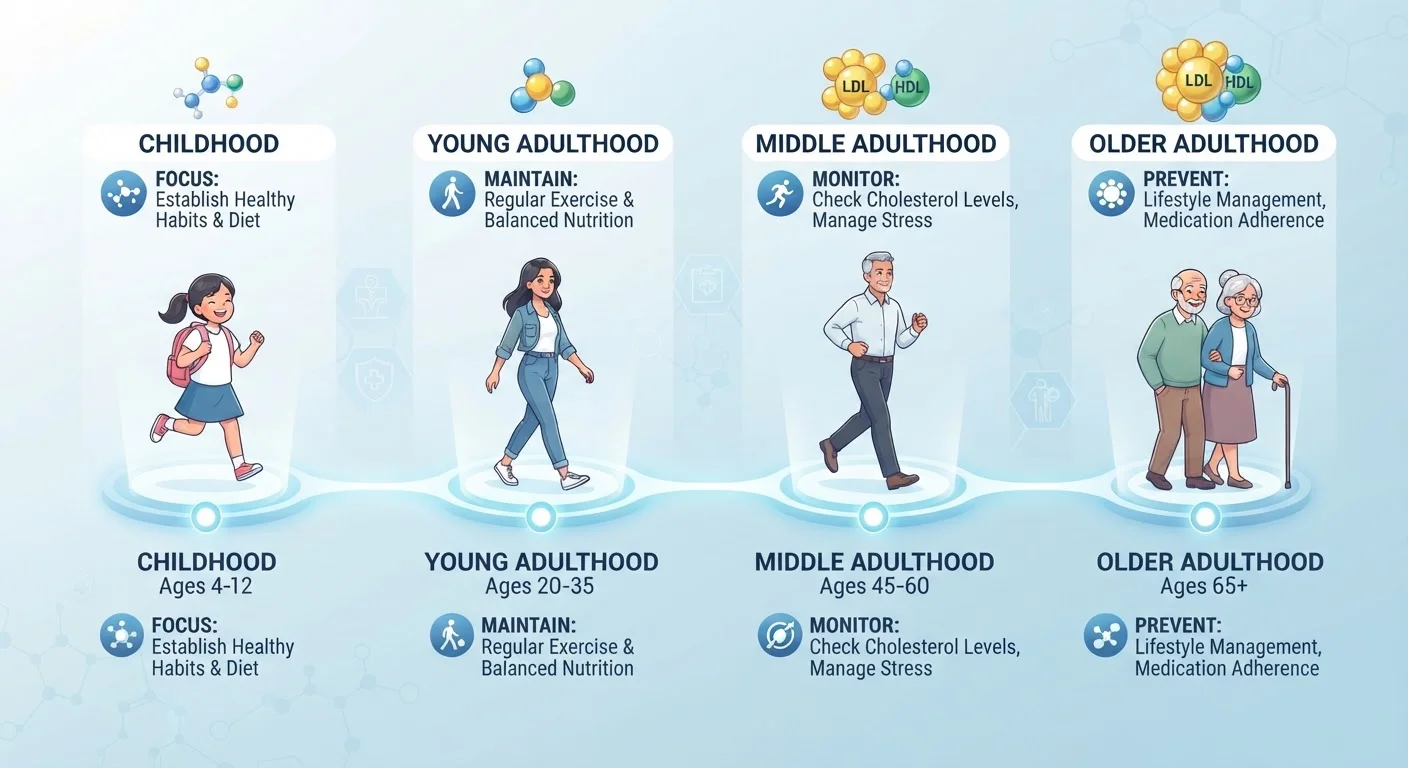
Cholesterol across the lifespan
Cholesterol is a waxy substance the body produces and uses to build cells, make hormones, and digest fats. The amounts of different cholesterol types circulating in the blood are not fixed: they rise and fall in response to age, hormonal changes, genetics, and lifestyle. What is considered a healthy range for a child differs from what is appropriate for a postmenopausal adult.
Lipid panels measure total cholesterol, low-density lipoprotein (LDL), high-density lipoprotein (HDL), and triglycerides. Each fraction has its own age-related trajectory, and clinicians consider all four values together rather than any single number in isolation.
Cholesterol in childhood and adolescence
Most people think of high cholesterol as a midlife concern, but the process of lipid accumulation in artery walls can begin in childhood. Autopsy studies going back decades have found early fatty streaks in the arteries of children and teenagers, particularly those with elevated LDL.
In healthy newborns, total cholesterol is relatively low, typically below 100 mg/dL. Values rise through early childhood and tend to stabilize between ages 2 and 8. During puberty, a temporary dip often occurs, particularly in boys, driven by hormonal changes and increases in body composition. After adolescence, levels generally resume an upward trajectory into early adulthood.
Pediatric guidelines in the United States recommend universal cholesterol screening between ages 9 and 11, and again between 17 and 21. Children with a parent or grandparent diagnosed with premature cardiovascular disease or a genetic lipid disorder warrant earlier evaluation. Genetic conditions such as familial hypercholesterolemia can push LDL to dangerously high levels from birth, well before any dietary pattern could be responsible.
Early adulthood: a deceptively stable period
In the twenties and early thirties, many adults have lipid profiles that fall within acceptable ranges, which can create a false sense of security. LDL does tend to be lower in this group on average, but it is not uniformly so. Young adults who carry genetic variants associated with high LDL, or who have diets high in saturated fat, can already have elevated values.
A common misconception is that cholesterol is only a concern later in life. Plaque development is slow and cumulative. Elevated LDL during early adulthood contributes to arterial changes that may not produce symptoms for 20 or 30 years. This is precisely why establishing a baseline lipid panel in the early twenties is recommended, even in the absence of symptoms or family history.
Lipid panels during pregnancy
Total cholesterol and triglycerides rise considerably during pregnancy as part of normal fetal development. Clinicians generally do not interpret a lipid panel drawn during pregnancy the same way as one drawn outside of it. Postpartum testing, usually several months after delivery, gives a more accurate picture of a woman's baseline lipid status. Anyone with questions about cholesterol during or after pregnancy should speak with their obstetric or primary care provider.
Diet influences cholesterol levels, but the relationship is more complex than often assumed. The liver manufactures roughly 75 to 80 percent of total cholesterol internally, which is why genetic factors often outweigh dietary ones in determining an individual's baseline numbers.
Midlife: hormonal shifts and rising LDL
From the late thirties onward, LDL tends to rise gradually in both men and women. In men, this increase is relatively linear through middle age. In women, the trajectory is different: LDL often remains somewhat lower than in age-matched men during the reproductive years, partly because estrogen supports higher HDL and moderates LDL.
The transition through perimenopause and into menopause changes this picture substantially. As estrogen falls, LDL typically increases and HDL may decrease. Hormonal shifts during this period affect lipid metabolism directly, and many women see their total cholesterol cross into elevated territory within a few years of their final menstrual period.
Triglycerides also tend to rise through midlife, influenced by body weight, physical activity levels, and carbohydrate intake. Cholesterol does not act in isolation: blood pressure, inflammation, and blood glucose all shift during midlife, and clinicians consider these factors together when assessing cardiovascular risk.
1 in 250
People estimated to have familial hypercholesterolemia
According to the American Heart Association, familial hypercholesterolemia is one of the most common inherited conditions affecting cardiovascular risk.
~75-80%
Proportion of cholesterol produced by the liver
The body's internal production accounts for the majority of circulating cholesterol, which is why genetics often has a greater influence than diet on baseline levels.
Ages 9-11
Recommended age for first universal cholesterol screening
The American Academy of Pediatrics recommends this window for routine lipid panel testing in all children, regardless of family history.
Later life: what aging does to lipid profiles
In adults over 65, total cholesterol may plateau or decline slightly, but this does not mean risk diminishes. Decades of cumulative LDL exposure, arterial stiffening, and changes in liver function all affect how the body processes lipids. The liver loses some efficiency with age, which can alter how quickly LDL is cleared from the bloodstream.
HDL levels in older adults also tend to decrease. Lower HDL is associated with reduced reverse cholesterol transport, the process by which excess cholesterol is carried from tissues back to the liver for disposal. This shift can increase cardiovascular risk even when total cholesterol numbers appear unremarkable on a standard report.
For older adults, the absolute cardiovascular risk matters more than any single cholesterol number. A clinician weighs age, blood pressure, smoking history, diabetes status, and lipid values together, often using validated risk calculators, to determine whether treatment is appropriate. Blood pressure follows a similarly age-related pattern, and the two conditions frequently appear together in older adults, compounding risk.
This article provides general health information and is not a substitute for personalized medical advice. Consult a qualified healthcare professional about your cholesterol levels, screening schedule, or any concerns about cardiovascular risk.