
Androgenetic Alopecia vs Telogen Effluvium: Two Very Different Kinds of Hair Loss

Key Takeaways
Option A
Androgenetic Alopecia
The progressive, hormone-driven form of hair loss.
Best for: Understanding chronic, patterned thinning that typically worsens over years without intervention.
Option B
Telogen Effluvium
The reactive, often temporary shedding triggered by physical or emotional stress.
Best for: Identifying sudden, diffuse shedding linked to a specific life event or systemic stressor.
If your hair is thinning in a defined pattern at the crown or temples
Androgenetic Alopecia
Patterned thinning concentrated at specific zones is characteristic of androgenetic alopecia, where androgen signalling progressively miniaturises follicles in those areas.
If you experienced sudden, widespread shedding after illness, surgery, or major stress
Telogen Effluvium
A systemic shock can push large numbers of follicles into the resting phase simultaneously, causing diffuse shedding that typically appears weeks after the triggering event.
If hair loss has persisted for more than a year without a clear life stressor
Androgenetic Alopecia
Chronic, gradual thinning that does not resolve on its own is more consistent with the progressive, genetically driven nature of androgenetic alopecia.
If you are postpartum, recently recovered from an illness, or under nutritional stress
Telogen Effluvium
These are among the most common triggers for telogen effluvium, and shedding in this context often resolves within several months once the body stabilises.
What each condition actually is
Androgenetic alopecia (AGA) is the most common form of hair loss in adults. It results from a genetically encoded sensitivity to dihydrotestosterone (DHT), a derivative of testosterone. In susceptible follicles, DHT binds to androgen receptors and triggers a gradual shortening of the growth phase (anagen). Over successive cycles, the follicle produces thinner, shorter hairs until it eventually stops producing visible hair at all. This process is called miniaturisation, and it is generally considered irreversible without medical intervention. To understand the cycle mechanics in more depth, see the biology of hair loss.
Telogen effluvium (TE) is a reactive condition, not a disease process in the same sense. A significant physiological or psychological stressor disrupts the normal hair cycle, causing an abnormally large proportion of follicles to enter the telogen (resting) phase simultaneously. When those follicles shed their hairs, typically two to three months after the triggering event, the loss can appear alarming but reflects a synchronised cycle interruption rather than follicle damage. Hormonal fluctuations around pregnancy and postpartum recovery are among the most recognisable triggers. Hormonal changes across life stages covers this in detail.
How the two conditions differ in presentation
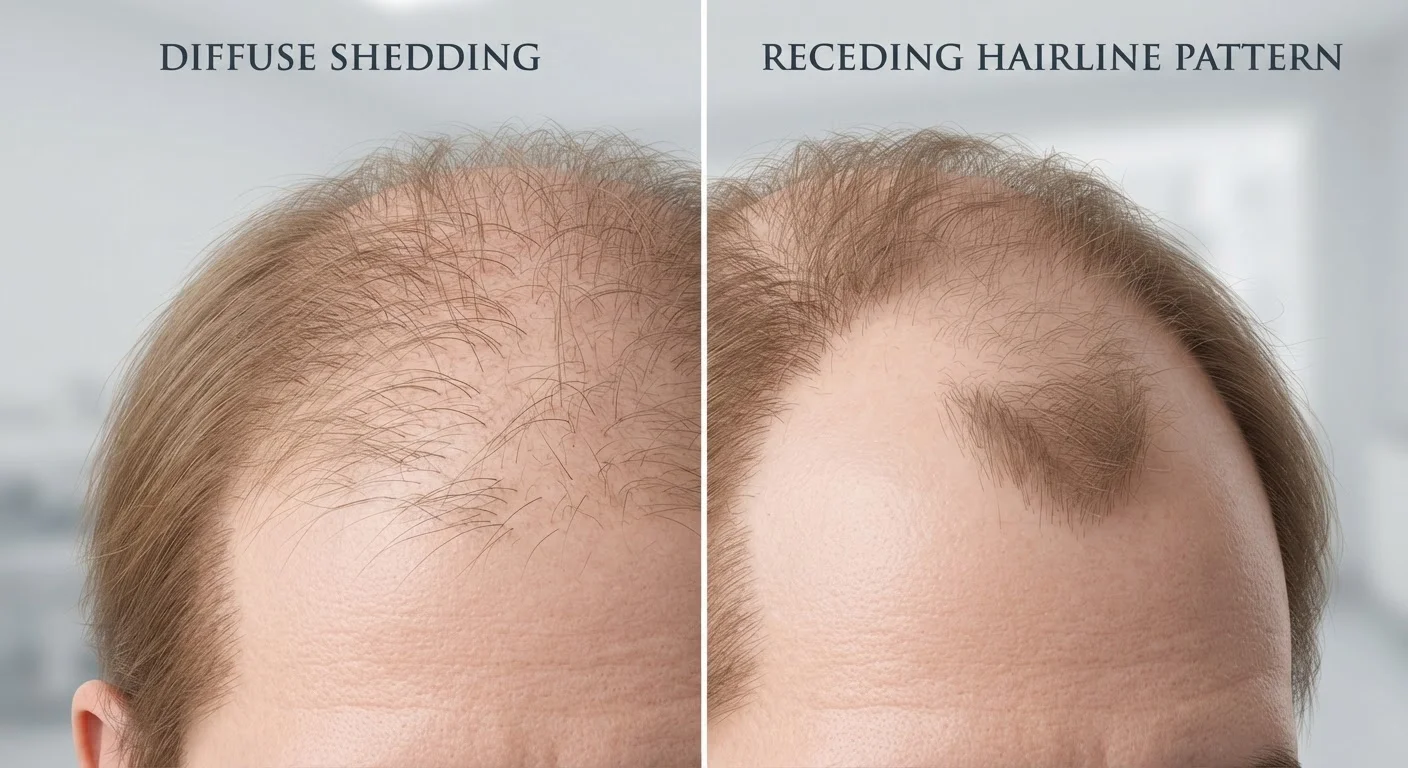
The distribution of hair loss is the first and most telling distinction. Androgenetic alopecia concentrates at specific zones: the frontal hairline and crown in men (following the Hamilton-Norwood scale), and diffuse thinning at the crown with hairline preservation in women (following the Ludwig scale). The scalp in affected areas may become more visible over months or years, but the loss is gradual and patterned.
Telogen effluvium presents as generalised thinning across the entire scalp. There is no predefined pattern. Patients often report handfuls of hair on their pillow, in the shower drain, or on a brush. The shedding phase is typically self-limiting, lasting up to six months in acute cases, though chronic telogen effluvium can persist longer if the underlying trigger is not resolved.
| Criterion | Androgenetic Alopecia | Telogen Effluvium |
|---|---|---|
| Primary cause | DHT sensitivity and genetics | Physiological or psychological stressor |
| Pattern of loss | Defined zones (crown, temples) | Diffuse across entire scalp |
| Onset | Gradual, over years | Rapid, weeks after trigger |
| Reversibility | Generally not reversible without treatment | Often reverses once trigger is resolved |
| Follicle damage | Progressive miniaturisation | Cycle disruption, follicles intact |
| Typical duration | Lifelong without management | Acute: up to 6 months |
| Sex prevalence | Both sexes, patterns differ | Both sexes, women more commonly diagnosed |
Because both conditions can coexist, someone with underlying AGA may experience a telogen effluvium episode that accelerates visible thinning, which can make the overall picture harder to interpret without a clinical assessment.
Causes and risk factors
Androgenetic alopecia is primarily genetic. It follows polygenic inheritance, meaning multiple genes contribute to susceptibility, and it can be inherited from either parent. Androgen levels matter too, but the critical factor is follicle sensitivity to DHT rather than circulating androgen levels alone. This explains why some people with normal testosterone levels still experience significant AGA.
Telogen effluvium has a wider and more varied list of triggers. Common ones include rapid weight loss, iron or ferritin deficiency, thyroid dysfunction, major surgery, high fever, psychological stress, and stopping hormonal contraceptives. Nutritional gaps, particularly insufficient protein and micronutrients such as zinc and biotin, can sustain or worsen the condition. Identifying and correcting the trigger is central to recovery. Common errors that undermine hair regrowth efforts outlines how misidentifying the cause can delay progress.
Scalp appearance is not always a reliable guide
Some people assume that a healthy-looking scalp rules out significant hair loss, but neither androgenetic alopecia nor telogen effluvium typically causes visible scalp inflammation. Conditions such as alopecia areata and scarring alopecias present differently and require separate clinical consideration. A trichoscopy (dermoscopy of the scalp) can give a clinician detailed information about follicle structure and density that is not visible to the naked eye.
What recovery looks like for each
Telogen effluvium generally has a more straightforward recovery path. Once the triggering stressor is identified and addressed, the follicles resume their normal cycling. Regrowth is typically visible within three to six months, though the timeline varies depending on how long the trigger persisted and individual recovery factors.
Androgenetic alopecia does not reverse without intervention. Follicles that have undergone miniaturisation do not spontaneously recover. Clinically studied options exist and are covered more fully in topical treatments vs oral approaches in hair regrowth. The earlier intervention begins, the more follicular activity there is to preserve.
For readers new to understanding how these processes connect, hair regrowth from root to tip provides a broader orientation to follicle biology and regrowth science. Anyone experiencing persistent or rapidly progressing hair loss should consult a dermatologist or trichologist for an accurate diagnosis before drawing conclusions based on pattern alone.
This article is for informational purposes only and is not medical advice. Consult a qualified healthcare professional for any concerns about hair loss or related health conditions.