

Key Takeaways
Start here
How hair actually grows
Next
Why hair stops growing or thins
Build on it
The role of scalp health
Go deeper
Nutrition, hormones, and hair
Apply it
Science-backed approaches to regrowth
When you're ready
What to do before starting any regrowth plan
How hair actually grows
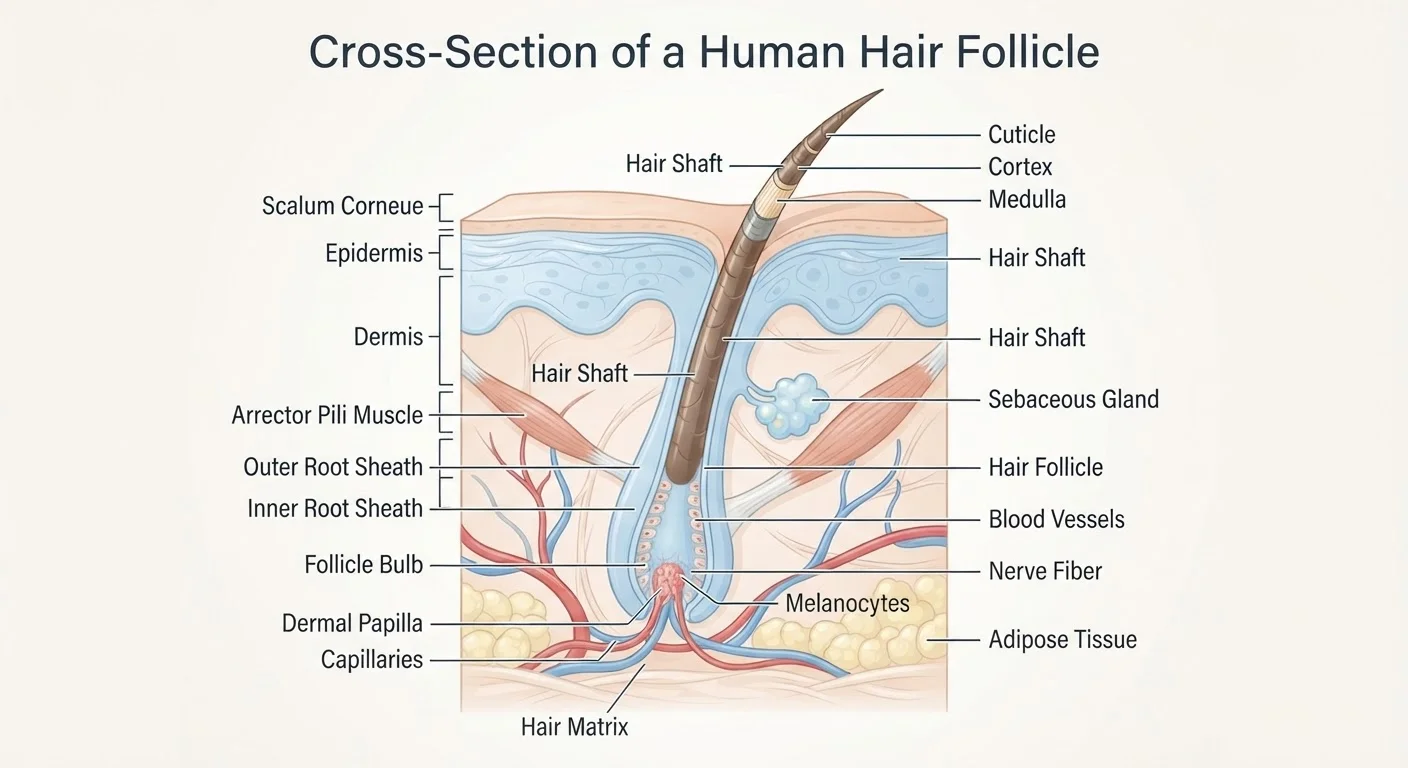
Each hair on your scalp grows from a follicle, a small organ embedded in the skin that produces the hair shaft. Follicles are not passive tubes; they contain living cells that divide, differentiate, and generate the structured protein filament you see above the skin. For a fuller explanation of follicle anatomy, see scalp biology fundamentals.
Every follicle moves through three phases independently of its neighbors. The anagen phase is the active growth period, lasting two to seven years for scalp hair. The catagen phase is a brief transition lasting about two weeks, during which growth stops and the follicle shrinks. The telogen phase is a resting period of roughly three months, after which the old hair sheds and a new anagen cycle begins.
At any given time, roughly 85 to 90 percent of scalp follicles are in anagen, which is why normal shedding of 50 to 100 hairs daily does not noticeably reduce density. Problems arise when the ratio shifts: more follicles enter telogen simultaneously, or the anagen phase shortens so that hairs never reach a visible length.
Anagen phase
The active growth stage of the hair cycle, during which the follicle produces new hair. This phase can last several years for scalp hair.
Telogen phase
The resting stage at the end of the hair cycle, lasting about three months, after which the hair sheds naturally.
Follicle miniaturization
A gradual shrinking of the hair follicle over successive growth cycles, producing progressively finer and shorter hairs until the follicle stops producing visible hair.
DHT (dihydrotestosterone)
A hormone derived from testosterone that can bind to follicle receptors in genetically susceptible individuals and trigger miniaturization.
Telogen effluvium
A temporary form of hair shedding in which a stressful event (illness, surgery, nutritional deficiency) causes many follicles to enter the resting phase at once.
Androgenetic alopecia
The most common form of hair loss in adults, caused by genetic sensitivity of follicles to DHT, producing patterned thinning over time.
Why hair stops growing or thins
Hair thinning is not one condition with one cause. The most common pattern in adults is androgenetic alopecia, in which a byproduct of testosterone called dihydrotestosterone (DHT) binds to receptors in genetically susceptible follicles and causes them to shrink progressively over successive cycles. This is called follicle miniaturization, and it affects both men and women, though the distribution of thinning differs.
Beyond androgenetic alopecia, other frequent causes include telogen effluvium (a temporary mass shift into the resting phase triggered by surgery, illness, rapid weight loss, or psychological stress), alopecia areata (an autoimmune condition in which the immune system targets follicles), and traction alopecia (follicle damage from persistent tension applied by tight hairstyles). Scalp infections, thyroid disorders, and certain medications can also disrupt the growth cycle. For a detailed look at these biological mechanisms, the biology of hair loss covers the subject in depth.
Identifying the correct cause is not optional. An approach suited to androgenetic alopecia will not resolve telogen effluvium driven by iron deficiency, and vice versa.
The role of scalp health
The scalp is living tissue with its own microbiome, sebaceous glands, and vascular network. Chronic inflammation from conditions like seborrheic dermatitis or psoriasis can interfere with the follicle environment. Poor circulation limits the delivery of oxygen and nutrients to the follicle bulb, where active cell division happens. Excess sebum or product buildup can block follicle openings without causing permanent damage but may impede healthy cycling. Scalp health and its connection to hair growth is an area many people underestimate when evaluating why their hair is thinning.
Gentle, regular cleansing matched to your scalp's oil production, along with managing any inflammatory conditions with appropriate clinical care, supports the environment follicles need. Scalp massage has some preliminary evidence for modestly improving follicle circulation, though it is not a replacement for addressing root causes.
Match your cleansing routine to your scalp type
Overwashing a dry scalp can strip protective oils, while underwashing an oily scalp can allow buildup that irritates follicles. A straightforward guideline is to wash often enough to keep the scalp comfortable and free of visible flaking or grease. If you have a diagnosed scalp condition, follow the regimen recommended by your clinician rather than a general rule.
Nutrition, hormones, and hair
Hair is metabolically expensive. The follicle bulb is one of the fastest-dividing cell populations in the body, which makes it sensitive to nutritional shortfalls. Iron deficiency is consistently associated with telogen effluvium, particularly in premenopausal women. Zinc, vitamin D, and B vitamins (especially biotin in people with true deficiency) also appear in the research literature as relevant. Protein intake matters too, because hair is almost entirely keratin, a structural protein.
The liver's role in metabolic health is relevant here: the liver processes hormones and converts nutrients into bioavailable forms that follicles depend on. Hormonal shifts at menopause, postpartum, or during thyroid dysfunction can accelerate thinning by altering the ratio of androgens to estrogens or by disrupting growth hormone signaling. These are systemic issues that require systemic assessment rather than topical fixes alone.
Science-backed approaches to regrowth
Two treatments have the strongest evidence base for androgenetic alopecia: minoxidil (a topical or oral vasodilator that prolongs the anagen phase) and finasteride (an oral 5-alpha-reductase inhibitor that reduces DHT production, approved for men). Both require consistent, long-term use; stopping reverses their effects. Neither is appropriate for everyone, and both have potential side effects worth discussing with a clinician.
Low-level laser therapy has moderate evidence for modestly improving density in some patients. Platelet-rich plasma (PRP) injections show promise in clinical studies, though the evidence base is still developing. For causes outside androgenetic alopecia, treatment targets the underlying condition: correcting a deficiency, managing an autoimmune response, or adjusting a medication causing shedding. Avoid the common pitfalls outlined in common errors that undermine hair regrowth efforts, including switching approaches before giving them adequate time.
This article is for informational purposes only and is not medical advice. Consult a qualified healthcare professional before starting any hair regrowth treatment or if you are concerned about hair loss.
What to do before starting any regrowth plan
Before investing time in any regrowth strategy, a structured self-assessment is worthwhile. Consider when the shedding began, whether it corresponds to a life event, how the pattern of thinning looks (diffuse versus patterned), and whether any other symptoms are present (fatigue, skin or nail changes, irregular cycles). This information will be useful to any clinician you consult.
Basic blood tests can rule out thyroid dysfunction, iron deficiency anemia, and vitamin D insufficiency, all of which are correctable and commonly overlooked. The self-assessment checklist for hair regrowth walks through the questions worth answering before committing to any approach. A dermatologist can perform a scalp examination, and in some cases a scalp biopsy, to confirm a diagnosis. Starting with that information means any effort you make will be directed correctly from the beginning.